
How to Improve F2L Lookahead
Quick answer
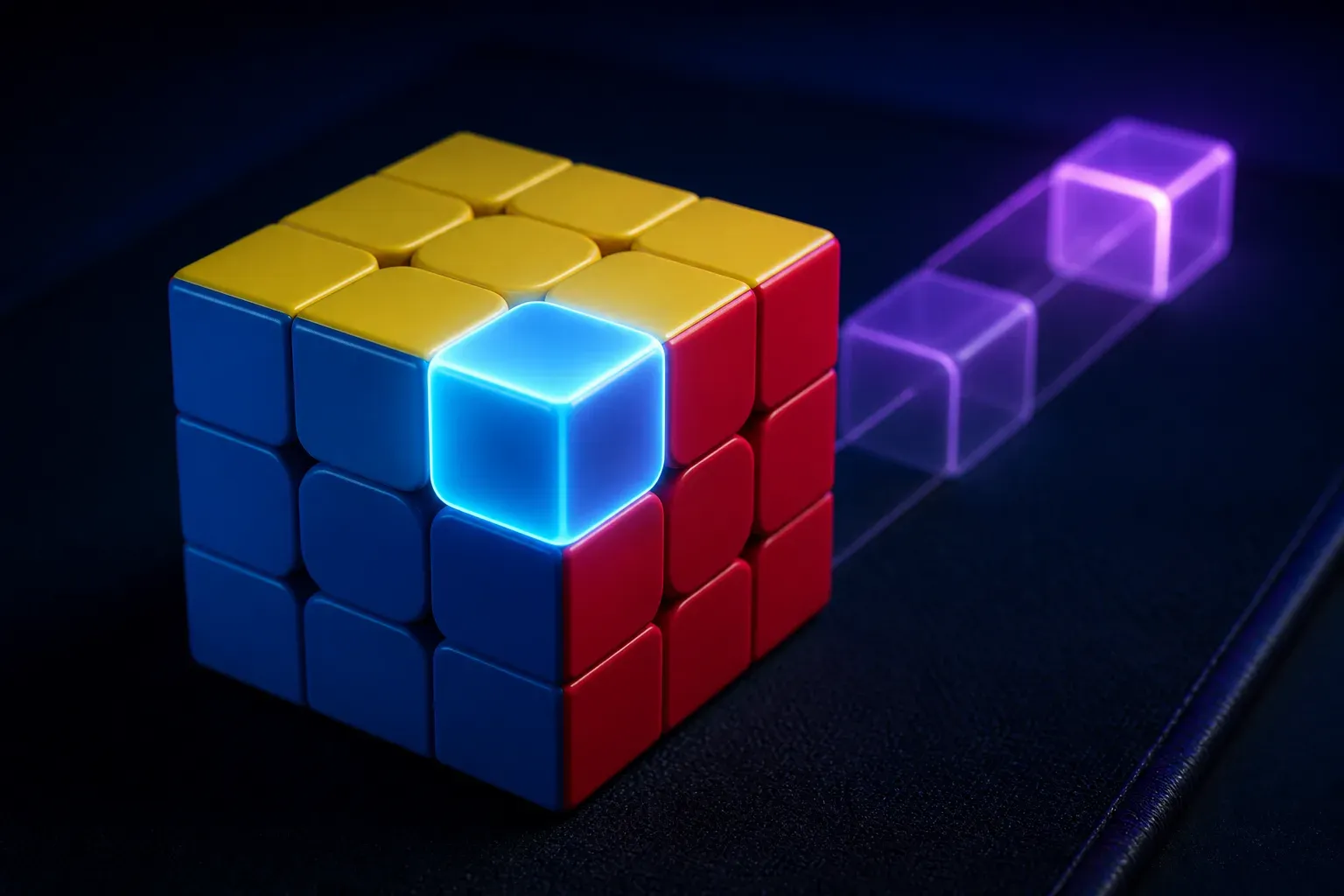
Lookahead means tracking your next F2L pair while your hands solve the current one, so you never stop turning. Train it with slow solves: turn at 50–70% of max speed, keep the cube moving continuously, and let your eyes leave the pair you are inserting. Expect two to three weeks of slow solves before it clicks.
On this pageWhat lookahead actually is
Ask any sub-15 solver for their number one tip and you will hear the same word: lookahead. It is the difference between a solve that flows and one that stutters pair to pair.
The good news: lookahead is not talent. It is a mechanical, trainable skill — and because pauses are visible on video, it is also the easiest weakness to measure.
What lookahead actually is
During F2L you solve four corner-edge pairs. A beginner solves pair 1, stops, searches for pair 2, solves it, stops again. Each search is a pause of 0.3–1.5 seconds — with three or four of them, entire seconds vanish.
With lookahead, your eyes abandon the current pair the moment its solution is decided, and go hunting for the next pair while your hands finish on autopilot. The result is one continuous stream of turns from cross to last layer.
The slow-solve method (the only drill that reliably works)
Slow solves rebuild your habits from the ground up:
- Turn at roughly half speed — slow enough that you never have to stop.
- Hard rule: the cube never stops moving during F2L. If you must pause, you were still too fast.
- While inserting each pair, force your eyes to find the pieces of the next pair.
- Do 15–20 of these per session for 2–3 weeks; add speed back only while the no-pause rule still holds.
- Untimed solves help — ignoring the clock removes the urge to rush and pause.
Why you cannot fix what you cannot see
Here is the trap: pauses are invisible from inside the solve. A hesitation that costs half a second feels like nothing. That is why coaches have students film their solves — on video, every stall and rotation is obvious.
Reviewing footage manually works but is tedious. Modern AI analysis automates it: it timestamps each pause, measures its length, and identifies which pair transition caused it, turning "practice lookahead" into "fix the 500ms pause before pair 3".
Beyond pauses: rotations kill lookahead too
Every cube rotation forces your eyes to re-orient, destroying whatever tracking you had. If your F2L solutions need frequent y-rotations, learn front and back slot inserts so pairs can be solved from where they sit. Fewer rotations means your lookahead has a stable picture to work with.
Training lookahead with CuberPal
CuberPal's F2L analysis is purpose-built for lookahead training — it finds every flow break automatically:
- Record or upload a solve; the AI produces a pair-by-pair F2L breakdown.
- Each detected pause is timestamped and measured (e.g., "500ms pause and rotation at 5.0–5.5s before inserting pair 3").
- Do a week of slow solves focusing on the exact transitions the analysis flagged.
- Ask Cubey for lookahead drills tuned to your times — it recommends slow-solve pacing based on your recent averages.
- Re-analyze weekly: watch detected pauses shrink from seconds to zero as your F2L phase time drops.
Turn this into practice
Use CuberPal to connect these steps to solve analysis, focused drills, lessons, and spaced repetition.
Frequently asked questions
How long does it take to develop F2L lookahead?
Most cubers feel a clear difference after 2–3 weeks of daily slow solves, and reach consistently pause-free F2L within 2–3 months. It feels slower at first — that is normal and temporary, and your times usually drop anyway.
What speed should slow solves be?
Slow enough that you never stop turning — for most people that is 50–70% of maximum turning speed, or roughly 1–2 turns per second during F2L. The no-pause rule sets the speed, not the other way around.
Does lookahead apply to the cross and last layer too?
Yes. Advanced solvers plan the cross plus first pair during inspection, and track last-layer stickers during the final F2L pair to start OLL without a pause. But F2L pair-to-pair transitions are where beginners lose the most time, so train there first.
Sources and fact checks
- [1]Speedsolving.com Wiki: First Two Layers — Reference for intuitive F2L, corner-edge pairing, and the four F2L slots.
- [2]Speedsolving.com Wiki: Look ahead — Reference for tracking the next pieces while executing the current step to reduce pauses.
- [3]CuberPal product overview — Current product overview and repository-backed screenshots for the CuberPal workflows described in this guide.