
How to Learn the CFOP Method
Quick answer
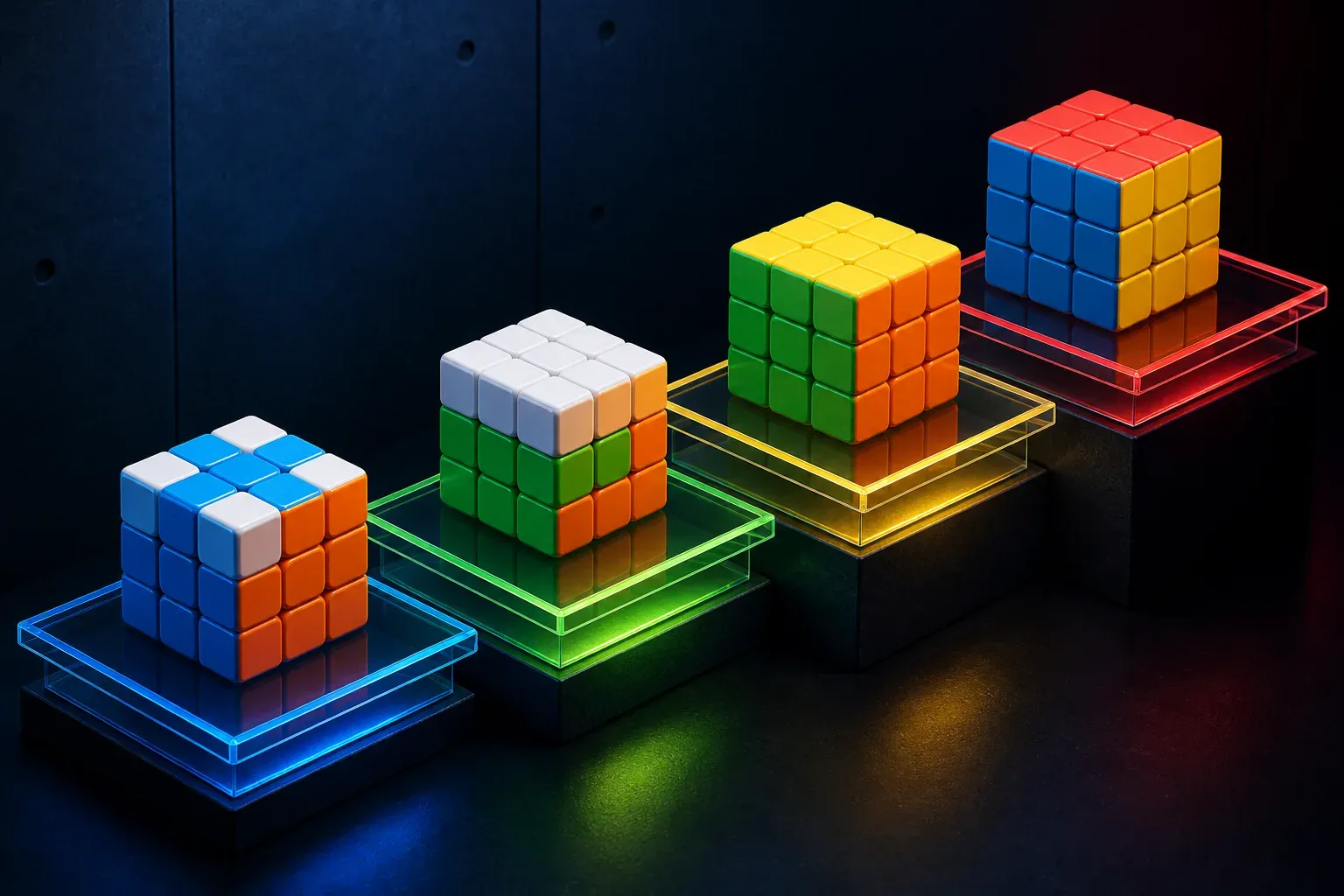
CFOP solves a 3x3 in four stages: Cross, F2L, OLL, and PLL. Start once you can complete the beginner method without a guide. Learn an efficient Cross and intuitive F2L first, add 2-look OLL and 2-look PLL for a complete CFOP solve, then learn full PLL before gradually adding full OLL cases.
On this pageCFOP learning order at a glance
CFOP stands for Cross, First Two Layers, Orientation of the Last Layer, and Permutation of the Last Layer. It replaces repeated layer-by-layer steps with a planned Cross, corner-edge pairs, and two last-layer stages. You do not need to memorize every advanced case before using the method.
The safest transition is incremental: keep a method that can always finish the cube, then replace one stage at a time. Your times may rise while recognition is new. Judge the switch by fewer pauses, cleaner solutions, and recall under normal solves—not by one fast single.
CFOP learning order at a glance
- Make your beginner solve reliable and learn standard move notation so a missed algorithm does not stop the session.
- Practice Cross solutions on the bottom and gradually plan more of the Cross during inspection.
- Learn intuitive F2L by pairing one corner with its matching edge, then inserting the pair without breaking solved slots.
- Add 2-look OLL and 2-look PLL so every last layer can be completed with a small, dependable algorithm set.
- Learn full PLL before full OLL when last-layer study is the priority; 21 PLL cases are a smaller set than 57 OLL cases.
The four steps of CFOP
- Cross — solve the four bottom-layer edges. No algorithms; pure planning. Goal: 8 moves or fewer, eventually planned entirely during inspection.
- F2L (First Two Layers) — pair up each corner with its matching edge and insert them together. Intuitive at first; 41 standard cases exist but you discover most solutions yourself.
- OLL (Orientation of the Last Layer) — make the top face one color. Full OLL is 57 algorithms; the 2-look version needs just 10.
- PLL (Permutation of the Last Layer) — move the top pieces to their final spots. Full PLL is 21 algorithms; 2-look needs 6.
The learning order that works
Phase 1: Cross and intuitive F2L. Use slow or untimed solves to understand how corners and edges pair. Keep a beginner-method fallback for cases you cannot yet solve, and record which pair types create pauses.
Phase 2: 2-look OLL and 2-look PLL. Learn a few cases at a time, mix recognition with execution practice, and continue normal solves so the algorithms work from realistic grips and viewing angles.
Phase 3: Full PLL. Add cases in small groups, review older cases between new ones, and measure recognition errors separately from execution errors. The goal is a dependable one-look PLL stage, not a deadline.
Phase 4: expand full OLL while improving F2L solutions and lookahead. Add cases at a pace that does not erase old ones, and use phase times to decide whether algorithms, Cross planning, or F2L continuity deserve the next practice block.
How to practice each stage without forgetting
New algorithms decay fast: learn five PLLs on Monday and by Friday two are gone. The fix is spaced repetition — review each algorithm at growing intervals (1 day, 3 days, a week), and drill the ones you fumble more often than the ones you know.
Pair that with case recognition practice: seeing a last-layer pattern and instantly knowing which algorithm it is matters as much as finger speed.
Learning CFOP with CuberPal
CuberPal includes a structured CFOP course that follows exactly this roadmap, so you never wonder what to learn next:
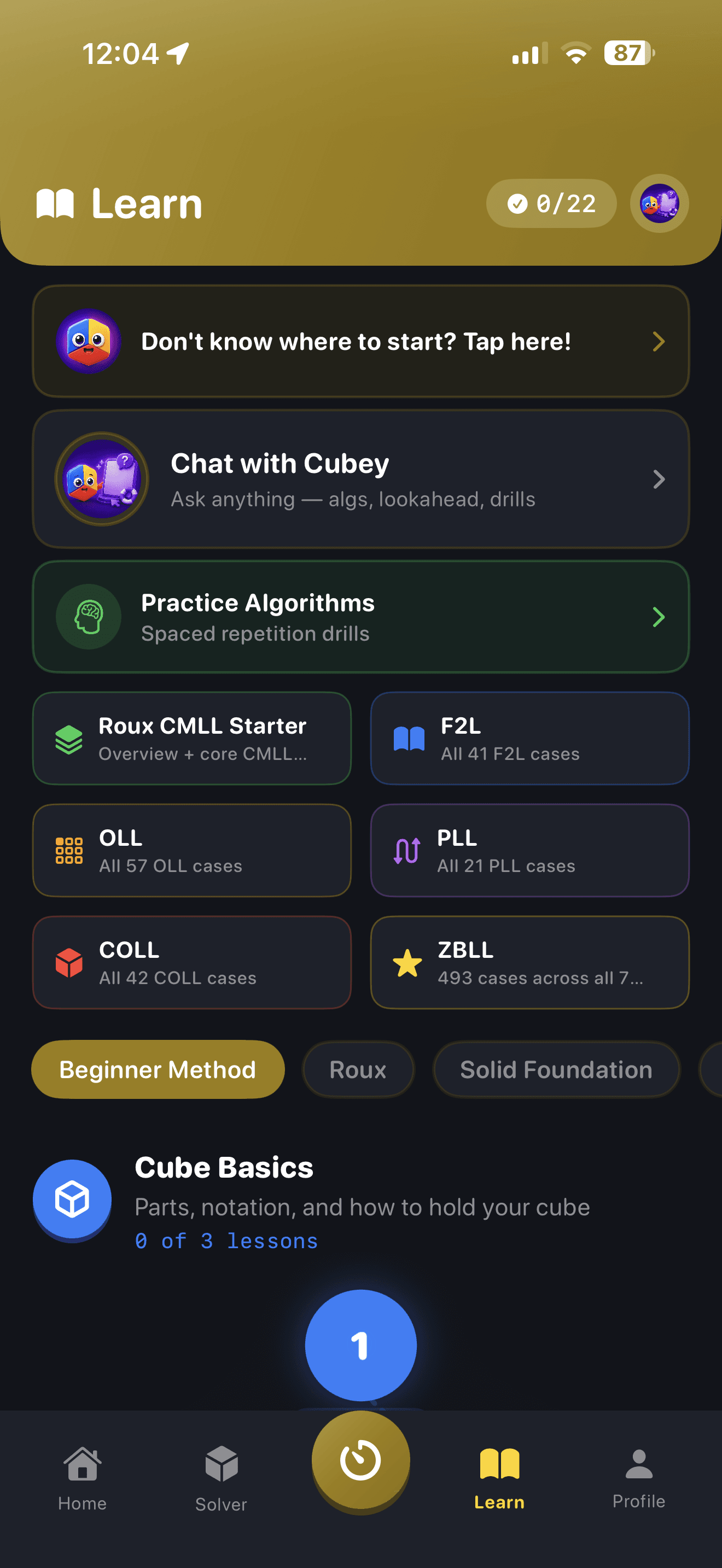
- Open the Learn tab and start the CFOP track: dedicated modules for Cross, F2L, OLL, and PLL with progressive lessons (there is a Beginner Method course too if you are not there yet).
- Work through F2L lessons that teach efficient pair insertions without unnecessary rotations.
- Browse the full algorithm catalogues — 41 F2L, 57 OLL, 21 PLL cases — each with a 3D cube preview and tap-through playback.
- Mark algorithms as learned to track your progress through each set, and let spaced repetition schedule your daily reviews.
- Once you complete the switch, record a solve for AI analysis to see your new phase times and what to improve next.
Turn this into practice
Use CuberPal to connect these steps to solve analysis, focused drills, lessons, and spaced repetition.
Frequently asked questions
How long does it take to learn CFOP?
There is no fixed schedule. You can begin using Cross, intuitive F2L, and a two-look last layer as soon as each stage is reliable, then add full PLL and OLL gradually. Practice frequency, recognition, and prior notation knowledge matter more than a calendar estimate.
Should I learn CFOP or Roux?
Both reach elite speeds. CFOP has far more learning resources, more standardized algorithms, and is easier to get help with — which is why most beginners choose it. CuberPal focuses on CFOP and also includes a Roux overview with a CMLL reference if you want to explore.
How many algorithms does CFOP require?
A minimum of 16 (2-look OLL + 2-look PLL) to solve with CFOP, 78 for "full CFOP" (57 OLL + 21 PLL). F2L is usually learned intuitively rather than memorized.
Sources and fact checks
- [1]Speedsolving.com Wiki: CFOP method — Reference for the Cross, F2L, OLL, and PLL method structure and algorithm-set counts; timing targets are CuberPal editorial guidance.
- [2]Apple App Store: Cubing Timer & Coach: CuberPal — Current product listing for CuberPal timer, analysis, coaching, algorithm practice, and cube-solver capabilities.