
How to Get Sub-20 on the 3x3
Quick answer
To work toward a sub-20 average on 3x3, diagnose the slowest phase instead of adding algorithms blindly. Build a Cross you can plan during inspection, reduce F2L pauses with controlled solves, make 2-look OLL dependable, learn full PLL when recognition is ready, and review averages plus phase times over many solves.
On this pageThe sub-20 checklist
Getting sub-20 on 3x3 means averaging under 20 seconds across an official-style average, not producing one lucky solve. The route is different for every cuber, so begin with several recorded solves and identify whether Cross planning, F2L pauses, last-layer recognition, or execution consistency is consuming the most time.
Use phase targets as diagnostic ranges, not universal requirements. A cuber with a slower last layer may compensate with efficient F2L, while another may need more time for Cross. The useful question is which repeated hesitation has the clearest practice drill.
The sub-20 checklist
A rough reference is a Cross near two seconds, F2L near ten or eleven seconds, and a last layer near six seconds. These are editorial benchmarks, not rules. Compare several solves, then work on the phase that repeatedly exceeds its share:
- Cross: improve solution efficiency and gradually plan more of it during the 15-second inspection. Track whether the first F2L pair is visible as the Cross finishes.
- F2L: reduce long searches between pairs. Turn slowly enough to see the next useful pieces, and review unnecessary rotations or pair choices after the solve.
- Full PLL (21 algorithms) so every permutation is one fast algorithm instead of two slow ones.
- 2-look OLL minimum (10 algorithms). Full OLL helps but is not required for sub-20.
- Fingertricks: algorithms executed with wrist-and-finger flow, not hand regrips.
Diagnose F2L pauses before adding algorithms
Record several solves and mark every visible stop, cube rotation, and pair you abandon. That evidence separates a recognition problem from an execution problem. A long pause usually deserves a case-specific drill; a rough insertion may need slower repetition or a different fingertrick.
Use controlled solves at a pace where you can track pieces while finishing the current pair. If tracking collapses, reduce turn speed until the solve remains continuous. Alternate those solves with targeted setups for the pair types that caused the most stops, then return to normal solves and measure whether the pause recurs.
Learn full PLL before full OLL
Full PLL contains 21 cases, which makes it a smaller advanced set than full OLL. Learn cases in small groups chosen by recognition clarity and comfortable execution. Keep a dependable two-look fallback until a new case can be recognized from multiple angles and executed from a normal last-layer grip.
Drill new algorithms daily with spaced repetition so they survive past next week. Recognition matters as much as execution: learn to identify each case from headlights and blocks in one glance.
Measure your progress by phase, not just by average
Your ao12 can stay flat while one phase improves and another becomes the new constraint. Review phase times alongside ao5, ao12, and ao100, and compare medians or typical solves rather than a personal best. Re-run the diagnosis after each practice cycle instead of assuming one checklist guarantees sub-20.
A repeatable sub-20 practice cycle
- Baseline: record a normal session and tag the largest Cross, F2L, OLL, and PLL delays.
- Focus: spend several short sessions on the single repeated issue with a drill that isolates it.
- Integrate: return to full solves and keep the technique when the scramble or grip is less convenient.
- Review: compare phase times and averages with the baseline, then choose the next bottleneck.
How CuberPal gets you to sub-20
CuberPal supports this diagnosis-and-practice loop by combining solve recording, phase review, algorithm study, and timer history in one app:
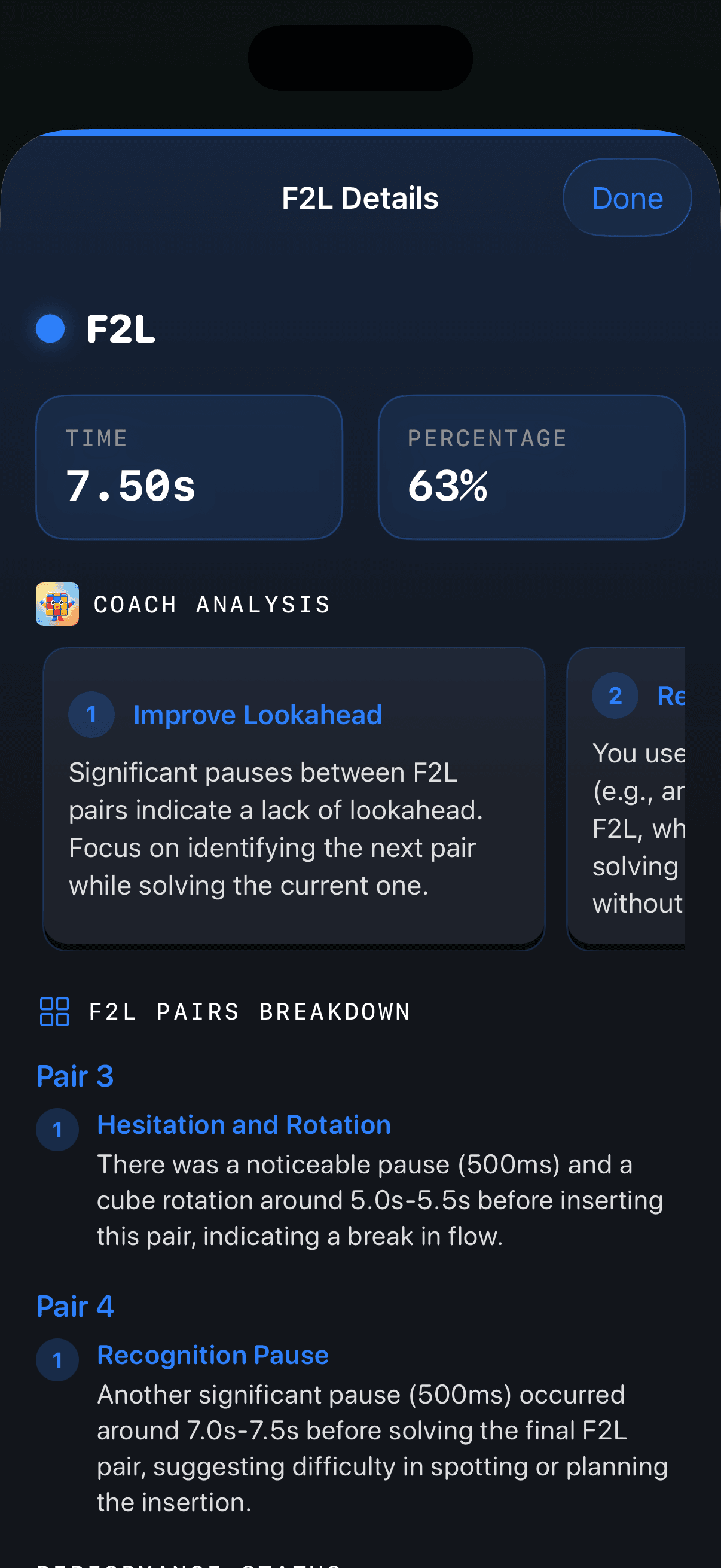
- Record a solve and let the AI break it into Cross, F2L, OLL, and PLL timings — instantly see whether your F2L is at the 10–11s target.
- Check the F2L pair analysis for detected pauses and rotations; each flagged hesitation is a concrete thing to fix.
- Learn full PLL in the algorithm catalogue: all 21 cases with 3D previews, alternative algorithms, and mark-as-learned tracking.
- Drill the PLLs you fumble with daily spaced repetition sessions tuned to your weak cases.
- Track ao5, ao12, and ao100 on the WCA-style timer and watch the average slide under 20.
Turn this into practice
Use CuberPal to connect these steps to solve analysis, focused drills, lessons, and spaced repetition.
Frequently asked questions
How long does it take to get sub-20 on 3x3?
There is no reliable universal timeline. Starting average, practice quality, recognition, and consistency all matter. Track phase data over repeated practice cycles and judge progress by fewer recurring pauses and a lower stable average, not a promised number of weeks.
Do I need full OLL for sub-20?
No. A dependable 2-look OLL can support a sub-20 average. Full PLL, Cross planning, F2L continuity, recognition, and execution consistency may offer clearer gains first, depending on your measured phase times.
Do I need an expensive cube to get sub-20?
No. Any modern magnetic speedcube from the last few years is more than capable of sub-20 — and well beyond. Skill, not hardware, is the bottleneck at this level.
Sources and fact checks
- [1]Speedsolving.com Wiki: CFOP method — Reference for the Cross, F2L, OLL, and PLL method structure and algorithm-set counts; timing targets are CuberPal editorial guidance.
- [2]Speedsolving.com Wiki: Look ahead — Reference for tracking the next pieces while executing the current step to reduce pauses.
- [3]Apple App Store: Cubing Timer & Coach: CuberPal — Current product listing for CuberPal timer, analysis, coaching, algorithm practice, and cube-solver capabilities.