
Beginner Method vs CFOP
Quick answer
Switch from the beginner method to CFOP when you can solve reliably without notes, understand basic notation, and want to trade short-term hesitation for a method with more efficient F2L and last-layer options. There is no required average: readiness matters more than whether you are at 90, 60, or 45 seconds.
On this pageThe practical answer: switch in stages
- The practical answer: switch in stages
- What the beginner method optimizes for
- What CFOP changes and what stays familiar
- The real tradeoff: speed now versus skill later
- Readiness checks that matter more than a time
- A low-friction transition plan
- How to compare the methods fairly
- What to fix when CFOP feels worse
- Your next practice decision
The practical answer: switch in stages
The beginner method is best for learning to solve; CFOP is better suited to systematic speed improvement. You do not need to abandon everything at once. Keep your familiar cross, replace beginner first- and second-layer steps with intuitive F2L, then use two-look OLL and two-look PLL. That staged version is already CFOP and avoids learning dozens of algorithms in one burst.
A good switching point is when the beginner solve is dependable enough that basic piece behavior no longer consumes all your attention. You should be able to solve without a tutorial, read R, U, prime, and double turns, and recover from a small mistake. Your average is useful context, not an entrance exam. A comfortable 90-second solver can start CFOP; a frustrated 45-second solver can also wait.
What the beginner method optimizes for
Most beginner methods reduce the puzzle to a sequence of visible, repeatable goals: cross, first-layer corners, middle-layer edges, and a multi-step last layer. That structure keeps recognition simple. You usually search for one piece at a time, place it, and move on. The limited algorithm set makes the method easy to retain after a break and excellent for a first independent solve.
The cost appears when you pursue lower averages. Solving first-layer corners separately from middle-layer edges creates extra moves and repeated searches. Turning the cube to find pieces interrupts flow. A last layer split across several looks adds recognition and execution pauses. You can optimize these habits, but the method does not naturally teach pair tracking, continuous transitions, or one-look last-layer systems.
What CFOP changes and what stays familiar
CFOP stands for Cross, First Two Layers, Orientation of the Last Layer, and Permutation of the Last Layer. The cross remains, although speedsolvers normally build it on the bottom and plan more of it during inspection. F2L pairs a corner with its matching edge and inserts both together, replacing the separate corner and middle-edge stages. OLL turns the last-layer stickers upward; PLL moves those oriented pieces to their final positions.
You can begin with intuitive F2L and a two-look last layer. Full OLL has 57 cases and full PLL has 21, but neither set is required to start. This is the central difference between adopting CFOP and completing every CFOP algorithm set. Adopting the method gives your solves a better structure. Expanding the algorithm sets is a later optimization chosen when recognition and practice capacity justify it.
The real tradeoff: speed now versus skill later
Your times will often rise when you first learn F2L because you are matching two pieces, predicting how they move, and protecting solved slots. That temporary slowdown is not proof that CFOP is wrong; it is the normal cost of replacing a memorized routine with a decision-making skill. Compare untimed solution quality and pause locations before comparing raw averages.
CFOP also asks for more ongoing study. You will gradually refine cross solutions, learn F2L cases from multiple angles, and add last-layer algorithms. If you only want a reliable casual solve, the beginner method may already meet your goal. If you enjoy deliberate practice and want a path toward sub-30, sub-20, or faster averages, that larger learning surface is an advantage rather than a burden.
Readiness checks that matter more than a time
Switch when three things are true. First, you can finish normal scrambles without outside help. Second, you can locate a corner by its three colors and an edge by its two colors, rather than thinking only in fixed sticker positions. Third, you are willing to perform slow solves where the goal is understanding, not beating a personal best. Those skills make intuitive F2L learnable.
Wait or slow the transition if notation still causes frequent wrong turns, if every unsolved state feels like a failure, or if you cannot practice without racing the timer. Fix those foundations first. Children and adults learn at different paces, and there is no deadline. A solver who adds one F2L idea per week can build a stronger method than someone who rushes through tutorials and preserves every old habit.
- Ready: independent solves, basic notation, and curiosity about piece movement.
- Not yet: frequent tutorial dependence or frustration with intentionally slow practice.
- Optional: a speed goal. CFOP is useful even before you choose a target average.
A low-friction transition plan
Week one: keep your beginner solve but build the cross on the bottom. After each cross, pause and identify all four corner-edge pairs. Week two: learn how to pair and insert one easy F2L case, then use beginner steps for anything confusing. Week three: finish all four slots with intuitive F2L, accepting slow times. Week four: use two-look OLL and two-look PLL on every solve.
Do not add full PLL, full OLL, color neutrality, and advanced F2L simultaneously. Each new layer of knowledge creates recognition work, and too many changes make it impossible to know what caused an error. Keep a fallback: if a case is unclear after a deliberate attempt, finish it with a known method, then reconstruct that case after the solve. Progress comes from reviewing the decision, not from getting stuck indefinitely.
How to compare the methods fairly
Use a set of at least 12 solves with each method, not a single lucky time. Track total time, obvious pauses, cube rotations, and whether the solve broke down. Early CFOP may be slower but show fewer moves and longer thinking pauses; that pattern means execution has room to catch up. If CFOP is both slower and chaotic, narrow practice to one F2L case family instead of returning immediately to random timed solves.
Judge the method against your goal. Reliability favors the familiar beginner approach. Move efficiency, lookahead potential, and an established upgrade path favor CFOP. Enjoyment matters too: Roux and other methods are legitimate speedsolving choices, so CFOP is not mandatory. The right method is one you will practice thoughtfully, not merely the one used in the tutorial you happened to find first.
What to fix when CFOP feels worse
If F2L takes forever, stop timing and solve one pair at a time while narrating where the corner and edge must meet. If you rotate constantly, solve with the empty slot at front-right, then repeat at front-left. If last layer is unreliable, separate recognition from execution: identify the case, verify it, and only then turn. Fast attempts hide which part of the process failed.
A common mistake is treating intuitive F2L as 41 algorithms to memorize. Case sheets are useful references, but first learn the three actions underneath them: separate a bad pair, pair pieces in the top layer, and insert into an open slot. Another mistake is comparing day-one CFOP to a beginner method practiced hundreds of times. Compare learning curves over several weeks, using averages and error rates rather than emotion after one session.
Your next practice decision
If you meet the readiness checks, spend your next session on bottom cross plus one F2L pair and finish the rest however you can. Repeat that small bridge until it feels ordinary, then expand. If you are not ready, strengthen notation and independent beginner solves without feeling behind. Either choice is productive when it targets the actual constraint.
At the end of the week, review an average and ask a specific question: are pauses caused by finding pieces, understanding a case, or executing the moves? That answer determines the next lesson. A learning dashboard, timer, or solve review is most useful when it records that focused question instead of turning the transition into a race for instant personal bests.
Continue the learning path
Learn CFOP
Build intuitive F2L before adding a large number of algorithms.
Open this topic clusterTurn this into practice
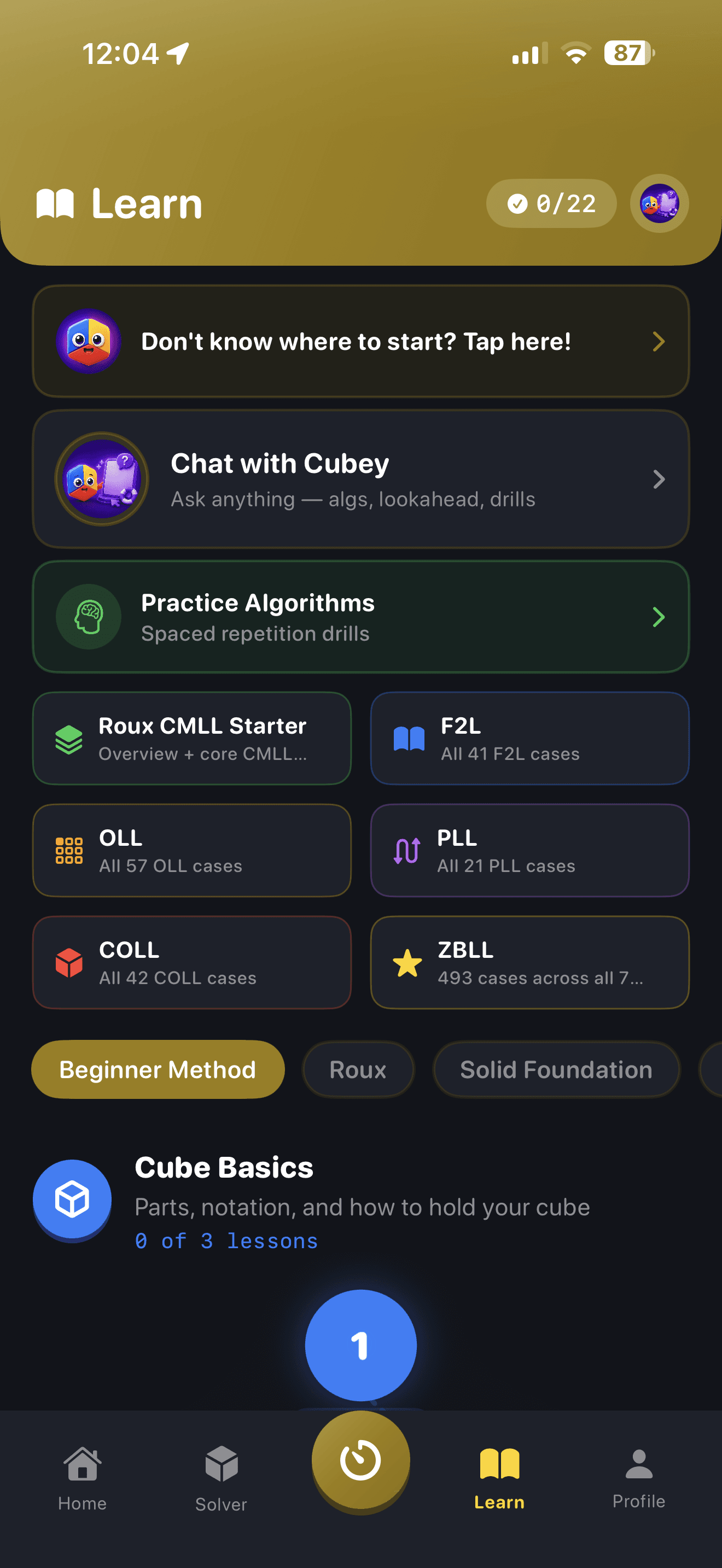
CuberPal combines a WCA-style timer, AI solve analysis, CFOP lessons, algorithm catalogues, spaced repetition, and a camera cube solver so speedcubing advice becomes a daily training loop.
Frequently asked questions
What average should I have before learning CFOP?
There is no required average. Start when you can solve without notes, read basic notation, and tolerate slower practice while learning F2L. Many people begin somewhere between roughly one and two minutes, but readiness is more useful than a cutoff.
Will CFOP make me slower at first?
Often, yes. Intuitive F2L adds recognition and decision-making before those skills become automatic. Track pauses and solution quality for several weeks instead of judging the switch by the first timed session.
Do I need all 78 OLL and PLL algorithms to use CFOP?
No. Start with two-look OLL and two-look PLL. Full PLL and full OLL are later upgrades; CFOP begins as soon as you use Cross, F2L, OLL, and PLL in any complete form.
Should every speedcuber use CFOP?
No. CFOP is widely taught and has a clear progression, but Roux, ZZ, and other methods can also be fast. Choose based on how you enjoy solving and practicing, not popularity alone.
Sources and fact checks
- [1]J Perm: CFOP Speedsolving Method — Reference for the four CFOP stages and the beginner-to-advanced progression.
- [2]Speedsolving.com Wiki: CFOP method — Method overview and terminology; readiness and transition advice are CuberPal editorial guidance.
Keep improving
Rubik's Cube Notation: The Complete Move Chart
Read next BlogCFOP Solve Splits by Speed
Read next GuideHow to Learn the CFOP Method
Read next GuideHow to Learn F2L: A Beginner's Tutorial
Read next BlogHow Long Does It Take to Learn CFOP?
Read next BlogWhat Is CFOP? The Cross, F2L, OLL and PLL Method
Read next