
CFOP Solve Splits by Speed
Quick answer
CFOP splits separate a solve into Cross, F2L, OLL, and PLL so you can train the phase that actually costs time. There is no universal perfect ratio. Measure at least 12 representative solves, compare each phase with your own total, and treat published split ranges as coaching heuristics rather than rules.
On this pageWhy splits are more useful than one solve time
- Why splits are more useful than one solve time
- How to measure CFOP splits reliably
- Think in proportions before target seconds
- Reading the Cross split
- Reading the F2L split
- Reading OLL and PLL splits
- A worked example from a 30-second average
- Turn the diagnosis into a two-week practice block
- Split mistakes that produce bad advice
Why splits are more useful than one solve time
A 24-second solve does not say what to practice. The same total can come from a six-second cross, a smooth 12-second F2L, and a fast last layer, or from a planned cross, a stalled F2L, and several quick algorithms. Those solvers need different sessions. Splits turn a result into a diagnosis by showing where time entered the solve.
Use four markers: the end of Cross, the insertion of the fourth F2L pair, the end of OLL, and the final move of PLL including any adjustment of the U face. These boundaries match the standard CFOP stages. Advanced techniques can blur them, but consistent definitions matter more than perfect taxonomy. If you always mark the same transitions, changes over time remain comparable.
How to measure CFOP splits reliably
Video is the simplest manual method. Record from an angle that shows the cube and timer, then step through the solve and note the four timestamps. A solve-analysis tool can speed this up when it detects phase transitions, but review uncertain boundaries yourself. Smart-cube telemetry can also help, although move detection errors and pauses before the first turn still need interpretation.
Measure a sample, not a showcase. Twelve solves is a useful minimum for spotting an obvious bottleneck; 50 gives a steadier picture. Exclude a solve only for a clear recording or tracking failure, not because it was slow. Keep inspection separate from execution unless your question is specifically about competition starts. Record mistakes and lockups beside the numbers because the median split alone will not explain them.
Think in proportions before target seconds
F2L usually occupies the largest part of a developing CFOP solve because it contains four pairs and the most open-ended recognition. Cross should become a smaller, planned opening. OLL and PLL are shorter algorithmic phases, but recognition and adjustment can make them look deceptively expensive. Instead of copying an elite solver's seconds, calculate each phase as a percentage of your own median total.
A practical starting model is Cross around 10 to 15 percent, F2L around 45 to 55 percent, and the full last layer around 30 to 40 percent. These are broad coaching heuristics, not published standards. Two-look last layer can reasonably take a larger share; a solver with full OLL and PLL may allocate less. Hardware, turning style, inspection skill, and method variations all shift the proportions.
Reading the Cross split
A slow Cross split can mean three different things: you started without a complete plan, the solution used too many moves, or execution involved a regrip and pause. Watch the solve rather than assuming the fix is faster turning. If your first move begins late, train inspection and commitment. If the cross flows but takes many moves, reconstruct the scramble and search for a shorter solution without a timer.
Measure the transition too. A two-second cross followed by a two-second search for the first pair is not truly a strong opening. Mark Cross at the last cross move, but write down whether you already knew the first pair. Once the cross itself is stable, practice preserving one corner-edge pair in your visual attention during execution. That turns the split from an isolated number into the start of continuous solving.
Reading the F2L split
F2L is often the best training opportunity because a few long searches can dominate the total. Count pauses, rotations, pair destructions, and difficult inserts. A 14-second F2L with constant turning may be healthier than an 11-second F2L created by frantic bursts and lucky visibility. The goal is repeatable recognition and efficient solutions, not one low split.
Break the phase into four pair intervals for a deeper look. If the first pair is consistently slow, cross-to-F2L planning is the issue. If the third or fourth pair is slow, you may be hiding pieces in filled slots or failing to track remaining colors. Use slow solves, solve pairs into back slots, and reconstruct the longest interval. Whole-phase averages tell you where; pair-level review tells you why.
Reading OLL and PLL splits
Separate recognition from execution whenever possible. A slow OLL may be an instant recognition followed by an awkward algorithm, or a fast algorithm preceded by a long orientation search. Film lets you see the gap. Record the case name, recognition pause, execution time, and whether a U-face adjustment was needed. The same process applies to PLL.
Two-look systems naturally include a second recognition pause, so do not compare them directly with one-look sets. If execution is stable but recognition dominates, use case identification drills from varied angles. If recognition is instant but turning is inconsistent, inspect grip, regrips, and first/last moves. If both are weak, prioritize correctness and recall before speed; racing an uncertain algorithm trains resets and lockups.
A worked example from a 30-second average
Suppose a solver's median splits are Cross 4.5 seconds, F2L 17.0, OLL 5.0, and PLL 3.5. The total is 30.0. Cross is 15 percent, F2L about 57 percent, and last layer about 28 percent. F2L stands out, but the video shows the first pair consumes five seconds. The actionable target is not vaguely faster F2L; it is a better Cross-to-first-pair transition.
For the next week, that solver can plan the full cross, track one pair, and do untimed reconstructions of the first eight moves. After 30 focused attempts, measure another 12 solves. If first-pair pauses shrink but total time does not, check whether turning errors rose. Improvement means the target behavior changed without creating a larger cost elsewhere. That is why splits and qualitative notes belong together.
Turn the diagnosis into a two-week practice block
Choose one phase based on the median and video evidence. For three sessions, spend 15 minutes on a drill specific to that cause: cross reconstruction, metronome-style F2L, OLL recognition, or PLL execution. Finish each session with one normal average of 12. Do not change the target midweek because of a single bad result. Consistency gives the practice enough exposure to work.
At the end of week one, review the phase median and error count. In week two, keep the drill if the behavior is improving but unstable; switch only when the original constraint is no longer dominant. Re-measure with the same camera angle and boundary definitions. A small split change that survives normal solves is more valuable than a dramatic drill time that disappears under scramble pressure.
Split mistakes that produce bad advice
Do not build a plan from your best solve, mix hand-timed and frame-timed data, or compare your two-look last layer with a full-set solver as if the phases were equivalent. Avoid rigid formulas such as F2L must be exactly half. They can flag a question, but they cannot account for a lucky skip, an x-cross, a rotationless solution, or an unusually difficult case.
Most importantly, do not optimize a phase in isolation until transitions get worse. A rushed cross that leaves no first pair, a faster OLL that ends in a poor PLL grip, or a PLL stopped before the final adjustment can make the spreadsheet look better while the solve gets worse. Use a phase breakdown to choose one experiment, then verify the full solve remains calm and complete.
Continue the learning path
Get faster at 3x3
Measure one solve, identify the slowest phase, and train that skill before chasing raw TPS.
Open this topic clusterTurn this into practice
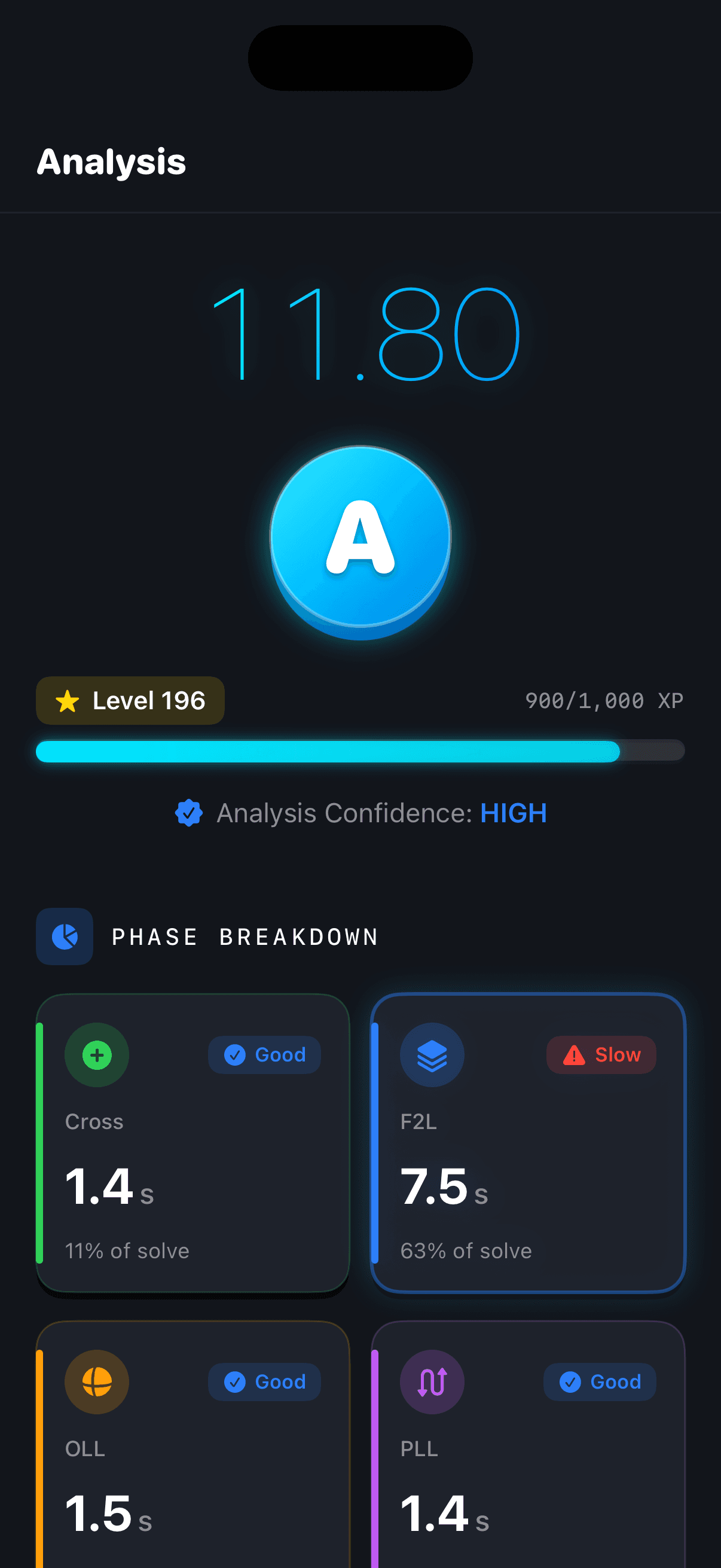
CuberPal combines a WCA-style timer, AI solve analysis, CFOP lessons, algorithm catalogues, spaced repetition, and a camera cube solver so speedcubing advice becomes a daily training loop.
Frequently asked questions
What should my CFOP splits be?
There is no universal ratio. As a broad starting heuristic, Cross may be about 10-15%, F2L 45-55%, and OLL plus PLL 30-40% of execution time. Your method, algorithm set, and transitions can shift those ranges.
How many solves do I need for useful split data?
Twelve representative solves can reveal a large bottleneck, while 50 or more gives a steadier baseline. Keep the phase boundaries and measurement method consistent.
Should inspection count in my Cross split?
Usually no: record inspection separately and start the Cross split at the timer start. If you are specifically studying competition readiness, track inspection quality and start penalties as their own observations.
Why is F2L usually the longest split?
F2L contains four pairs and more open-ended recognition than the algorithmic last layer. Long searches, rotations, and pair mistakes can compound, so inspect pair-level intervals before assuming you only need faster turns.
Sources and fact checks
- [1]Speedsolving.com Wiki: CFOP method — Reference for Cross, F2L, OLL, and PLL phase definitions; split ranges are clearly labeled CuberPal training heuristics.
- [2]J Perm: CFOP Speedsolving Method — Practical reference for the stages and skill progression discussed.
- [3]World Cube Association Regulations: Speed Solving — Official reference for inspection, timer starts, and completion when collecting competition-style data.