
How to Get Sub-30 on Rubik's Cube
Quick answer
To average under 30 seconds on 3x3, build a planned bottom cross, use intuitive F2L with fewer long searches, and make two-look OLL and PLL reliable. Full OLL is not required. Diagnose averages and pauses, then train one bottleneck at a time instead of relying on more random solves.
On this pageWhat sub-30 should mean in practice
- What sub-30 should mean in practice
- Use the smallest CFOP toolkit that covers every solve
- Build a baseline before choosing drills
- Plan the cross, then preserve the first pair
- Make F2L continuous before making it fast
- Keep the last layer boring and dependable
- Turn more calmly to unlock real speed
- A repeatable weekly sub-30 plan
- Plateaus, expectations, and the next milestone
What sub-30 should mean in practice
Treat sub-30 as an average, not a single solve under 30 seconds. A lucky scramble, skip, or unusually easy F2L can produce a fast single before the underlying skills are stable. Use rolling averages of 12 and 100 for training, and understand that an official WCA average of five drops the best and worst results before averaging the middle three.
The useful question is not whether you have ever seen 29.xx. It is whether normal scrambles usually finish without a major pause, missed algorithm, or restart. A solver averaging 31 with clean solves is often closer than a solver whose times swing between 22 and 50. Consistency shows that recognition and execution survive different cases.
Use the smallest CFOP toolkit that covers every solve
A practical sub-30 toolkit is a bottom cross, intuitive F2L, two-look OLL, and two-look PLL. That is a complete version of CFOP. You do not need 57 OLL cases, advanced last-layer subsets, or elaborate first-pair prediction. Full PLL can help later, but it cannot compensate for a cross you improvise after the timer starts or an F2L pair that takes eight seconds to find.
Reliability comes first. Every last-layer case should have a known response, even if it takes two looks. Every basic F2L relationship should be solvable without returning to a beginner middle-layer algorithm. If one case repeatedly causes a breakdown, isolate it. The goal is to remove catastrophic delays before shaving tenths from an already fast case.
Build a baseline before choosing drills
Record 12 to 25 normal solves with standard inspection. Note the total, the approximate Cross and F2L times, any rotation that felt necessary, and the longest pause. Do not alter your style to make the test look good. The baseline needs to reveal what happens when you solve naturally. Use the median alongside the average so one very slow error does not disguise the typical pattern.
Sort the causes into four buckets: opening, F2L recognition, last-layer recall, and execution. If Cross plus the first pair takes ten seconds, start there. If F2L is smooth but last layer contains two long recalls, review algorithms. If every phase looks reasonable but lockups add time, slow the turns and inspect finger placement. Pick the largest repeatable cause, not the most interesting skill.
Plan the cross, then preserve the first pair
During inspection, aim to know the order of all four cross edges. If that is beyond your current visualization, plan three and deliberately locate the fourth before starting. Solve the cross on the bottom so the completed pieces do not require a cube flip. After each solve, reconstruct the cross and find an alternative with fewer moves or a better ending grip.
Once the cross can be executed without searching, use the freed attention to track one corner or edge for the first pair. You do not need a full cross-plus-first-pair solution. Simply knowing where one promising piece will land prevents the common two-second freeze after the cross. A slightly slower cross with immediate continuation is better than a fast isolated cross followed by a search.
Make F2L continuous before making it fast
Sub-30 F2L does not require perfect solutions. It requires recognizing a corner-edge pair, pairing it without destroying solved work, and inserting it with limited hesitation. Do slow solves at a pace where the cube never stops. Turn slowly enough that your eyes can leave the current pair and search for the next one. If you lose track, reduce speed again rather than bursting and pausing.
Limit rotations by learning to insert into front-left and front-right slots and by using back slots when the view is clear. Do not ban rotations absolutely; one deliberate rotation can be better than an awkward sequence you do not understand. Count unnecessary rotations and repeated U turns. Those are concrete symptoms of recognition uncertainty, and they give a better drill target than a vague instruction to improve lookahead.
Keep the last layer boring and dependable
Two-look OLL and two-look PLL are sufficient for a sub-30 average when they are recognized and executed reliably. Learn cases in small groups, test recall from random angles, and prefer an ergonomic algorithm you can reproduce over a theoretically faster option. Time recognition and execution separately. A fast algorithm does not help if you stare at the case for three seconds first.
Full PLL is a reasonable next upgrade because it reduces the permutation stage to one look and has a smaller set than full OLL. Add cases only when your current two-look set is stable. Learn two related cases, practice their setup and inverse, then mix them with old cases. Continue normal solves so the new recognition skill appears in context rather than only in a trainer.
Turn more calmly to unlock real speed
Many 35-second solvers can turn faster than they can see. Maximum TPS creates lockups and hides the next pair, producing a fast-slow-fast rhythm. Reduce turning speed during F2L until pauses shrink. Keep algorithm execution crisp, but enter and leave each algorithm with a stable grip. The target is continuous information, not the loudest cube.
Film one solve from above or over your shoulder. Count full stops, regrips, and moments when your eyes follow the pieces already being inserted. A full stop is usually more expensive than a slightly slower turn. Choose one execution change per session, such as using the left index for U' or avoiding a regrip in a common trigger. Small stable motions accumulate across every solve.
A repeatable weekly sub-30 plan
Use four short sessions. Session one: 15 cross reconstructions and 10 cross-to-first-pair attempts. Session two: 20 slow F2L solves with no timing. Session three: a small OLL or PLL recognition set followed by clean algorithm repetitions. Session four: a competition-style average of 12 and review of the three slowest solves. Each session should end with one written observation.
Repeat the same emphasis for two weeks before changing it. If your baseline identified F2L pauses, do not abandon the block because a PLL failed once. Keep a small maintenance dose for other phases, but give the main constraint enough focused repetitions. Compare the new average, median, pause count, and error rate with the baseline under the same conditions.
Plateaus, expectations, and the next milestone
There is no reliable calendar for reaching sub-30. Practice history, cube control, method comfort, and available time vary too much. Avoid promises that everyone will arrive in a certain number of weeks. Instead, look for leading indicators: more crosses fully planned, fewer F2L stops, automatic two-look recognition, and a narrower spread between good and bad solves.
When your rolling average consistently sits below 30, resist replacing the whole routine with advanced algorithms. Review which improvement produced the result and stabilize it across an average of 100. Then choose the next largest phase from your data. The same loop that reaches sub-30—measure, isolate, drill, retest—remains useful at sub-25 and sub-20.
Continue the learning path
Get faster at 3x3
Measure one solve, identify the slowest phase, and train that skill before chasing raw TPS.
Open this topic clusterTurn this into practice
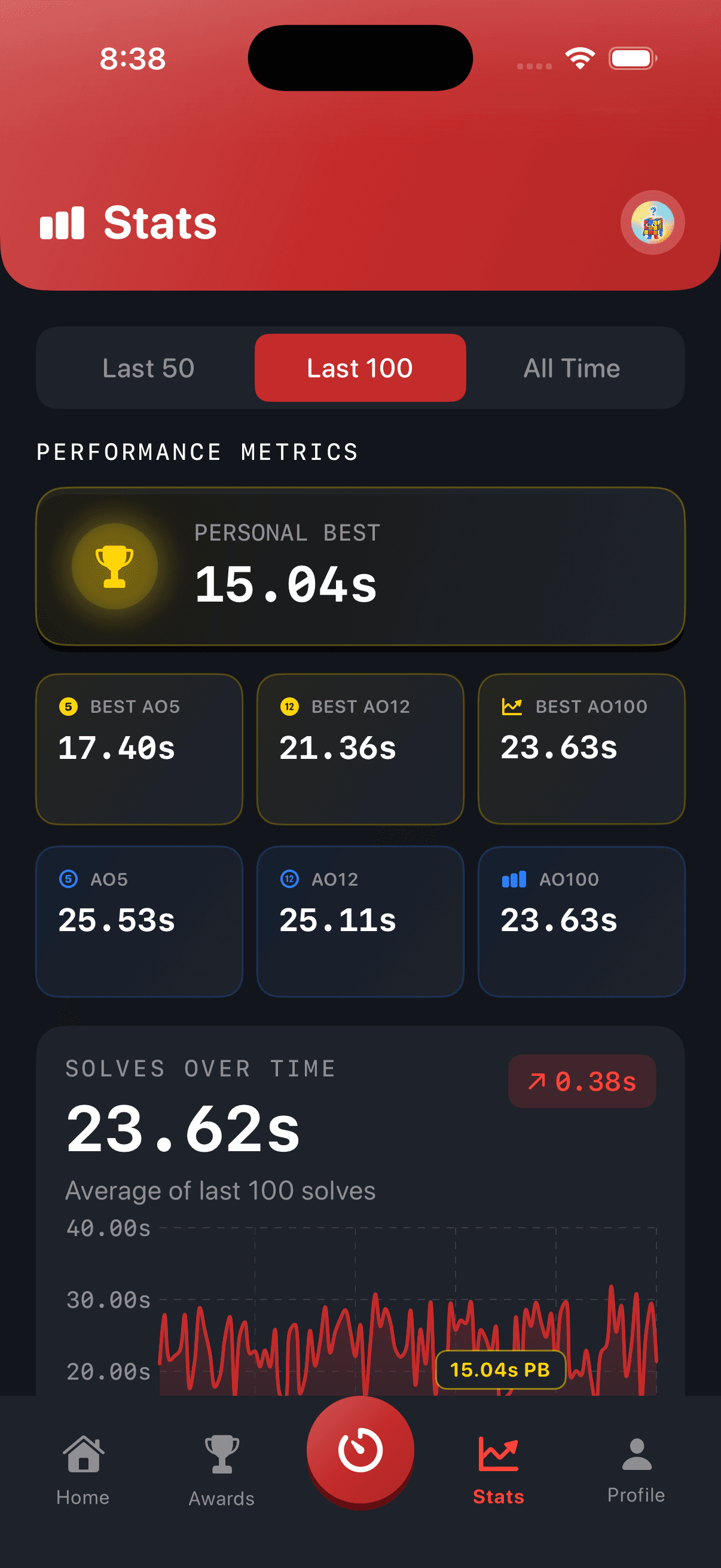
CuberPal combines a WCA-style timer, AI solve analysis, CFOP lessons, algorithm catalogues, spaced repetition, and a camera cube solver so speedcubing advice becomes a daily training loop.
Frequently asked questions
Do I need full PLL or full OLL for sub-30?
No. Reliable two-look OLL and two-look PLL can support a sub-30 average. Full PLL is a useful later upgrade, but Cross and F2L usually offer larger gains first.
How long does it take to get sub-30?
There is no dependable universal timeline. Measure leading skills such as planned Cross, fewer F2L pauses, and stable last-layer recall rather than comparing your calendar with someone else's.
Should I practice only timed solves?
No. Timed averages test whether a skill holds under normal conditions, while untimed Cross reconstructions, slow F2L, and case drills create the skill. Use both in the same week.
Does one solve under 30 seconds make me sub-30?
In everyday cubing language, sub-30 usually means an average below 30 seconds, not a single. Track an average of 12 or 100 to judge consistency.
Sources and fact checks
- [1]J Perm: CFOP Speedsolving Method — Reference for Cross, intuitive F2L, beginner OLL/PLL, and the staged CFOP progression.
- [2]Speedsolving.com Wiki: CFOP method — Method terminology; milestone training advice is CuberPal editorial guidance, not a guaranteed timeline.
- [3]World Cube Association Regulations: Events and Results — Official definition of Average of 5 and competition result formats.