
Rubik's Cube Notation: The Complete Move Chart
Quick answer
Rubik's Cube notation uses R, L, U, D, F, and B for the right, left, up, down, front, and back faces. A plain letter is a clockwise quarter-turn while looking directly at that face, a prime (R') turns it counterclockwise, and 2 (R2) is a half-turn. Lowercase letters or w (r, Rw) are wide turns, M, E, and S are middle slices, and x, y, and z rotate the whole cube, so y' means rotate the whole cube counterclockwise as seen from the top.
On this pageComplete notation chart
- Complete notation chart
- 30-second notation cheat sheet
- The notation rule that prevents most mistakes
- The six face letters
- Prime marks and double turns
- Wide turns, slices, and lowercase letters
- Cube rotations change your frame of reference
- How to parse a long algorithm without getting lost
- Common notation errors and how to diagnose them
- A ten-minute notation practice routine
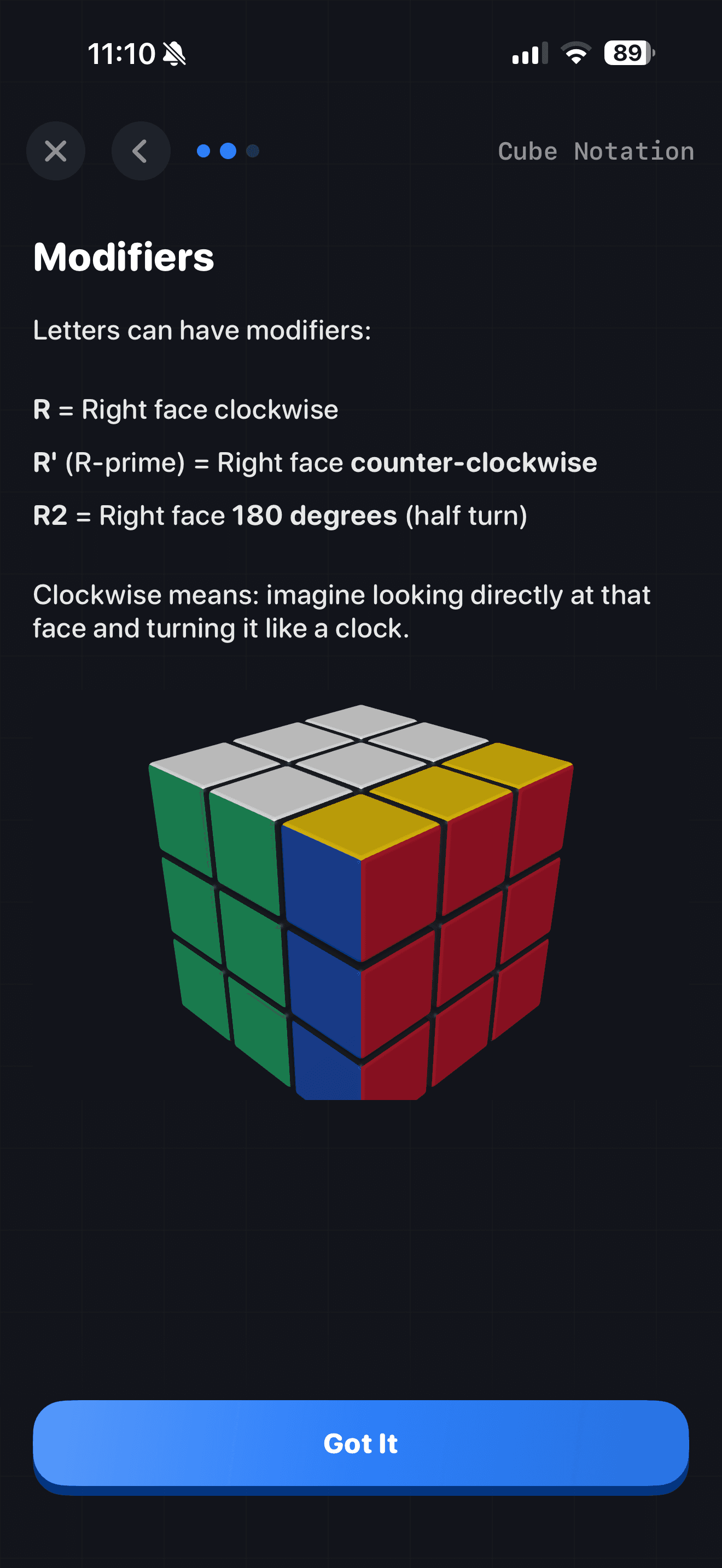
For a standard 3x3, read a move as a face letter plus an optional modifier. R turns the right face clockwise from the right-face viewpoint, R' turns it counterclockwise, and R2 turns it 180 degrees. The same rule applies to L, U, D, F, and B.
Complete notation chart
Every move below is read while looking straight at the face named by the letter. Add ' (prime) for counterclockwise and 2 for a half-turn to any of them.
- R: right face clockwise. R': right face counterclockwise. R2: right face half-turn.
- L: left face clockwise. L': counterclockwise. L2: half-turn.
- U: top (up) face clockwise. U': counterclockwise. U2: half-turn.
- D: bottom (down) face clockwise. D': counterclockwise. D2: half-turn.
- F: front face clockwise. F': counterclockwise. F2: half-turn.
- B: back face clockwise as seen from behind the cube. B': counterclockwise. B2: half-turn.
- r or Rw, l or Lw, u or Uw, and so on: turn that face together with the layer next to it.
- M: middle slice between L and R, turned in the same direction as L. E: slice between U and D, same direction as D. S: slice between F and B, same direction as F.
- x: rotate the whole cube in the direction of R. x' is the opposite direction, toward you on top.
- y: rotate the whole cube in the direction of U, so the right face becomes the front. y' rotates the other way, so the left face becomes the front.
- z: rotate the whole cube in the direction of F, clockwise as you look at the front. z' is counterclockwise.
30-second notation cheat sheet
- R, L, U, D, F, B: turn the named outer face one quarter-turn clockwise while looking directly at that face.
- Prime, written as an apostrophe: reverse the direction, as in U' or F'.
- 2: turn the named layer 180 degrees, as in R2. The final cube state is the same in either turning direction.
- Rw or r: turn two right layers together; M, E, and S name slices; x, y, and z rotate the entire cube.
The notation rule that prevents most mistakes
Read every face turn from the viewpoint of the face being named. R means look straight at the right face and turn it clockwise; F means look straight at the front face and turn it clockwise. You do not keep one imaginary camera fixed in front of the cube for every letter. That single detail explains why a correct B move can feel backward when you watch it from the front.
Notation describes motions, not sticker colors. U means the layer currently on top, even if that face is blue, and R means the layer currently on your right. Choose an orientation before an algorithm and keep it unless the sequence includes a rotation. If a tutorial says yellow on top and green in front, match that grip before reading the first move.
The six face letters
The basic alphabet is U for up, D for down, R for right, L for left, F for front, and B for back. A bare letter is a 90-degree clockwise turn. After R, the right face has moved one quarter-turn; after U, the top layer has moved one quarter-turn. Centers define which face is which because the centers do not change their relative positions on a standard 3x3.
Practice opposites together: R with L, U with D, and F with B. Do R four times and the cube returns to its starting state. Repeat for each face. Then alternate opposite faces, such as R L R' L'. These simple checks give immediate feedback: if the cube does not return when expected, the issue is usually viewpoint or direction rather than memory.
- R and L turn the right and left faces.
- U and D turn the top and bottom faces.
- F and B turn the front and back faces.
Prime marks and double turns
An apostrophe is read as prime and reverses the direction: R' is a counterclockwise right-face turn when you look directly at the right face. The number 2 means a half-turn, so U2 rotates the up face 180 degrees. A half-turn reaches the same position clockwise or counterclockwise, which is why U2 and U2' usually describe the same cube state even when a fingertrick guide distinguishes the execution direction.
Treat the modifier as part of the move, not as a separate instruction. In R U R' U', there are four moves: right, up, right-prime, up-prime. Say the sequence aloud while turning slowly. A useful accuracy test is to perform the sequence six times; this particular four-move trigger returns a solved cube to solved. Do not chase speed until every prime mark produces the intended direction.
Wide turns, slices, and lowercase letters
A wide move turns two adjacent layers together. Rw turns the right two layers as one block, and many algorithm sheets write the same move as lowercase r. Likewise, Uw or u turns the top two layers. On cubes larger than 3x3, a number can specify how many layers move, so 3Rw means the three rightmost layers. Check the notation key when a source uses lowercase letters because older tutorials are not always consistent.
Slice moves name an internal layer: M is the middle slice between L and R, E is the equatorial slice between U and D, and S is the standing slice between F and B. Their directions follow L, D, and F respectively. That convention feels arbitrary at first, so learn a slice inside an algorithm instead of memorizing it in isolation. For example, M2 is visually easy to check because the middle slice makes a half-turn.
Cube rotations change your frame of reference
The letters x, y, and z rotate the entire cube rather than a layer. An x rotation follows the direction of R, y follows U, and z follows F. After a y rotation, the face that was on your right or left may now be the front, so every later face letter is interpreted in the new orientation. Rotations are not pauses in the algorithm; they deliberately redefine your grip and viewpoint.
Separate rotations from wide moves. An x rotation moves the whole cube; Rw moves only the two right layers. They can look similar in a fast video, but they leave different pieces in place. When learning from text, physically pause after x, y, or z, identify the new front and top centers, then continue. As the sequence becomes familiar, that orientation update will become automatic.
How to parse a long algorithm without getting lost
Do not read a 12-move algorithm as 12 unrelated symbols. Break it into short phrases that match hand motions or familiar triggers. The sequence R U R' U' is often treated as one four-move unit. A longer line such as R U R' U R U2 R' can be read as R U R', then U, then R U2 R'. Chunking reduces the amount held in working memory and makes mistakes easier to locate.
Keep one finger on the written sequence or reveal only one chunk at a time. After each chunk, compare the cube with the diagram or animation. If the state diverges, undo only that chunk rather than restarting blindly. During the first clean repetitions, say primes and doubles aloud. Later, recall the shape and finger rhythm, but return to the written notation whenever execution begins drifting.
Common notation errors and how to diagnose them
The most common error is using your front-facing idea of clockwise for every layer. The second is accidentally rotating the whole cube during a face turn. The third is losing the starting orientation between setup and algorithm. If an algorithm fails, reset the cube, confirm top and front colors, and replay at one move per second. Name each move before making it. That controlled replay usually exposes the first divergence.
Also distinguish an apostrophe from punctuation and the digit 2 from a repeated letter. R2 is one half-turn, not two separate timed actions; R R reaches the same state but may encourage an unnecessary regrip. In copied notation, smart quotes can replace the plain apostrophe. They mean prime in prose, but some trainers only accept the standard apostrophe character, so normalize the text before pasting it into a tool.
A ten-minute notation practice routine
Spend two minutes on the six face turns and their inverses. Spend two minutes on wide turns and rotations, always naming the new front after a rotation. Then choose one short trigger and perform it slowly from a solved cube while reading, from memory, and finally with your eyes tracking pieces instead of your hands. Finish with a scramble line, checking each token rather than trying to solve.
Accuracy is the pass condition. When you can execute an unfamiliar line without reversing B, D, or L, begin increasing tempo. Good notation fluency means written algorithms become instructions you can test, compare, and practice, not strings you memorize by appearance. Use the notation lesson or move playback beside your cube until the symbols and physical turns agree every time.
Continue the learning path
Cube fundamentals
Learn the notation, then use a visual solver only when you are genuinely stuck.
Open this topic clusterTurn this into practice
CuberPal combines a WCA-style timer, AI solve analysis, CFOP lessons, algorithm catalogues, spaced repetition, and a camera cube solver so speedcubing advice becomes a daily training loop.
Frequently asked questions
What does R' mean on a Rubik's Cube?
R' means turn the right face 90 degrees counterclockwise while looking directly at the right face. The apostrophe is pronounced prime.
Does R2 have a clockwise direction?
R2 is a 180-degree right-face turn, so clockwise and counterclockwise reach the same cube state. Some fingertrick resources show a preferred execution direction, but the notation normally does not require one.
Are r and Rw the same move?
In most modern 3x3 resources, lowercase r and Rw both mean turning the two right layers together. Because older sources can vary, check the notation key before learning a long algorithm.
What is the difference between y and U?
U turns only the top layer. A y rotation turns the entire cube in the same direction as U and changes which center is considered the front for all following moves.
What does y' mean in Rubik's Cube algorithms?
y' is a whole-cube rotation counterclockwise as seen from the top, the opposite of U's direction. The face that was on your left becomes the new front, and every following move is read from that new orientation.
What do x, y, and z mean in cube notation?
They rotate the whole cube instead of turning a layer: x follows the direction of R, y follows U, and z follows F. Add a prime for the opposite direction and 2 for a 180-degree rotation.
What does M mean on a Rubik's Cube?
M is the middle slice between the left and right faces, turned in the same direction as L. M' turns it the opposite way, and M2 is a half-turn of the middle slice.
Sources and fact checks
- [1]J Perm: Rubik's Cube Move Notation — Reference for face turns, primes, double turns, wide moves, rotations, and slice conventions.
- [2]World Cube Association Regulations: Article 12 Notation — Official notation used for WCA scramble sequences and puzzle moves.
- [3]Sebastiano Tronto: Cube Notation — Additional notation reference and examples.
Keep improving
Beginner Method vs CFOP
Read next BlogHow to Practice Speedcubing
Read next GuideHow to Learn the CFOP Method
Read next GuideThe 7 Best Rubik's Cube Apps for Beginners in 2026
Read next BlogRubik's Cube Patterns: Checkerboard, Six Spots and More
Read next BlogInvalid Scramble Meaning: Check Your Cube Solver Input
Read next