
How to Get Faster at Cubing
Quick answer
To get faster at cubing, stop practicing blindly and find out where your time actually goes. Most solvers lose 60%+ of their solve to F2L pauses, not slow turning. Measure your phase times (Cross, F2L, OLL, PLL), fix the slowest phase first, and drill algorithms with spaced repetition instead of random solves.
On this pageStep 1: Find out where your time actually goes
Every cuber hits the same wall: you do hundreds of solves, your times stop dropping, and you have no idea why. The problem usually is not turning speed — it is that random solving does not tell you what to fix.
This guide breaks down how speedcubers actually improve at every level, and how to use data from your own solves to target the right weakness instead of guessing.
Step 1: Find out where your time actually goes
A 25-second CFOP solve is not 25 seconds of equal effort. A typical breakdown is roughly 10% Cross, 55–65% F2L, and the rest last layer. That means for most cubers, F2L is where the seconds hide — usually in pauses between pairs, cube rotations, and bad inserts.
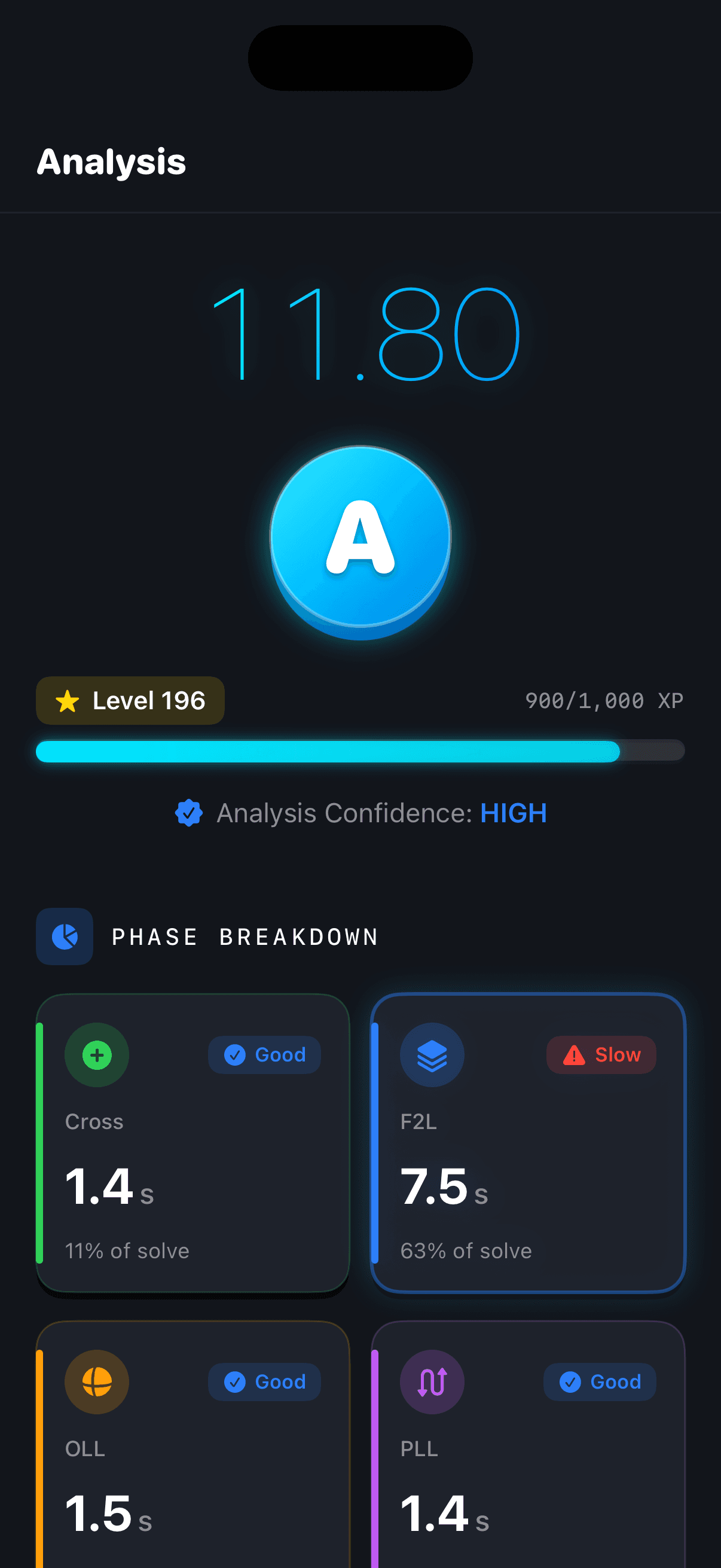
Before changing anything, measure. Film a few solves and time each phase, or use an AI analysis tool that does it automatically. Once you can see "Cross 1.4s, F2L 7.5s, OLL 1.5s, PLL 1.4s", the plan writes itself: the slow phase is the one to train.
Step 2: Fix the right thing for your speed range
What "getting faster" means depends on where you are:
- Over 60 seconds: finish learning CFOP basics — intuitive F2L and 4-look last layer. See our guide to learning the CFOP method.
- 30–60 seconds: plan the full cross during inspection, learn full PLL, and stop rotating during F2L.
- 20–30 seconds: lookahead is everything. Slow your turning down and eliminate pauses between F2L pairs.
- 15–20 seconds: refine F2L solutions (fewer moves, better fingertricks), learn full OLL, start cross-to-F2L transition planning.
- Sub-15: advanced last-layer sets like COLL and ZBLL, and squeezing rotations out of every solve.
Step 3: Replace random solves with deliberate practice
Grinding 100 solves a day feels productive, but improvement comes from focused reps: slow solves where you never pause, drilling only the algorithms you fumble, and re-solving the same F2L case until the better solution is automatic.
Spaced repetition — reviewing algorithms right before you would forget them — is the fastest way to make new algorithms stick. It is how cubers memorize 21 PLLs or 493 ZBLLs without burning out.
Step 4: Get feedback on your actual solves
The biggest unlock is feedback. Top cubers post solve videos to forums and ask for critique; you can get the same analysis instantly from AI. A tool that watches your solve can catch the 500ms hesitations, unnecessary rotations, and missed pairs that you literally cannot feel while solving.
How to get faster with CuberPal
CuberPal was built around exactly this workflow: measure, target, drill, re-measure. Here is how to run it:
- Record a solve in the app (POV or tripod) or upload an existing video from your camera roll.
- Get an instant AI analysis: phase-by-phase timings for Cross, F2L, OLL, and PLL, with your slowest phase flagged.
- Read the F2L pair-by-pair breakdown — CuberPal detects pauses, rotations, and inefficient inserts and tells you which pair broke your flow.
- Ask Cubey, the built-in AI coach, what to practice next. It knows your recent stats and suggests drills for your speed range.
- Drill your weak algorithms with spaced repetition practice, then re-analyze a solve a week later to confirm the phase time dropped.
Turn this into practice
Use CuberPal to connect these steps to solve analysis, focused drills, lessons, and spaced repetition.
Frequently asked questions
How long does it take to get faster at cubing?
With deliberate practice, most cubers can go from 60 to 30 seconds in 2–3 months, and from 30 to 20 seconds in another 3–6 months. Progress is much faster when you train your measured weakness instead of doing random solves.
Should I turn faster to get faster?
Usually no. Most time is lost to pauses, not slow turning. Paradoxically, turning slower with zero pauses produces faster solves than turning fast with hesitations. Fix flow first, then add turning speed back.
How many solves a day should I do?
Quality beats quantity. 20 focused solves with analysis and targeted drills beat 100 mindless ones. A good session: a few timed solves, one analyzed solve, then 10–15 minutes of algorithm drills on your weak cases.
Sources and fact checks
- [1]Speedsolving.com Wiki: CFOP method — Reference for the Cross, F2L, OLL, and PLL method structure and algorithm-set counts; timing targets are CuberPal editorial guidance.
- [2]Speedsolving.com Wiki: Look ahead — Reference for tracking the next pieces while executing the current step to reduce pauses.
- [3]Apple App Store: Cubing Timer & Coach: CuberPal — Current product listing for CuberPal timer, analysis, coaching, algorithm practice, and cube-solver capabilities.