
How to Practice Speedcubing
Quick answer
A productive speedcubing session combines a short warm-up, one evidence-based drill target, a small set of normal timed solves, and review. Use drills to build the skill and timed averages to test transfer. Repeat the same focus for several sessions before choosing the next bottleneck.
On this pagePractice is not the same as doing more solves
- Practice is not the same as doing more solves
- Use a simple four-part session
- Choose the target from data, not mood
- Cross and inspection drills
- F2L drills for recognition and lookahead
- Algorithm and recognition practice
- Timed solves are the transfer test
- Review without turning every solve into homework
- Manage volume, recovery, and motivation
- Turn every session into the next one
Practice is not the same as doing more solves
Random timed solves are useful tests, but they do not guarantee that the cause of a plateau receives enough attention. Deliberate practice chooses a specific skill just beyond current reliability, gives immediate feedback, and repeats it with concentration. In cubing, that might mean planning a complete Cross, tracking the first pair, distinguishing two OLL mirrors, or removing a PLL regrip.
Begin with evidence from a recent average or video. Name the repeated behavior that costs time and choose one drill that changes it. If you cannot state what a repetition is teaching, return to the diagnosis. Focused practice is tiring, so a smaller number of high-quality attempts can be more useful than a long session in which every solve repeats the same unnoticed pause.
Use a simple four-part session
A practical 45-minute structure is five minutes of easy warm-up solves, 15 minutes on one focused drill, 15 minutes on normal timed solves, and ten minutes reviewing the slowest or most revealing attempts. Shorten every block proportionally for a 20-minute session. Keep the order: prepare, build, test, reflect.
Warm-up is not a performance test. Turn comfortably, check cube alignment, and recall familiar algorithms. The drill block isolates the target. The timed block restores normal scramble variety and inspection. Review converts outcomes into the next action. End with one sentence such as first-pair pauses fell, but back-slot inserts caused rotations. That note is more useful than a screenshot of the best single.
Choose the target from data, not mood
Record at least an average of 12 and note Cross, F2L, OLL, and PLL pauses. Video three representative solves if phase timing is unavailable. Sort errors into recognition, planning, recall, and execution. The largest repeatable cost becomes the primary target for the next several sessions. Keep other skills alive with a small maintenance dose.
Do not switch targets after every bad solve. One missed PLL does not outweigh ten slow first-pair transitions. Use a two-week block unless the drill is clearly wrong or painful. Compare median phase time, error count, and pause frequency before and after. Progress can appear as greater consistency before the total average falls, so track the behavior you deliberately trained.
Cross and inspection drills
Take a scramble, use normal inspection time, and plan as much of the Cross as possible without turning. Execute only the Cross, then stop and compare it with alternative solutions. Repeat on 15 scrambles. If four edges are too much, plan three and locate the fourth deliberately. Increase the requirement only when the current level is accurate.
For competition-style practice, use the current WCA inspection procedure: the judge calls eight and twelve seconds, a start at 15.00 receives a +2, and a start at 17.00 is DNF under the current regulations. Home drills do not need a judge, but practicing the calls and a calm timer start prevents inspection skill from disappearing under event conditions.
F2L drills for recognition and lookahead
Slow solves are the main F2L tool. Turn at a pace that never requires a full stop and force your eyes to search for the next pair while the current one enters. If you lose it, reduce speed. Another drill solves only one pair from each scramble, reconstructs it, and finds a solution with fewer rotations or a better final grip.
Use empty-slot and back-slot practice when rotations dominate. Set up a familiar pair and insert it into each slot without changing cube orientation. Do not memorize every alternative immediately; choose one recurring awkward case from video. The drill succeeds when the new solution appears in a normal solve without breaking flow, not when it is fast in ten prepared repetitions.
Algorithm and recognition practice
Separate case recognition, algorithm recall, and execution. For recognition, name the case and required U adjustment without turning. For recall, produce the algorithm slowly from the name or diagram. For execution, use a known aligned setup and focus on fingertricks. Then mix old and new cases and place them back into complete last-layer solves.
Learn only a few new cases at once and revisit them after a delay. Balanced presentation helps every selected case receive practice; realistic frequency later tests whether learning survives natural randomness. Track misses and slow cases so review is selective. Repeating strong algorithms while avoiding one confusing mirror feels productive but leaves the actual bottleneck intact.
Timed solves are the transfer test
After the drill, complete a normal average of 12 with standard inspection and no artificial setups. Do not force the trained technique into every scramble. Let it appear where appropriate and record whether it did. This tests transfer: the ability to use a skill while planning, recognizing, and managing the rest of the solve.
Judge the block by more than the average. Note success rate, major pauses, lockups, and time spread. A new F2L solution might initially make the average slower while reducing rotations; that can be a healthy intermediate step. If the target behavior never appears, make the next drill more contextual by adding the preceding move or a random entry state.
Review without turning every solve into homework
Review the three most informative solves, not necessarily only the three slowest. One may reveal a repeated pause, one a successful new behavior, and one an execution failure. Reconstruct the critical moment, test an alternative, and write one decision for the next session. Stop once you have an actionable pattern; exhaustive analysis can replace actual practice.
Keep a compact log: date, average, target, drill, one observation, next step. Weekly, compare phase or behavior trends rather than personal-best singles. Monthly, run a larger benchmark such as an average of 100 under similar conditions. Consistent records prevent recency bias and show when a skill is stable enough to leave the primary focus.
Manage volume, recovery, and motivation
Stop focused drills when accuracy collapses or discomfort appears. Short attentive sessions repeated across the week are easier to sustain than occasional marathons. Warm up cold hands, vary movements, and take breaks from high-repetition algorithms. There is no required daily solve count; the right volume is one that preserves deliberate attention and leaves you willing to return.
Mix focused sessions with free solves, side events, or untimed experimentation. Enjoyment is not a distraction from improvement; it supports consistency. If a milestone creates pressure, switch the goal from hit sub-20 to plan ten complete crosses. Process goals are directly controllable and give feedback even when scramble difficulty makes totals noisy.
Turn every session into the next one
End by choosing the next concrete rep. It might be 15 Cross reconstructions, a mixed set of two confused PLLs, or ten slow F2L solves with zero full stops. Load only the cases or phase you intend to train, then use a normal timer block to verify transfer. A practice dashboard is helpful when it keeps that loop visible rather than simply adding another number.
The durable cycle is diagnose, isolate, practice, test, and review. Repeat it until the chosen behavior changes, then select the next constraint. This method works whether the target is a first independent solve, sub-30, or an advanced recognition issue because the decision always comes from what your current solves actually show.
Continue the learning path
Practice with purpose
Use enough solves for a meaningful average, then turn your weakest pattern into a drill.
Open this topic clusterTurn this into practice
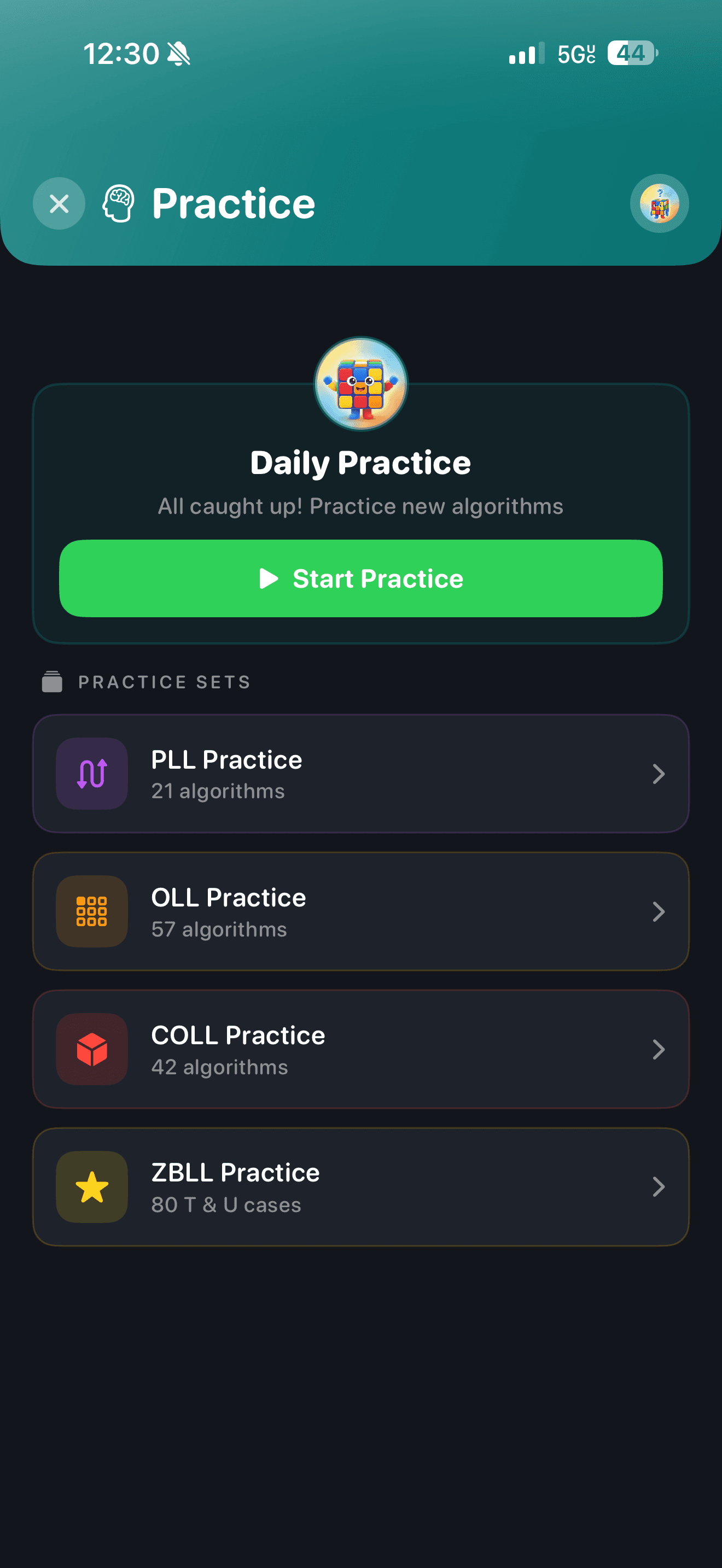
CuberPal combines a WCA-style timer, AI solve analysis, CFOP lessons, algorithm catalogues, spaced repetition, and a camera cube solver so speedcubing advice becomes a daily training loop.
Frequently asked questions
How many solves should I do per day?
There is no universal number. Choose a volume that preserves attention and accuracy. A focused drill plus an average of 12 can be more useful than 100 mindless solves.
Are slow solves good practice?
Yes, especially for F2L lookahead and continuous turning. Slow down enough to find the next pair before the current insert ends, then gradually raise the pace without restoring pauses.
How often should I change my practice target?
Keep one primary target for several sessions or roughly two weeks, then compare the trained behavior with a baseline. Change sooner only if the drill is clearly mismatched or causes discomfort.
Should I practice with WCA inspection at home?
Use it during transfer and competition-style blocks. Isolated drills can ignore inspection, but normal timed solves should rehearse the current official timing and start procedure if you plan to compete.
Sources and fact checks
- [1]CubeSkills: Cubing Practice Tips — First-party speedcubing guidance on deliberate practice, drills, solve review, and one-aspect focus; the session structure is CuberPal editorial guidance.
- [2]J Perm: CFOP Speedsolving Method — Reference for Cross, F2L, OLL, and PLL skills used in the drills.
- [3]World Cube Association Regulations: Speed Solving — Official inspection calls, timing thresholds, start, and stop procedures for competition-style practice.