
Speedcubing Fingertricks
Quick answer
Speedcubing fingertricks are efficient ways to turn layers with individual fingers while preserving grip and visibility. Learn them inside real triggers, begin at a controlled pace, remove unnecessary regrips, and increase speed only when the cube stays aligned and your eyes can keep tracking pieces.
On this pageThe goal is less interruption, not maximum TPS
- The goal is less interruption, not maximum TPS
- Start from a neutral, repeatable grip
- Learn U turns in both directions
- Use triggers as the unit of practice
- Remove regrips one algorithm at a time
- Protect lookahead during F2L
- Build speed through clean repetitions
- Diagnose lockups, overshooting, and strain
- A focused fingertrick audit
The goal is less interruption, not maximum TPS
A fingertrick assigns a turn to a finger or short hand motion so the rest of your grip stays ready. The benefit is not only a faster individual move. Good fingertricks reduce regrips, keep the cube stable, preserve visibility, and connect one trigger to the next. A slower continuous solve usually beats fast bursts separated by searches and hand resets.
Measure the full phrase. If a clever U2 is quick but leaves your thumb trapped before the next R move, it is not efficient in that algorithm. If a new grip causes locks under normal scramble pressure, return to controlled repetitions. Fingertricks are solutions to recurring motion problems, not a collection of tricks you must display.
Start from a neutral, repeatable grip
A common neutral grip places the thumbs on the front face and the remaining fingers around the back and sides. Exact placement varies with hand size and cube, but both hands should support the puzzle without squeezing. From this position, R and L turns can use wrists and fingers while index fingers remain available for U-layer flicks.
Notice where an algorithm begins and ends. OLL often benefits from returning to a stable front-thumb grip because PLL follows. PLL ends the solve, so its final grip can prioritize a clean AUF and timer stop. Do not force one grip onto every sequence. Define a home position, then allow purposeful changes whose benefit is greater than their reset cost.
Learn U turns in both directions
U is commonly pushed with an index finger, and U' can be pushed with the opposite index finger rather than rotating the wrist back. Practice both from a stable grip so either hand can move the top layer without taking your eyes off the cube. For U2, many solvers use two fingers in succession, but the exact double flick should match comfort and control.
Begin with single turns that land exactly on alignment. Then alternate U U' and perform U2 from both hands if useful in your algorithms. A misaligned top layer makes the next side turn lock, so accuracy sets the speed limit. Do not flick so hard that the cube leaves the supporting hand; minimal force and proper tension are more repeatable than dramatic motion.
Use triggers as the unit of practice
Short sequences such as R U R' U' recur across F2L, OLL, and PLL. Practice the entire trigger so each finger prepares the next move. Say which hand performs each U turn, then repeat slowly without pauses. The aim is one continuous phrase whose final grip is known, not four individually fast turns.
Mirror common triggers with the left hand instead of rotating the cube to use the right. Left-hand control may feel weak at first, but it can remove rotations during F2L and improve access to front-left slots. Train mirrored motions at low speed and keep a right-handed fallback until accuracy is stable. Symmetry is useful, but forcing a mirror that hurts or consistently locks is not.
Remove regrips one algorithm at a time
Film an algorithm and count moments when the hands leave their working position to grab the cube again. Identify the first unnecessary regrip. Sometimes changing one U to a push, beginning with a thumb slightly higher, or using a different algorithm removes it. Make that single change and test the whole sequence before redesigning every move.
Some regrips are intentional and cheaper than an awkward no-regrip solution. Compare total execution, lock rate, and entry and exit positions. An algorithm that wins in isolated repetition may lose when entered from F2L. Keep the version that performs reliably in context. Ergonomics and hand size differ, so another solver's fastest fingertrick is evidence to test, not a command.
Protect lookahead during F2L
F2L fingertricks should make a known pair automatic enough that your eyes can search elsewhere. During slow solves, look away from the pair as soon as its insertion path is decided. If your hands cannot finish without visual supervision, reduce speed and repeat that insert. Automatic execution creates attention for the next pair.
Avoid turning faster simply because the current case is familiar. A sudden burst can make the next pieces harder to track. Use even, quiet movement for F2L and save higher speed for algorithms with fixed outcomes. Count pauses rather than TPS. If a new fingertrick reduces a regrip but increases the number of stops, it has not yet transferred to solving.
Build speed through clean repetitions
Perform five slow perfect reps, then five at a moderate pace. If all are aligned and recall is automatic, increase speed slightly for another five. At the first repeated lockup, return one level. A metronome can expose uneven rhythm, but do not let it force a pace that sacrifices alignment. Short sets preserve attention better than hundreds of careless turns.
Randomize the setup after isolated practice. Execute the trigger from different grips, U-face angles, and preceding moves. Finish with normal solves and note whether the motion appeared without conscious preparation. Motor learning inside one prepared setup can be brittle; solve-ready fingertricks must tolerate the variety that F2L and last-layer transitions create.
Diagnose lockups, overshooting, and strain
Lockups can come from layer misalignment, excessive force, a poorly timed next move, or cube settings that do not match your control. Slow video helps identify which layer is late. Overshooting often means the flick is too forceful or the supporting hand is not stabilizing the cube. Adjust one variable and retest rather than loosening hardware after every bad rep.
Fingertrick practice should not hurt. Stop when a motion causes pain, numbness, or persistent discomfort, and do not copy extreme hand positions. Warm up with easy solves, use brief sets, and vary the movement. This is practical training advice, not medical treatment; recurring symptoms deserve appropriate professional guidance rather than another algorithm variation.
A focused fingertrick audit
Choose one frequently used algorithm. Record ten executions from the actual starting grip, noting time, regrips, locks, and final position. Change one motion, repeat ten controlled reps, then place the algorithm back into random cases. Keep the change only if accuracy and the surrounding transition improve, not merely the best isolated time.
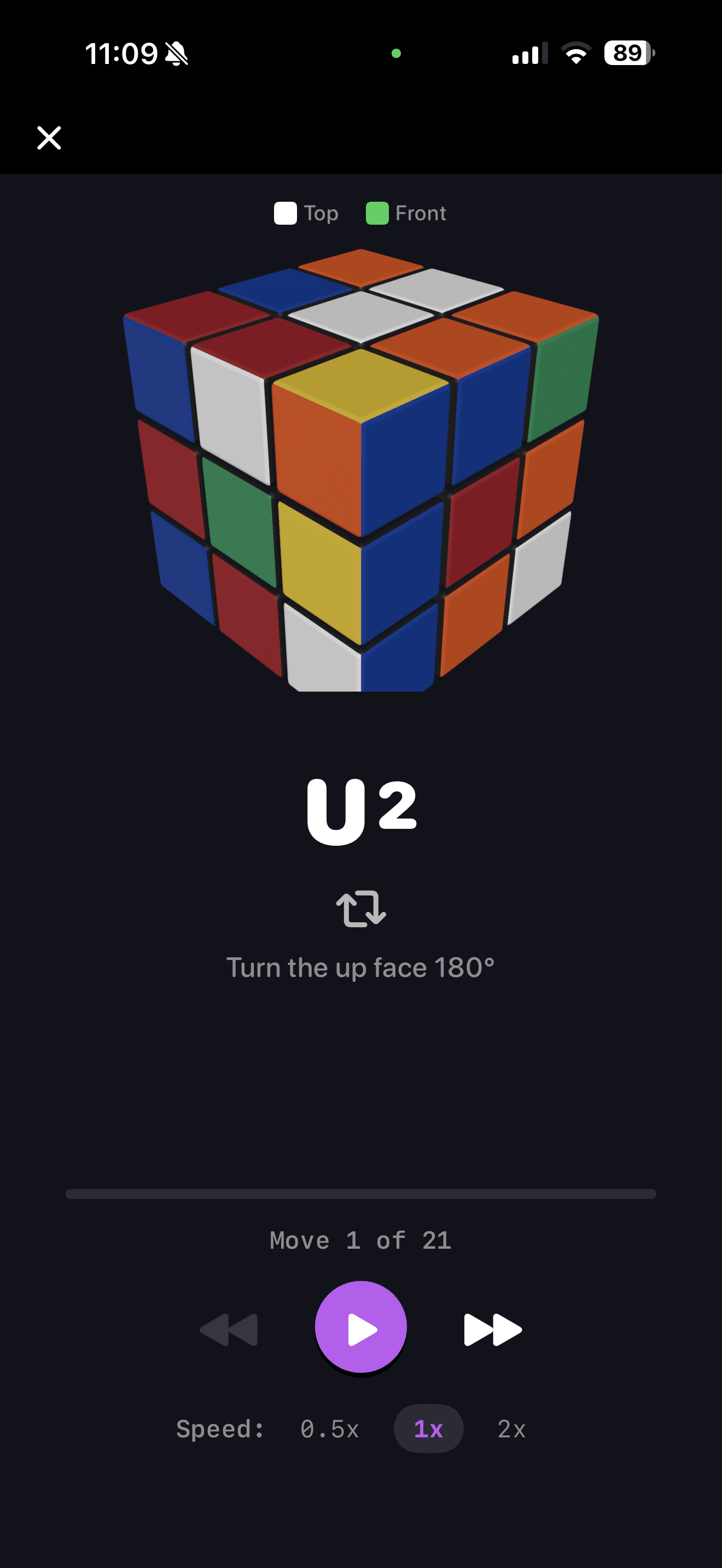
For the next practice session, select a single recurring friction point: a U2 double flick, left-hand U', or a regrip inside one PLL. Use move playback or a trusted fingertrick reference to understand the direction, then teach the hand slowly. Small improvements to moves used every solve are more valuable than rare flashy techniques that never become dependable.
Continue the learning path
Get faster at 3x3
Measure one solve, identify the slowest phase, and train that skill before chasing raw TPS.
Open this topic clusterTurn this into practice
CuberPal combines a WCA-style timer, AI solve analysis, CFOP lessons, algorithm catalogues, spaced repetition, and a camera cube solver so speedcubing advice becomes a daily training loop.
Frequently asked questions
What are fingertricks in speedcubing?
They are efficient finger and hand motions for turning layers while minimizing grip changes. Their value comes from smoother algorithms, better transitions, and preserved lookahead, not speed alone.
Which fingertrick should a beginner learn first?
Start with controlled U and U-prime index pushes inside a familiar trigger such as R U R-prime U-prime. Add U2 double flicks only after single turns align reliably.
Are no-regrip algorithms always faster?
No. A purposeful regrip can be faster and more reliable than an awkward no-regrip sequence. Compare the complete entry, algorithm, exit, and lock rate.
Can fingertricks make lookahead worse?
Yes if you turn too fast to track pieces or must watch your hands. Reduce the pace until the current insert is automatic and your eyes can move to the next pair.
Sources and fact checks
- [1]J Perm: Rubik's Cube Finger Tricks — Practical reference for common turning motions, regrip reduction, and OLL/PLL transitions.
- [2]Speedsolving.com Wiki: Fingertricks — Terminology and examples; ergonomic choices are presented with individual caveats.
- [3]J Perm: Rubik's Cube Move Notation — Reference for the U, U-prime, U2, and trigger notation used in drills.