
How to Get Sub-15 on Rubik's Cube
Quick answer
A consistent sub-15 average usually comes from planning the full Cross and tracking the first pair, keeping F2L efficient and pause-light, recognizing OLL and PLL quickly, and executing reliable algorithms without disruptive regrips. Advanced sets such as COLL or ZBLL are optional; first remove the repeated losses visible in your own solves.
On this pageSub-15 is a consistency problem, not a secret algorithm
- Sub-15 is a consistency problem, not a secret algorithm
- Audit the solve at the level of transitions
- Plan Cross and carry information into F2L
- Make F2L solutions easier to see and execute
- Use full PLL and OLL as tools, not credentials
- Train recognition from the view you actually have
- Raise turning speed only where control survives
- When advanced subsets are actually worth learning
- A four-session sub-15 training loop
Sub-15 is a consistency problem, not a secret algorithm
A single 14-second solve can arrive through a friendly scramble, a last-layer skip, or unusually visible pairs. A sub-15 average means ordinary cases repeatedly fit inside the same budget. That requires fewer pauses and cleaner transitions across the whole solve. New algorithms can save time, but they help only after recognition and execution are stable enough to use them without hesitation.
Start with a representative average of 50 or 100 and tag the largest repeated loss. Common constraints are an unplanned first pair, inefficient F2L solutions, OLL or PLL recognition, regrips, and inaccurate turning. Work from evidence rather than a generic advanced checklist. Two 17-second solvers may need opposite plans even when both know full OLL and PLL.
Audit the solve at the level of transitions
Record video and mark the end of Cross, F2L, OLL, and PLL. Then inspect the gaps between phases. A fast Cross followed by a two-second search is not a strong opening. A fast OLL that leaves an awkward PLL grip may cost more than it saves. For each solve, note the longest stop, the number of rotations, the first-pair delay, and any last-layer misrecognition.
Use median phase times to find the normal bottleneck and slow solves to understand it. Do not force universal split targets onto every style. A broad coaching model might place Cross near 10 percent, F2L near half, and last layer in the remaining third, but x-crosses, two-look steps, and different turning strengths change those ratios. The useful comparison is your current sample against your next sample.
Plan Cross and carry information into F2L
At this level, the full Cross should normally be planned during inspection. Reconstruct every inefficient opening and search for a solution that preserves a comfortable grip. Move count matters, but visibility matters too. A seven-move Cross that exposes a known first pair can beat a six-move solution that hides every useful piece and forces a pause.
Progress from tracking one corner to predicting a complete first pair. Begin by choosing a likely pair during inspection and watching one piece through the Cross. When that is dependable, calculate how the second piece changes. You do not need a planned x-cross on every scramble. The practical pass condition is starting F2L with a decision instead of scanning the entire cube after the final cross move.
Make F2L solutions easier to see and execute
Sub-15 F2L gains rarely come from memorizing every possible trick. First remove repeated inefficiencies: taking pieces out of solved slots, using several U turns to search, rotating for cases solvable from the current angle, or inserting a pair into the front when a back-slot insert would preserve visibility. Reconstruct the worst pair from each session and find one simpler alternative.
Practice at a turn rate where you can locate the next pair before finishing the current insert. If your eyes remain on the pieces being solved, slow down. Track unsolved colors and use empty slots as safe working space. Learn alternative solutions only when a recurring case still forces a rotation or poor grip. An algorithm earns its place when it reduces a known friction point, not because it appears on an advanced list.
Use full PLL and OLL as tools, not credentials
Full PLL is a high-value set because it converts last-layer permutation from two looks to one across 21 cases. Full OLL covers 57 orientation cases and can remove another recognition step. Many sub-15 solvers know both, but merely knowing the sequences is insufficient. A new case that adds a three-second recognition pause is temporarily slower than a familiar two-look route.
If either set is incomplete, prioritize the cases that appear often in your practice and whose two-look alternative is expensive. Learn small groups, test them from random U-face angles, and require clean recall before adding more. If both sets are complete, time recognition and execution separately. A slow case may need a better visual cue, a different algorithm, or a new fingertrick; those are different fixes.
Train recognition from the view you actually have
During a solve, you rarely receive a perfectly aligned diagram. Practice OLL and PLL from all four U-face adjustments and from the front angles your last F2L insert creates. For OLL, identify top-face shape and side stickers. For PLL, use blocks, bars, headlights, and piece cycles rather than rotating the cube until it resembles a flashcard.
Separate recognition-only reps from full execution. Show a case, name it and its adjustment, then reset without turning. In another block, execute known cases from a consistent starting grip. Finally mix them in normal solves. This progression reveals whether the delay is seeing the case, recalling the algorithm, or moving the hands. A single combined timer hides that distinction.
Raise turning speed only where control survives
High turns per second help during rehearsed algorithms, but F2L needs visual bandwidth. If faster turning creates locks or long searches, the net solve is slower. Use a steady pace for pair work and allow bursts for algorithms you can execute without watching. Film your hands to find regrips, double flicks that fail, and first moves that begin from an awkward thumb position.
Change one motion at a time. You might replace a whole-hand U' with a left-index push, learn a U2 double flick, or choose a PLL ending that allows a quick final adjustment. Drill the motion slowly, then inside the complete algorithm, then from the preceding phase. Execution is not truly improved until the entry and exit remain smooth in a random solve.
When advanced subsets are actually worth learning
COLL, Winter Variation, VLS, and ZBLL can reduce moves or skip later steps in specific states. They also add recognition categories and algorithm maintenance. Consider a subset when full OLL and PLL are dependable, F2L is already efficient, and your data identifies a repeated last-layer opportunity. Learn a coherent small group before committing to an entire set.
Do not use advanced algorithms to avoid a foundational problem. ZBLL will not fix a first-pair pause, and an awkward VLS choice can break lookahead more than it saves. Compare the new route with your existing one for recognition time, execution reliability, and resulting adjustment. Keep it only if the whole transition improves under random conditions, not just during isolated repetitions.
A four-session sub-15 training loop
Session one: 20 Cross-plus-first-pair attempts with reconstruction. Session two: slow F2L solves and review of the three least efficient pairs. Session three: recognition-only OLL and PLL drills followed by clean execution reps. Session four: a competition-style average, video review, and a new phase report. Keep a short maintenance block for algorithms not currently targeted.
Run the loop for two weeks on one primary constraint. Compare median total, phase time, pause count, and errors with the baseline. If the target improves but the average does not, look for a cost transferred to the next transition. Once the new behavior survives normal solves, choose the next constraint. That measured cycle is a more dependable route to sub-15 than collecting advanced cases without a reason.
Continue the learning path
Get faster at 3x3
Measure one solve, identify the slowest phase, and train that skill before chasing raw TPS.
Open this topic clusterTurn this into practice
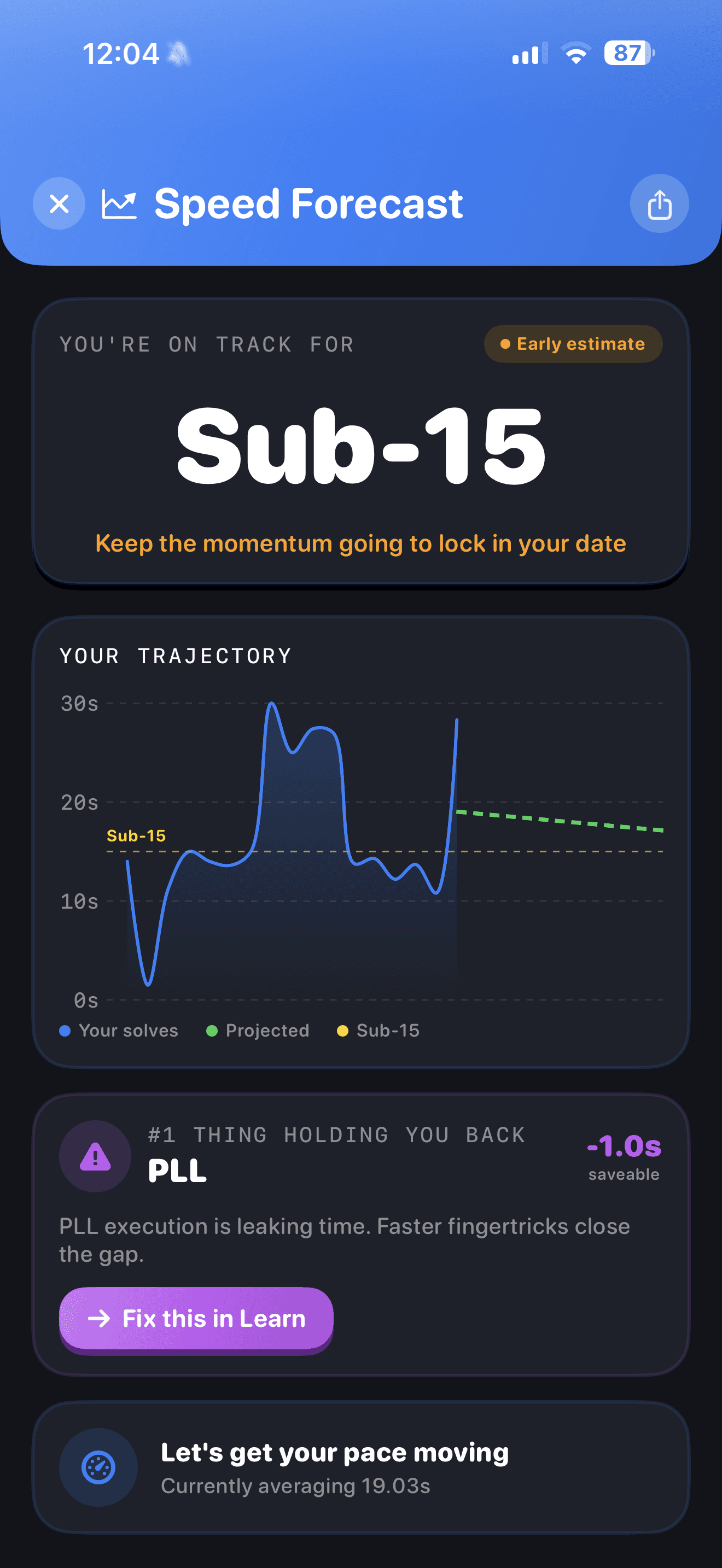
CuberPal combines a WCA-style timer, AI solve analysis, CFOP lessons, algorithm catalogues, spaced repetition, and a camera cube solver so speedcubing advice becomes a daily training loop.
Frequently asked questions
Do I need full OLL and full PLL for sub-15?
They are common and useful at this level, especially full PLL, but no algorithm set guarantees the milestone. Reliable recognition, efficient F2L, and smooth transitions remain essential.
Do I need ZBLL to average sub-15?
No. ZBLL is an optional advanced subset with a large recognition and maintenance cost. Learn it only after your core CFOP is stable and your data shows last-layer cases are the right investment.
What is the most important sub-15 skill?
There is no single answer for every solver. For many, reducing F2L pauses and carrying a planned first pair out of Cross offers more than another algorithm set. A phase audit should decide.
Should I turn as fast as possible to reach sub-15?
No. Use speed where the sequence is automatic, but keep F2L slow enough to see the next pair. Lockups and stop-start turning usually cost more than a modestly lower TPS.
Sources and fact checks
- [1]J Perm: CFOP Speedsolving Method — Reference for CFOP stages and the full OLL/PLL progression.
- [2]J Perm: CFOP Cross — Practical reference for cross planning and improving the Cross-to-F2L opening.
- [3]Speedsolving.com Wiki: CFOP method — Method and subset terminology; all milestone priorities are presented as coaching guidance, not guarantees.