
How to Learn ZBLL (And Whether You Should)
Quick answer
ZBLL solves the whole last layer in one algorithm whenever edges are oriented — 493 algorithms across 7 subsets. It is worth starting once you are sub-15 with full OLL/PLL. Learn COLL first (42 cases), then the T and U ZBLL subsets, and rely on spaced repetition: no one retains 493 algorithms on scramble luck alone.
On this pageWhat ZBLL is (and when it applies)
ZBLL is speedcubing’s most famous "endgame" algorithm set: when your last-layer edges are already oriented after F2L, one algorithm finishes the entire solve. No OLL-then-PLL — just one look, one execution.
It is also famously huge: 493 algorithms. Here is an honest assessment of who benefits, and the path that makes it actually learnable.
What ZBLL is (and when it applies)
After F2L, if all four last-layer edges are oriented (the top face shows a cross), ZBLL solves corners and edges simultaneously in one algorithm. Combined with edge control or ZBF2L during the last pair, you can hit this state in most solves.
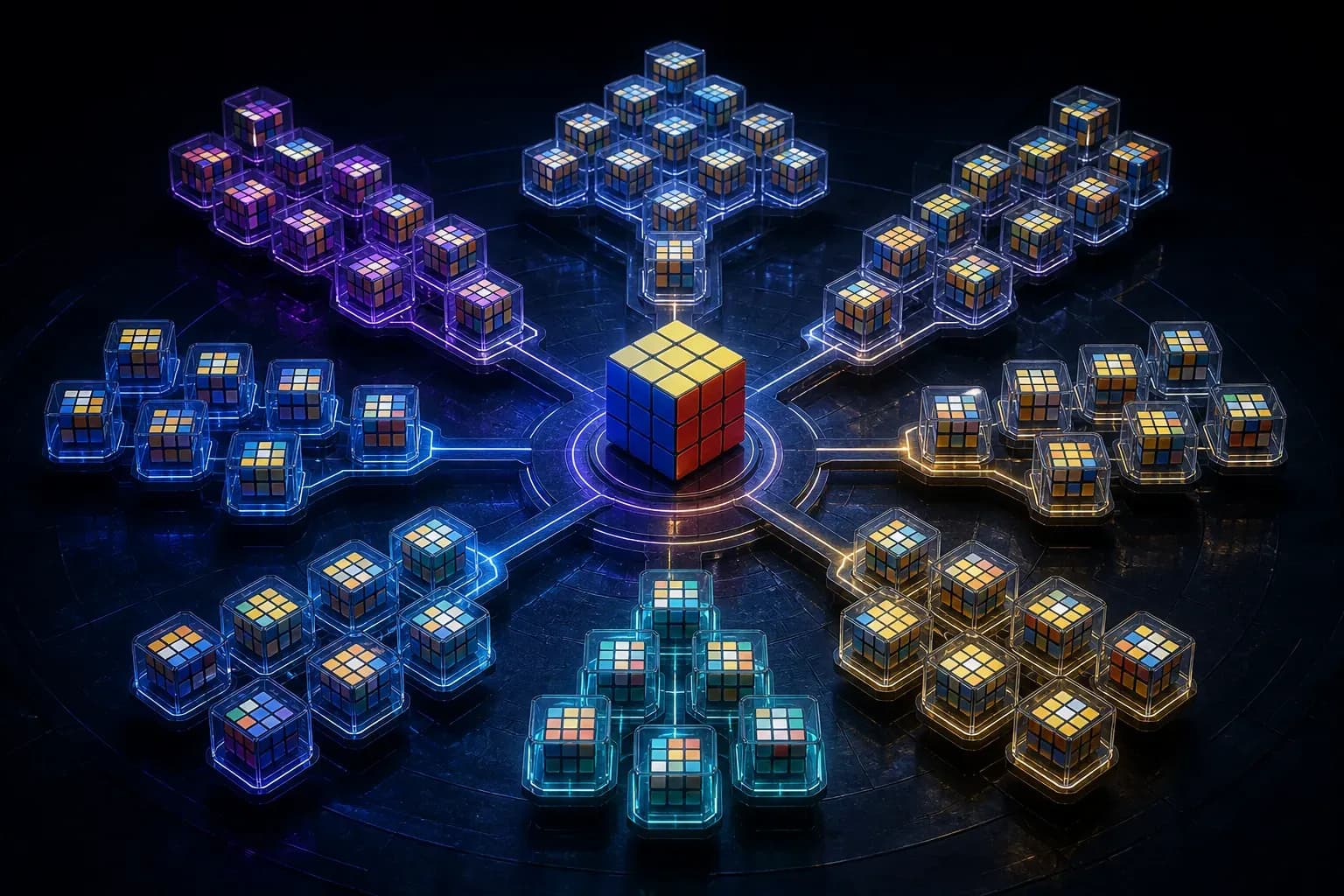
The set splits into 7 subsets by corner orientation: T, U, L, H, Pi, Sune, and Antisune. Each subset has around 72 cases — so "learning ZBLL" really means learning a series of manageable subsets, not one monolithic wall.
Should you learn it? An honest answer
- Averaging over 20 seconds: no. Full PLL, full OLL, and lookahead give far more speed per hour of practice.
- Sub-15 to sub-18 with full OLL/PLL: start COLL (42 cases, corners-of-last-layer when edges are oriented) — it is the natural on-ramp and useful immediately.
- Sub-13 and hunting tenths: yes, ZBLL subsets start paying off, saving roughly a second on applicable solves.
- Any level, but you love algorithms: also yes — plenty of cubers learn ZBLL sets because collecting them is fun. That is a legitimate reason.
The learning path: COLL → T → U → the rest
Start with COLL to build the recognition habit (reading corner orientation + permutation in one glance). Then take ZBLL T and U — their recognition is easiest and their algorithms are the most ergonomic. Expect a subset to take 1–2 months at a sustainable pace.
Recognition deserves half your practice time: top ZBLL users read the case from two sides in a fraction of a second. Practice case identification separately from execution.
Retention is the whole battle
The reason most ZBLL attempts die is math: individual cases appear once in hundreds of solves, so natural practice never reinforces them. Without scheduled reviews, cases decay faster than scrambles resurface them.
Spaced repetition inverts this — every case gets reviewed exactly when you are about to forget it, regardless of scramble luck. It is the only reliable way to hold hundreds of algorithms long-term.
Learning ZBLL with CuberPal
CuberPal ships one of the few complete mobile ZBLL systems — the full library plus the drilling engine to retain it:
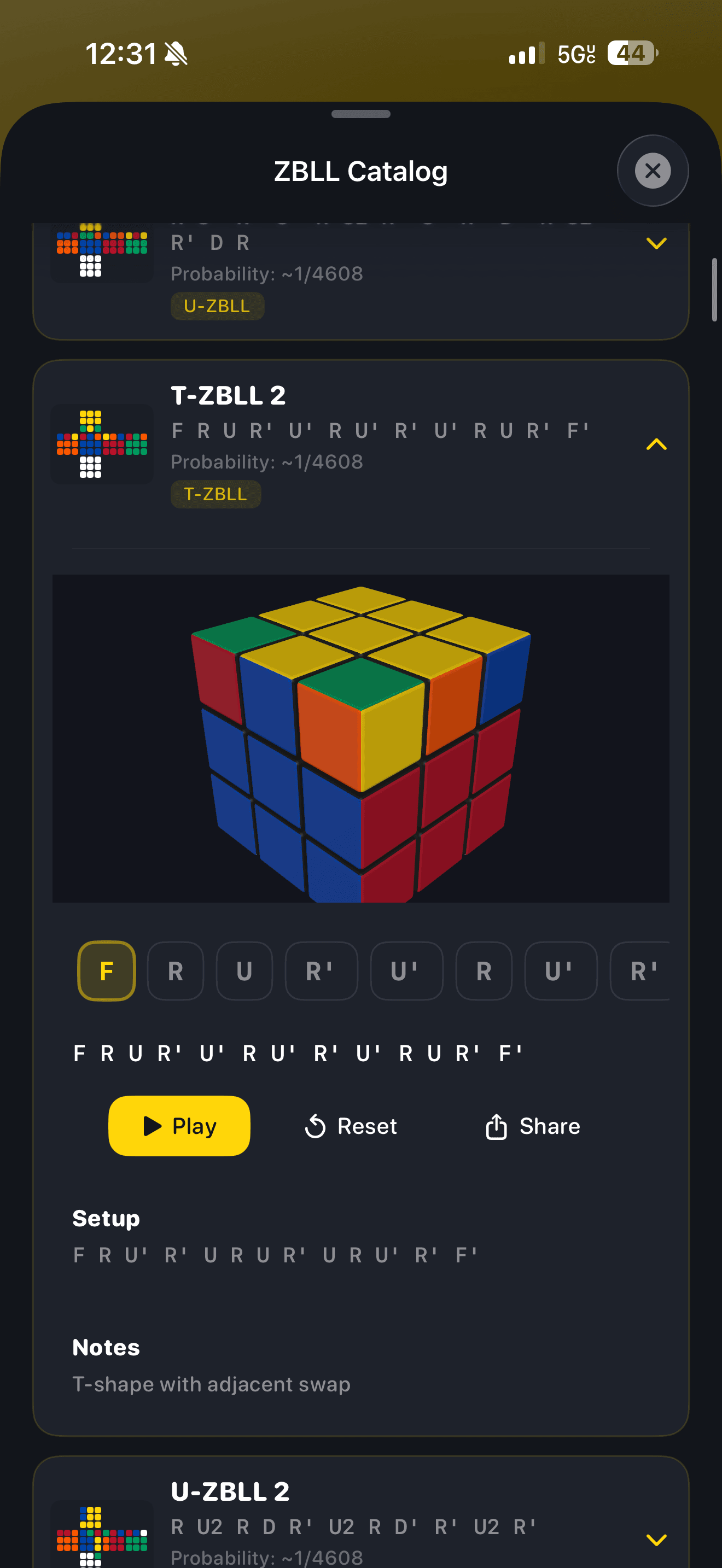
- Open the ZBLL catalogue: 493 cases across all 7 subsets, each with a 3D cube preview, setup scramble, and algorithm alternatives.
- Start with the COLL catalogue (42 cases) to build recognition before committing to full subsets.
- Mark cases as Learned to track completion per subset, and filter to see what is still in progress.
- Configure spaced repetition sessions scoped to the subsets you are learning — daily drills hit the cases you are about to forget.
- Tap through any algorithm on the 3D cube when a case feels shaky, and share progress with your cubing friends for accountability.
Turn this into practice
Use CuberPal to connect these steps to solve analysis, focused drills, lessons, and spaced repetition.
Frequently asked questions
How many algorithms is ZBLL?
493 cases across 7 subsets (T, U, L, H, Pi, Sune, Antisune), each subset containing roughly 72 cases. Most learners take it one subset at a time over many months.
What speed should I be before learning ZBLL?
The usual advice is sub-15 with full OLL and PLL already solid. Before that, lookahead and F2L efficiency return far more time. COLL (42 cases) is the standard stepping stone.
Is COLL the same as ZBLL?
COLL is a subset of the same idea: when last-layer edges are oriented, COLL solves the corners in one algorithm (leaving an edge permutation), while ZBLL solves everything. Learn COLL first — its 42 cases teach you the recognition system ZBLL builds on.
Sources and fact checks
- [1]Speedsolving.com Wiki: ZBLL — Reference for ZBLL prerequisites, recognition, and the 493-case count including PLL.
- [2]Cepeda et al.: Distributed practice in verbal recall tasks — Peer-reviewed quantitative review supporting spaced rather than massed review for long-term retention; cubing drill recommendations are editorial applications.
- [3]Apple App Store: Cubing Timer & Coach: CuberPal — Current product listing for CuberPal timer, analysis, coaching, algorithm practice, and cube-solver capabilities.