
How to Learn Full PLL

Quick answer
Learn full PLL in probability order, not alphabetical order: U perms and T perm first, then J, A, and R perms, then G perms, and finally the rare E, N, and V cases. Add 2–3 algorithms per week, drill daily with spaced repetition, and practice recognizing each case from its headlights and blocks. Most cubers finish in 4–8 weeks.
On this pageLearn cases in probability order
PLL — permuting the last layer in a single algorithm — is the best return on investment in speedcubing. It is only 21 algorithms, you execute exactly one of them in every solve, and upgrading from 2-look to full PLL cuts 1.5–3 seconds off your average.
The reason people stall is not learning the algorithms; it is forgetting them. Here is the order and the retention system that gets you through all 21.
Learn cases in probability order
Some PLL cases show up constantly, others almost never. Learn the frequent ones first and you get most of the speed benefit after just a handful:
- First: U perms (Ua, Ub) and T perm — edges-only and the most common cases you will see.
- Next: J perms (Ja, Jb), A perms (Aa, Ab), and R perms (Ra, Rb) — fast, ergonomic corner+edge cases.
- Then: H and Z perms (edges only), F and Y perms.
- Then: the four G perms — everyone dreads them, but they are just four related algorithms; learn one per week.
- Last: E, N (Na, Nb), and V perms — the rarest cases.
Recognition is half the skill
Executing a T perm in 1.2 seconds is useless if you spend two seconds figuring out that it is a T perm. Learn each case by its side-sticker pattern: headlights (two matching corner stickers framing a different edge), solid blocks, and opposite-color pairs.
A good habit: after finishing OLL, read only two side faces. Every PLL can be identified from two adjacent sides — practicing this makes recognition effectively instant.
The retention system: spaced repetition
Cramming five algorithms in a day guarantees losing three by next week. Memory research is unambiguous: reviews spaced at increasing intervals (1 day, 3 days, 7 days) beat massed repetition by a wide margin.
The practical routine: each day, drill your newest algorithms plus whichever older ones are due for review. Fumbled cases come back sooner; solid ones get spaced out. Ten minutes a day of this holds the entire set permanently.
Learning full PLL with CuberPal
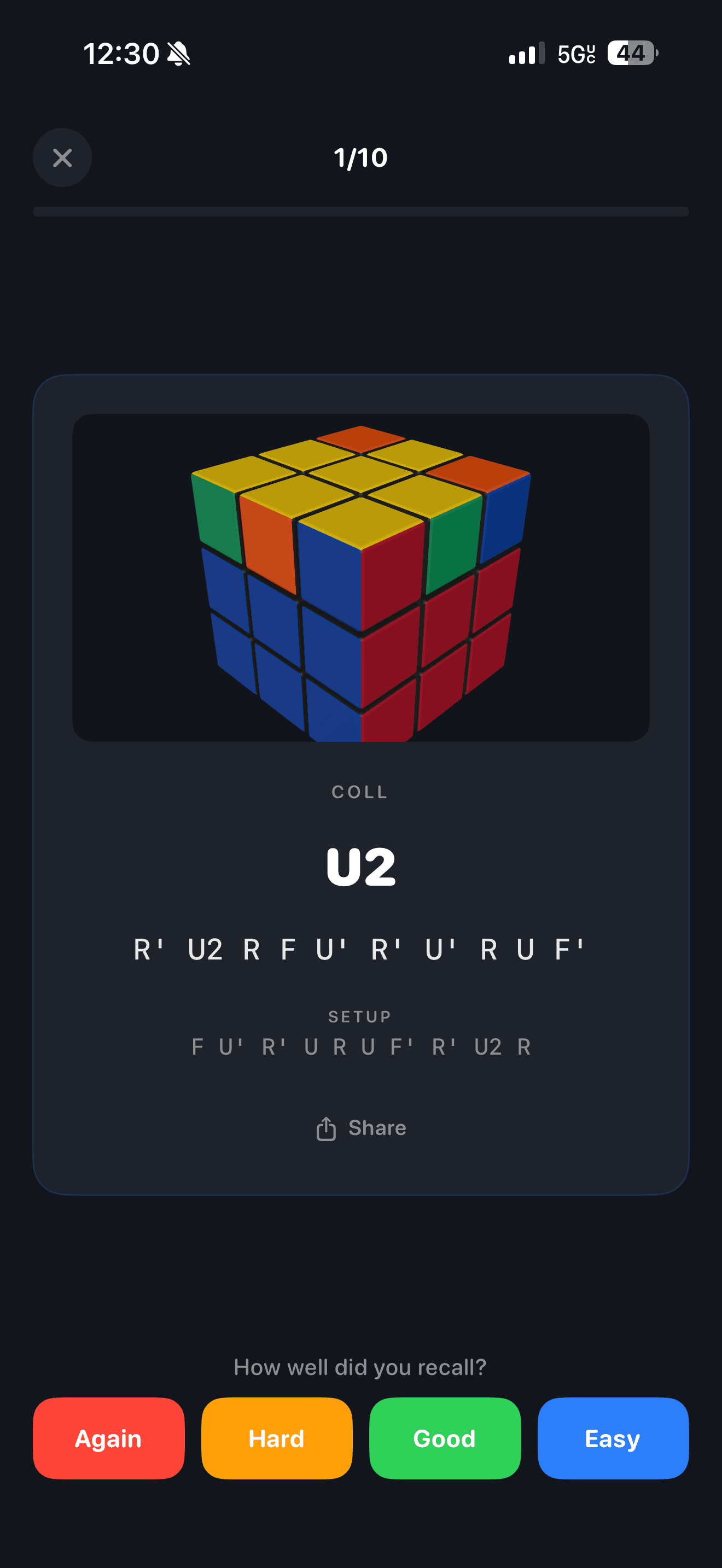
CuberPal packages the whole system — catalogue, recognition previews, and the spaced repetition engine:
- Open the PLL catalogue: all 21 cases with 3D cube previews, standard notation, and alternative algorithms if the mainstream one does not fit your fingertricks.
- Tap through each algorithm move by move on the 3D cube to learn it correctly the first time.
- Mark each case as Learning or Learned to see your progress through the set at a glance.
- Run daily spaced repetition sessions — CuberPal automatically drills the cases you struggle with more often.
- Verify the payoff with AI solve analysis: watch your PLL phase time drop as 2-look turns into 1-look.
Turn this into practice
Use CuberPal to connect these steps to solve analysis, focused drills, lessons, and spaced repetition.
Frequently asked questions
How long does it take to learn full PLL?
At 2–3 new algorithms per week with daily spaced repetition reviews, most cubers learn all 21 PLLs in 4–8 weeks — including recognition, which matters as much as execution.
Is full PLL worth it before full OLL?
Yes, always learn full PLL first. It is 21 algorithms versus 57, and the time saved per solve is larger. Nearly every speedcuber follows the order: 2-look everything → full PLL → full OLL.
What is the hardest PLL to learn?
Most cubers vote for the G perms (Ga, Gb, Gc, Gd) because there are four of them with similar-looking cases, plus the N perms for being long. Learning G perms one per week with extra recognition drills removes the pain.
Sources and fact checks
- [1]Speedsolving.com Wiki: PLL — Reference for permutation of the last layer and its 21 cases.
- [2]Cepeda et al.: Distributed practice in verbal recall tasks — Peer-reviewed quantitative review supporting spaced rather than massed review for long-term retention; cubing drill recommendations are editorial applications.
- [3]Apple App Store: Cubing Timer & Coach: CuberPal — Current product listing for CuberPal timer, analysis, coaching, algorithm practice, and cube-solver capabilities.