
How to Learn OLL (Without Drowning in 57 Cases)
Quick answer
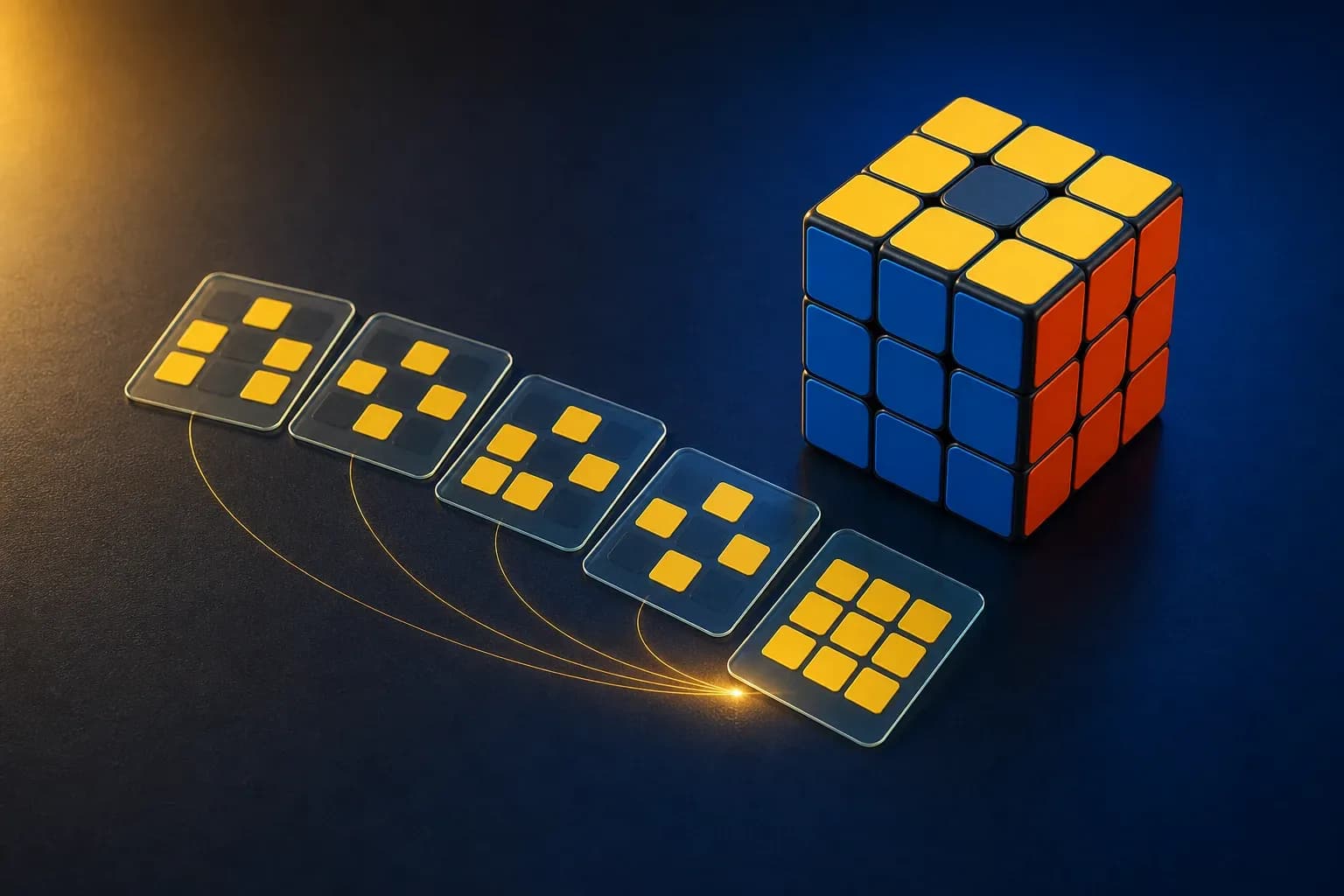
Start with 2-look OLL: orient edges with one of 3 short algorithms, then corners with one of 7 — only 10 algorithms total. Move to full OLL (57 cases) only after full PLL, learning by visual groups: crosses, dots, T/W/L shapes, and so on. Grouping plus spaced repetition makes the full set take weeks, not years.
On this pageStage 1: 2-look OLL (10 algorithms)
OLL — making the whole top face one color in a single look — is the biggest algorithm set in standard CFOP. The number 57 scares people, but nobody learns them as 57 separate facts.
Here is the staged approach: 10 algorithms gets you solving, groups and spaced repetition get you to the full set.
Stage 1: 2-look OLL (10 algorithms)
Split orientation into two steps. First orient the edges — you will see a dot, an L-shape, or a line, each fixed by a short algorithm (3 to learn). Then orient the corners with one of the 7 corner cases (Sune, Antisune, H, Pi, T, U, L).
These 10 algorithms handle every OLL situation on the cube. Combined with 2-look PLL, this is the standard "4-look last layer" every CFOP solver starts with.
Stage 2: full OLL, learned in visual groups
When full PLL is done and you are chasing sub-20 to sub-15, finish OLL by family — cases in the same group share recognition patterns and often similar algorithms:
- Cross cases (edges already oriented) — you know these from 2-look; they are done.
- T, W, and L shapes — short, fast algorithms, great early wins.
- Square and small-lightning shapes — many are just Sune variants.
- C and I shapes, fish shapes, knight-move shapes — mid-difficulty groups.
- Dot cases (no edges oriented) — the longest algorithms; save them for last.
Keeping 57 algorithms alive
The failure mode of full OLL is decay: you learn the dot cases, stop seeing them for a week (they are rare), and they evaporate. Spaced repetition fixes exactly this — rare cases get scheduled reviews so scramble luck does not decide what you remember.
Track which cases are Learned versus Learning, and drill the weak ones daily. Ten focused minutes beats an hour of hoping the right cases come up in solves.
Learning OLL with CuberPal
CuberPal covers both stages — the beginner 10 and the full 57 — with the tracking to survive the long tail:
- Follow the OLL learning module: structured lessons that start with 2-look edge and corner orientation.
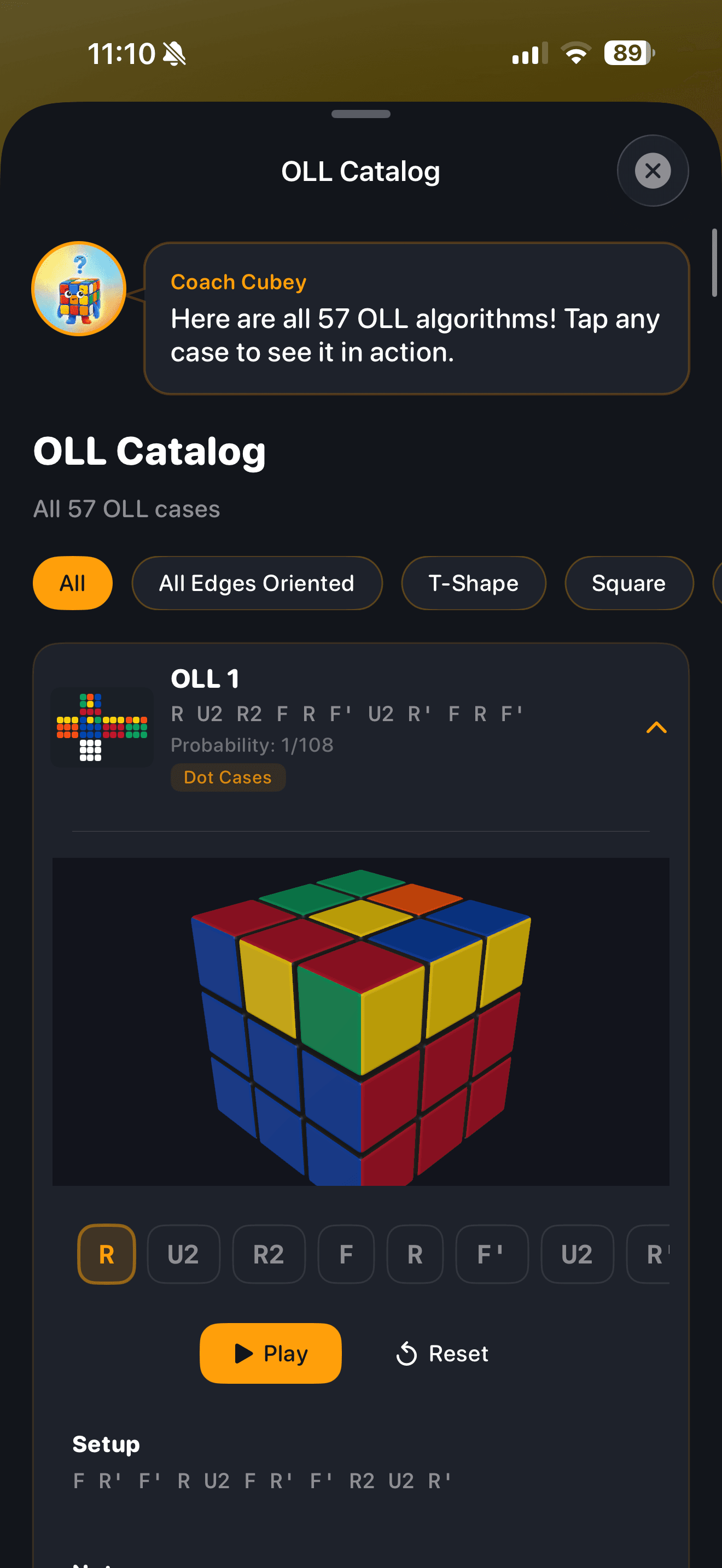
- Browse all 57 cases in the OLL catalogue with 3D cube previews and tap-through playback for each algorithm.
- Mark cases as Learned as you go and filter by Learning to see exactly what is left.
- Let spaced repetition schedule daily drills weighted toward your fumbled and rarely-seen cases.
- Confirm with AI analysis that your OLL phase time is dropping — and ask Cubey which OLL group to learn next.
Turn this into practice
Use CuberPal to connect these steps to solve analysis, focused drills, lessons, and spaced repetition.
Frequently asked questions
Should I learn full OLL or full PLL first?
Full PLL first, always. It is 21 algorithms versus 57 and saves more time per solve. Full OLL is the right project when you are between 20 and 15 seconds.
How long does full OLL take to learn?
Learning 3–4 new cases per week with spaced repetition, roughly 3–5 months. Many cubers spread it out longer, prioritizing common and fast cases first — that is perfectly fine.
Is 2-look OLL enough for sub-20?
Yes. Plenty of cubers hit sub-20 with 2-look OLL. Full OLL saves roughly a second per solve and becomes important on the road to sub-15.
Sources and fact checks
- [1]Speedsolving.com Wiki: OLL — Reference for orientation of the last layer and its 57 non-solved cases.
- [2]Cepeda et al.: Distributed practice in verbal recall tasks — Peer-reviewed quantitative review supporting spaced rather than massed review for long-term retention; cubing drill recommendations are editorial applications.
- [3]Apple App Store: Cubing Timer & Coach: CuberPal — Current product listing for CuberPal timer, analysis, coaching, algorithm practice, and cube-solver capabilities.