
How Long Does It Take to Learn CFOP?
Quick answer
Most cubers can learn the basic CFOP sequence in a few weeks with regular practice, but becoming fluent is a longer project. Plan roughly 1–2 weeks for Cross fundamentals, 2–4 weeks for basic F2L, and another 2–3 weeks for 2-look OLL and PLL as starting ranges; expect several months for strong recognition, smooth execution, and gradual full OLL and PLL. These are planning ranges, not promises: your starting method, practice consistency, and definition of “learned” matter more than the calendar.
On this pageWhat counts as learning CFOP?
The honest answer is that “learning CFOP” can mean three different milestones. You might mean understanding the four stages, finishing a solve with beginner-friendly 2-look last-layer algorithms, or recognizing and executing the full system smoothly in an average. Those milestones are far apart. A realistic learner can understand the structure and start a basic version in weeks, while fluent F2L and a large last-layer library usually need months of repeated practice. Treat the estimates below as a planning map, not a promise that a certain number of days will produce a certain average.
What counts as learning CFOP?
CFOP stands for Cross, First Two Layers, Orientation of the Last Layer, and Permutation of the Last Layer. Cross and F2L are primarily planning, piece recognition, and movement skills; they are not simply two fixed algorithm lists. OLL and PLL are the last-layer stages, and you can begin with 2-look versions before learning full sets. J Perm describes 2-look OLL as 3 edge algorithms plus 7 corner algorithms, and 2-look PLL as 2 corner algorithms plus 4 edge algorithms. That is 16 algorithms for a complete beginner-friendly version, compared with 57 OLL and 21 PLL cases for full last layer. You do not need all 78 cases before you can honestly say you are using CFOP.
A useful definition is functional rather than numerical: you have learned a stage when you can recognize what to do, execute it without a guide, and recover from ordinary cases in a mixed solve. Memorizing a sequence once is not the same as owning the skill. If you want the full method overview first, read the CuberPal CFOP guide at https://www.cuberpal.com/guides/learn-cfop-method. It explains the same progression in teaching order; this article focuses on the calendar and practice expectations.
A realistic stage-by-stage timeline
One published CFOP learning roadmap gives these starting ranges: about 1–2 weeks for Cross, 2–4 weeks for basic F2L, and 2–3 weeks for 2-look OLL and PLL. The same source describes full CFOP as a 6–12 month project on average, with 30–60 minutes of daily practice associated with a possible 3–6 month path toward a consistent sub-20 average. Those numbers are estimates from a general guide, not a controlled study or a guarantee. They are most useful as a way to notice whether your plan is too compressed or too vague. Someone practicing ten focused minutes a few times a week should not compare their calendar with someone practicing an hour every day.
Use the ranges as checkpoints rather than deadlines. By the end of a Cross block, you might aim to plan a simple bottom cross during inspection and execute it without looking underneath. During a basic F2L block, aim to pair corner and edge pieces deliberately, even if your times get worse at first. During a 2-look last-layer block, aim to identify the correct substep and finish without opening a tutorial. If a checkpoint is not stable, extend that block. Extending practice is cheaper than layering new algorithms on top of a skill you cannot yet recognize.
Cross: roughly one to two weeks to build the habit
Cross is often the shortest CFOP stage to understand, because you already know how to make a cross from a beginner method. The change is doing it efficiently, on the bottom, and with a plan before the timer starts. Spend short sessions inspecting a scramble, locating the four cross edges, and predicting the order in which you will solve them. Then execute slowly enough to keep the planned sequence in your head. A useful early goal is not a two-second cross; it is a cross you can plan and finish without pauses or unnecessary cube rotations.
Do not spend the entire first week chasing a perfect move count. Record whether your plan was complete, whether the first move was correct, and whether you had to stop to search. If those three answers improve, the skill is advancing even when your full solve time does not. J Perm and other CFOP tutorials emphasize bottom-cross planning, while the CuberPal guide at https://www.cuberpal.com/guides/learn-cfop-method can serve as the next lesson after this short practice block.
F2L: expect the longest early adjustment
F2L is where many learners feel that CFOP has made them slower. Instead of solving a bottom corner and then a middle edge separately, you pair a corner and its matching edge and insert them together. CubeSkills recommends beginning F2L around a one-minute beginner-method average, but readiness is not a hard gate. The important prerequisite is that you can finish a solve and understand where pieces belong. At first, use intuitive pairing and a slow turning pace. Your hands may know the old layer-by-layer sequence while your eyes are trying to track two pieces, so pauses and temporary time increases are normal.
Plan for several weeks before F2L feels automatic, and longer before lookahead becomes reliable. Practice one slot at a time, separate stuck pieces without breaking the cross, and solve slowly while watching for the next pair. Do not rush to memorize every named case. The CuberPal F2L tutorial at https://www.cuberpal.com/guides/how-to-learn-f2l explains the beginner route, and https://www.cuberpal.com/blog/how-many-f2l-algorithms explains why the common 41-case list is a reference rather than a requirement for starting.
2-look OLL and PLL: weeks, not one afternoon
The 2-look versions make CFOP finishable without asking a beginner to memorize the full last-layer library. A reasonable early goal is to learn a small number of algorithms, attach each one to a visual case, and practice recognition separately from execution. One session can be enough to understand an algorithm, but reliable recall in a random solve usually needs spaced revisits. A two- or three-week block is a useful planning range for 2-look OLL and PLL when you practice regularly; it does not mean every learner will memorize 16 cases in exactly that time.
Learn one case by looking at the pattern, naming the substep, executing slowly, and then testing it from a few different angles. If you forget, return to the case rather than guessing. Full PLL is usually a better next expansion than full OLL because it is a smaller 21-case set. Full OLL adds 57 cases, and both recognition and execution need time to settle. J Perm notes that there is no fixed moment when advanced Cross, F2L, OLL, or PLL must begin; use your own pauses and averages to decide instead of a calendar alone.
Full CFOP: a months-long fluency project
If “full CFOP” means full PLL, full OLL, advanced F2L choices, efficient Cross planning, lookahead, and consistent execution, think in months rather than weeks. The algorithms are only one part of the work. You need to recognize cases from random scrambles, choose a comfortable angle, execute without a regrip that breaks flow, and keep the new skill available while solving everything around it. It is common to know an algorithm intellectually but lose time because recognition or setup is not automatic yet.
Use a small weekly target: add a few cases, review older cases, and put the new cases into complete solves only after slow recognition is dependable. Record the first pause or mistake, not only the final time. The related CuberPal article at https://www.cuberpal.com/blog/cfop-solve-splits helps separate Cross, F2L, OLL, and PLL losses; https://www.cuberpal.com/blog/beginner-method-vs-cfop covers the decision to switch methods. Those pages are different from this timeline: they help you choose or diagnose, while this article sets expectations for the learning curve.
How to make the calendar useful
Use consistent evidence instead of asking whether you are progressing by feeling. Time a comparable set of solves, such as an average of five or twelve, and write down the stage that caused the first pause. A free browser timer at https://www.cuberpal.com/tools/cube-timer can give you fresh scrambles, optional inspection, penalties, and rolling averages for this routine. Keep the same puzzle and method while you compare sessions. If you change your algorithm set, cube, and practice schedule at the same time, the calendar cannot tell you what helped.
A simple four-week cycle is enough to begin. In week one, plan and execute Cross plus a few intuitive F2L pairs. In week two, keep F2L slow and add recognition practice. In week three, review 2-look last-layer cases while timing a small set. In week four, stop adding new material and test retention in mixed solves. Repeat or lengthen the cycle until the skill is stable. Consistency matters more than heroic sessions: a short practice habit you can sustain will beat an ambitious schedule that disappears after three days.
The bottom line
You can start using a basic form of CFOP in a few weeks, but there is no finish line at which everyone is equally “done.” Cross can become familiar quickly; F2L usually needs the most hands-on adjustment; 2-look OLL and PLL can make the method complete without full algorithm sets; and full CFOP fluency is a months-long practice project. Choose the next skill from your solve evidence, keep the ranges flexible, and count reliable recognition and execution as progress even when your average temporarily gets slower.
Continue the learning path
Learn CFOP
Build intuitive F2L before adding a large number of algorithms.
Open this topic clusterTurn this into practice
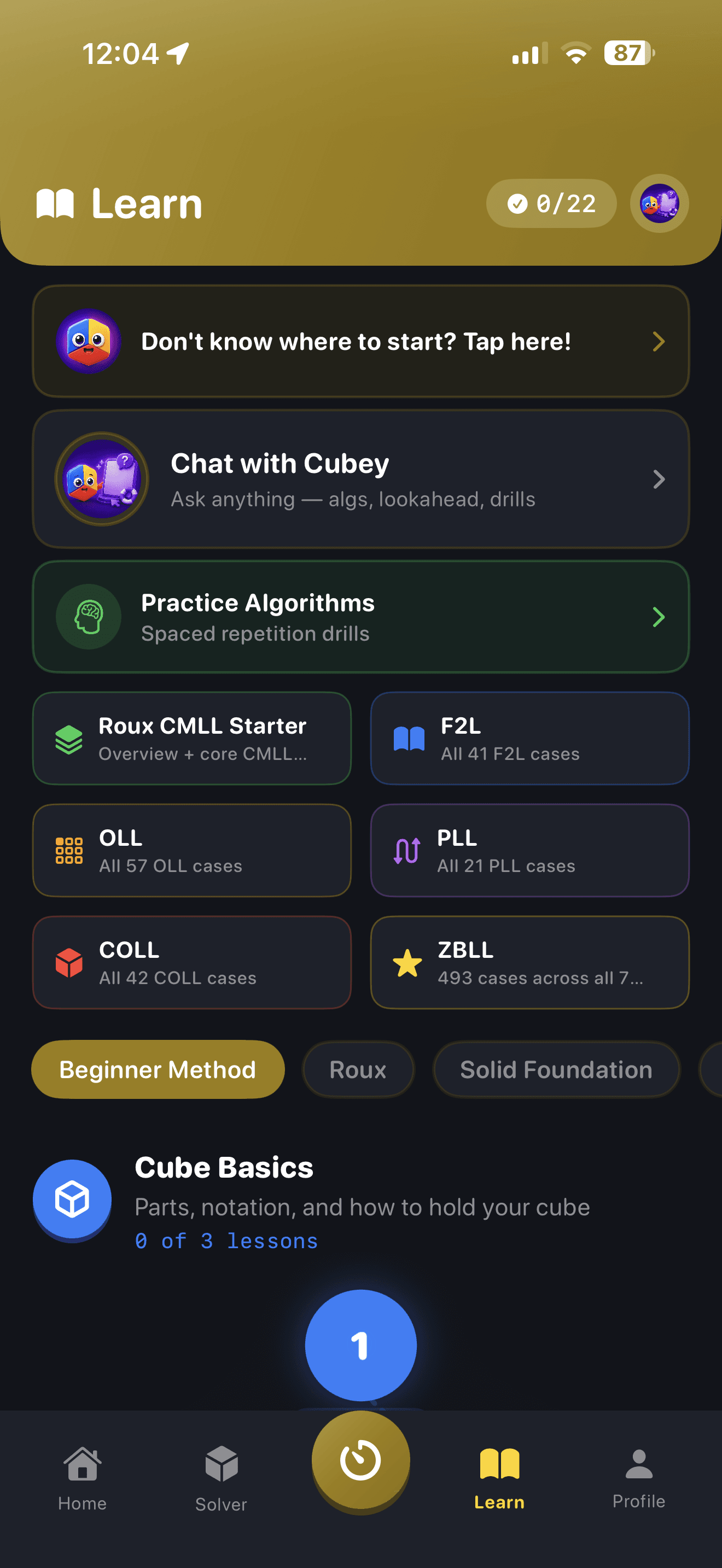
CuberPal combines a WCA-style timer, AI solve analysis, CFOP lessons, algorithm catalogues, spaced repetition, and a camera cube solver so speedcubing advice becomes a daily training loop.
Frequently asked questions
Can I learn CFOP in one week?
You can understand the four stages and learn part of a beginner-friendly 4-look version in a week, especially with prior solving experience. Fluent F2L, reliable recognition, and full OLL and PLL require repeated practice beyond memorizing the outline. Treat one week as an introduction, not a promise of a stable average.
Do I need all 78 CFOP algorithms?
No. Cross and intuitive F2L do not require fixed algorithm lists, and 2-look OLL plus 2-look PLL can finish the last layer with 16 algorithms. Full CFOP commonly refers to 57 OLL and 21 PLL cases, but add those gradually when your recognition and current method justify them.
Why did my time get worse after switching to CFOP?
That is normal because F2L asks your eyes and hands to coordinate a new pairing process. Slow down, protect the cross, and practice one slot or case at a time before judging the switch. Compare several averages rather than one solve, and let the new movement patterns settle.
How many minutes a day should I practice CFOP?
There is no universal minimum, but a consistent short session is more useful than an occasional marathon. One published guide uses 30–60 minutes daily when describing a possible three- to six-month path toward a consistent sub-20 average; treat that as a sourced planning example, not a guarantee.
Sources and fact checks
- [1]J Perm CFOP Speedsolving Method — Supports the four CFOP stages, intuitive F2L, 2-look OLL and PLL algorithm counts, the practice warning, and the absence of a fixed deadline for advanced stages.
- [2]CubeSkills F2L Tutorial — Supports the F2L transition from the beginner method, the corner-edge pairing explanation, and the approximate one-minute readiness guideline.
- [3]Speedcube CFOP Learning Guide — Supports the published planning ranges for Cross, F2L, 2-look last layer, full CFOP, and the 30–60 minute daily practice example.
- [4]Cubelelo CFOP Method Explained — Provides an independent cross-check for the 1–2 week basics estimate, several-month advanced learning frame, and full versus 2-look algorithm scope.
- [5]CuberPal Online Cube Timer — Supports the current product claim that the free browser timer provides scrambles, optional inspection, penalties, and rolling solve averages for practice tracking.