
F2L Algorithms: The Complete Case List for CFOP
Quick answer
Standard F2L has 41 cases. Most of them can be solved intuitively once you understand how a corner and edge pair up. Learn the basic inserts and the cases you can't work out on your own first, then use this list as a reference instead of memorizing all 41 at once.
On this pageHow F2L cases are grouped
- How F2L cases are grouped
- Basic inserts (the cases everything reduces to)
- Corner and edge in the top layer
- Corner in the top layer, edge in the middle layer
- Corner in the bottom slot, edge in the top layer
- Corner and edge both in the slot (solved but wrong)
- Which F2L algorithms to learn first
- How to practice F2L algorithms without memorizing a list
- How CuberPal helps with F2L
This is a reference for every standard F2L case. If you're still learning how pairs form, start with how to learn F2L; the algorithms make more sense once you can see why they work.
Every algorithm is for the front-right slot, with the cross on the bottom. "Front color" and "right color" mean the colors of the front and right centers. For a refresher on R, U' and r, see our Rubik's Cube notation guide.
If an algorithm starts with a U turn, the cue describes the case before that turn.
How F2L cases are grouped
Each F2L case is defined by two things: where the corner and edge are, and which way they face. The corner can be in the top layer or already in the slot. The edge can be in the top layer or already in the slot. The corner's white sticker can face up, front or right (or down, in the slot), and the edge can be oriented either way.
Put those together and you get 41 distinct cases, not counting the one where the pair is already solved. If you want the full reasoning behind that number, read how many F2L algorithms there are. On this page the 41 cases are grouped like this:
- Basic inserts: 4 cases where the pair is one short move from going in.
- Corner and edge in the top layer, white facing the side: 12 cases.
- Corner and edge in the top layer, white facing up: 8 cases.
- Corner in the top layer, edge in the middle layer: 6 cases.
- Corner in the bottom slot, edge in the top layer: 6 cases.
- Corner and edge both in the slot: 5 cases.
The case numbers follow SpeedCubeDB's numbering, so you can cross-check any case there.
Basic inserts (the cases everything reduces to)
These four are the endpoints of almost every other case. Whatever you do intuitively, you are usually setting up one of these. Learn them until you don't have to think.
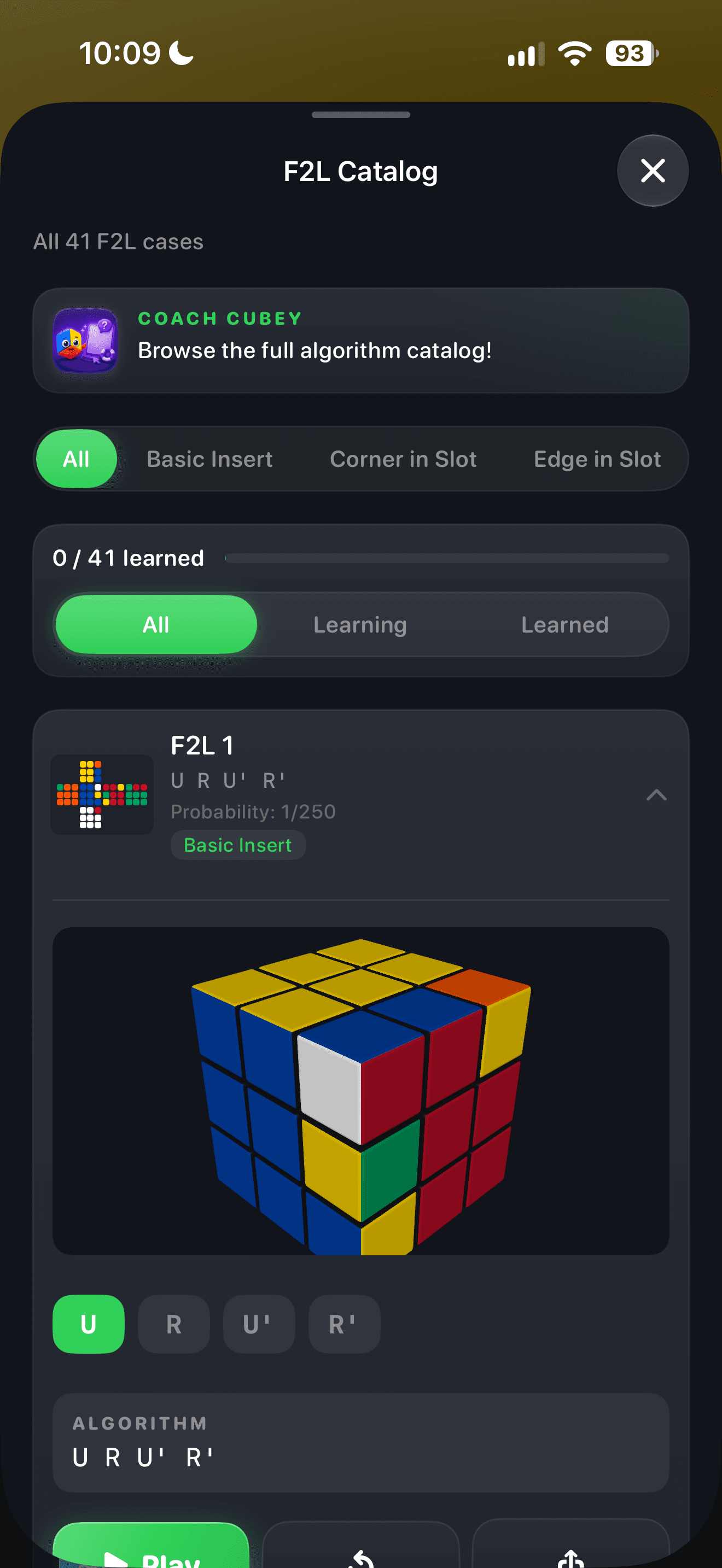
F2L 1: Corner above the slot with white facing front; edge on the right side of the top layer (UR) with the front color on top. Algorithm: U R U' R'
F2L 2: Corner above the slot with white facing right; edge at the front of the top layer (UF) with the right color on top. Algorithm: F R' F' R
F2L 3: Corner above the slot with white facing front; edge on the left side of the top layer (UL) with the right color on top. Algorithm: F' U' F
F2L 4: Corner above the slot with white facing right; edge at the back of the top layer (UB) with the front color on top. Algorithm: R U R'
Corner and edge in the top layer
This is the biggest group. Both pieces are in the top layer, and the job is to pair them up and then insert. The trick is to recognize them quickly from the corner's white sticker and where the edge is.
Corner white sticker facing the side, pieces split
The corner and edge are separated in the top layer. Most of these solutions move the edge into a spot where it pairs naturally with the corner, then finish with a basic insert.
F2L 5: Corner above the slot with white facing front; edge at the back of the top layer (UB) with the front color on top. Algorithm: U' R U R' U2 R U' R'
F2L 6: Corner above the slot with white facing right; edge on the left side of the top layer (UL) with the right color on top. Algorithm: U' r U' R' U R U r'
F2L 7: Corner above the slot with white facing front; edge on the left side of the top layer (UL) with the front color on top. Algorithm: U' R U2 R' U' R U2 R'
F2L 8: Corner above the slot with white facing right; edge at the back of the top layer (UB) with the right color on top. Algorithm: r' U2 R2 U R2 U r
F2L 9: Corner above the slot with white facing front; edge at the back of the top layer (UB) with the right color on top. Algorithm: U' R U' R' U F' U' F
F2L 10: Corner above the slot with white facing right; edge on the left side of the top layer (UL) with the front color on top. Algorithm: U' R U R' U R U R'
Corner white sticker facing the side, pieces next to each other
Here the edge sits right next to the corner or directly in front of it. Some of these are already paired the wrong way, so you split them and rebuild the pair.
F2L 11: Corner above the slot with white facing front; edge on the right side of the top layer (UR) with the right color on top. Algorithm: U' R U2 R' U F' U' F
F2L 12: Corner above the slot with white facing right; edge at the front of the top layer (UF) with the front color on top. Algorithm: R U' R' U R U' R' U2 R U' R'
F2L 13: Corner above the slot with white facing front; edge at the front of the top layer (UF) with the right color on top. Algorithm: y' U R' U R U' R' U' R
F2L 14: Corner above the slot with white facing right; edge on the right side of the top layer (UR) with the front color on top. Algorithm: U' R U' R' U R U R'
F2L 15: Corner above the slot with white facing front; edge at the front of the top layer (UF) with the front color on top. Algorithm: M U r U' r' U' M'
F2L 16: Corner above the slot with white facing right; edge on the right side of the top layer (UR) with the right color on top. Algorithm: R U' R' U2 F' U' F
Corner white sticker facing up
When white faces up, the corner can't pair with the edge directly. You first turn it so white faces the side, which is why these algorithms are a bit longer.
F2L 17: Corner above the slot with white facing up; edge on the right side of the top layer (UR) with the front color on top. Algorithm: R U2 R' U' R U R'
F2L 18: Corner above the slot with white facing up; edge at the front of the top layer (UF) with the right color on top. Algorithm: y' R' U2 R U R' U' R
F2L 19: Corner above the slot with white facing up; edge at the back of the top layer (UB) with the front color on top. Algorithm: U R U2 R' U R U' R'
F2L 20: Corner above the slot with white facing up; edge on the left side of the top layer (UL) with the right color on top. Algorithm: y' U' R' U2 R U' R' U R
F2L 21: Corner above the slot with white facing up; edge on the left side of the top layer (UL) with the front color on top. Algorithm: U2 R U R' U R U' R'
F2L 22: Corner above the slot with white facing up; edge at the back of the top layer (UB) with the right color on top. Algorithm: r U' r' U2 r U r'
F2L 23: Corner above the slot with white facing up; edge at the front of the top layer (UF) with the front color on top. Algorithm: U R U' R' U' R U' R' U R U' R'
F2L 24: Corner above the slot with white facing up; edge on the right side of the top layer (UR) with the right color on top. Algorithm: F U R U' R' F' R U' R'
Corner in the top layer, edge in the middle layer
The edge is already in the slot, either placed correctly or flipped. You take it out together with the corner, pair them, and put them back in.
F2L 31: Corner above the slot with white facing up; edge in the slot, flipped. Algorithm: U' R' F R F' R U' R'
F2L 32: Corner above the slot with white facing up; edge in the slot, placed correctly. Algorithm: U R U' R' U R U' R' U R U' R'
F2L 33: Corner above the slot with white facing front; edge in the slot, placed correctly. Algorithm: U' R U' R' U2 R U' R'
F2L 34: Corner above the slot with white facing right; edge in the slot, placed correctly. Algorithm: U R U R' U2 R U R'
F2L 35: Corner above the slot with white facing front; edge in the slot, flipped. Algorithm: U' R U R' U F' U' F
F2L 36: Corner above the slot with white facing right; edge in the slot, flipped. Algorithm: U F' U' F U' R U R'
Corner in the bottom slot, edge in the top layer
The corner is already in the slot but the edge is still on top. If the corner is twisted, you pull it out while pairing it with the edge.
F2L 25: Corner in the slot with white on the bottom; edge on the right side of the top layer (UR) with the front color on top. Algorithm: U' R' F R F' R U R'
F2L 26: Corner in the slot with white on the bottom; edge at the front of the top layer (UF) with the right color on top. Algorithm: U R U' R' F R' F' R
F2L 27: Corner in the slot with white facing front; edge on the right side of the top layer (UR) with the front color on top. Algorithm: R U' R' U R U' R'
F2L 28: Corner in the slot with white facing right; edge at the front of the top layer (UF) with the right color on top. Algorithm: R U R' U' F R' F' R
F2L 29: Corner in the slot with white facing front; edge at the front of the top layer (UF) with the right color on top. Algorithm: R' F R F' U R U' R'
F2L 30: Corner in the slot with white facing right; edge on the right side of the top layer (UR) with the front color on top. Algorithm: R U R' U' R U R'
Corner and edge both in the slot (solved but wrong)
Both pieces are in the right slot, but one or both are twisted or flipped. Many cubers find them hard to solve efficiently by feel.
F2L 37: Corner in the slot with white on the bottom; edge in the slot, flipped. Algorithm: R2 U2 F R2 F' U2 R' U R'
F2L 38: Corner in the slot with white facing front; edge in the slot, placed correctly. Algorithm: R U' R' U' R U R' U2 R U' R'
F2L 39: Corner in the slot with white facing right; edge in the slot, placed correctly. Algorithm: R U' R' U R U2 R' U R U' R'
F2L 40: Corner in the slot with white facing front; edge in the slot, flipped. Algorithm: r U' r' U2 r U r' R U R'
F2L 41: Corner in the slot with white facing right; edge in the slot, flipped. Algorithm: R U' R' r U' r' U2 r U r'
Which F2L algorithms to learn first
You don't need to memorize all 41 to get faster. A common order:
- The four basic inserts, until they're automatic.
- The cases you can't solve intuitively. For many cubers that means the "both pieces in the slot" group and some of the white-facing-up cases. If you find yourself freezing on a case, that's the one to learn.
- Cases where your intuitive solution needs a cube rotation. An algorithm can often skip it; see rotationless F2L.
- Cases where you keep getting stuck. If a pair keeps refusing to come together, see how to fix a stuck F2L pair.
Once the basics feel easy, you can also look at pseudoslotting, where you solve a pair into a different slot on purpose to save moves.
How to practice F2L algorithms without memorizing a list
The aim is to see a case and know what to do without stopping:
- Do slow solves that never pause, tracking the next pair. That's the core of F2L look-ahead.
- Learn why each algorithm pairs and inserts, so you remember it and can adapt it to other slots. See how to memorize cube algorithms.
- Drill recognition: set up a case, name it, then solve it.
- Practice two or three cases at a time, then work them into full solves. An algorithm trainer helps.
- Keep your finger tricks clean; execution matters as much as knowing the moves.
To see whether F2L is really where your time goes, check your CFOP solve splits. Use our scramble generator and cube timer to keep practice honest.
How CuberPal helps with F2L
CuberPal is a speedcubing timer and coach:
- See how long each F2L pair takes and where your lookahead breaks down.
- Learn F2L, OLL and PLL algorithms with spaced-repetition practice and focused drills.
- Time your solves and get a weekly recap of your progress and what to work on next.
If you're working through the whole method, the CFOP learning path shows where F2L fits. For the last layer, see our CFOP algorithms reference.
Find the F2L cases that slow you down with CuberPal.
Continue the learning path
Learn CFOP
Build intuitive F2L before adding a large number of algorithms.
Open this topic clusterTurn this into practice
CuberPal combines a WCA-style timer, AI solve analysis, CFOP lessons, algorithm catalogues, spaced repetition, and a camera cube solver so speedcubing advice becomes a daily training loop.
Frequently asked questions
How many F2L algorithms are there?
Standard F2L has 41 cases for a single slot, not counting the solved case. You don't need an algorithm for every one, because most can be solved intuitively. See how many F2L algorithms there are for the full explanation.
Should I learn F2L algorithms or intuitive F2L?
Start with intuitive F2L. Once you understand how pairs form, learn algorithms for the cases you can't solve well by feel, or where an algorithm saves a rotation. Many fast solvers use a mix of both.
What is the hardest F2L case?
It depends on the solver, but many cubers find the cases where both pieces are already in the slot, and some white-facing-up cases, the least intuitive. They are worth learning as algorithms.
Sources and fact checks
- [1]SpeedCubeDB: 3x3 F2L algorithms — Case numbering, grouping and the front-right-slot algorithms; all 41 checked on a cube simulator 2026-11-04.
- [2]Speedsolving.com Wiki: First Two Layers — Supports the conventional 41 last-slot F2L case count.
- [3]Cube Timer & Coach: CuberPal on the App Store — Supports the CuberPal feature statements (listing checked 2026-11-04).
- [4]CuberPal on Google Play — Supports the CuberPal feature statements (listing checked 2026-11-04).
Keep improving
How to Learn F2L: A Beginner's Tutorial
Read next BlogHow Many F2L Algorithms Do You Need?
Read next BlogRotationless F2L: How to Reduce Cube Rotations
Read next GuideHow to Improve F2L Lookahead
Read next BlogHow Long Does It Take to Learn CFOP?
Read next BlogWhat Is CFOP? The Cross, F2L, OLL and PLL Method
Read next