Rotationless F2L: How to Reduce Cube Rotations
By CuberPal Editorial Team · Updated 2026-07-29 · Editorial standards
Quick answer
Rotationless F2L means solving more F2L pairs from your current grip instead of turning the whole cube before every insert. Start by noticing which rotations are automatic, learn to use open slots and alternative angles, and keep only rotations that make the next decision genuinely easier. Do not try to memorize every F2L case at once.
What rotationless F2L actually means
F2L solves the first two layers after the cross by pairing a corner with its matching edge and inserting that pair into one of four slots. Rotationless F2L does not mean that a cube rotation is forbidden. It means you stop rotating by reflex and first ask whether the pair can be set up or inserted from the grip you already have. The goal is a clearer, more continuous solve, not a rigid zero-rotation scorecard.
That distinction matters because a rotation can occasionally make a difficult case simpler or make the next pair easier to see. Treat each rotation as a choice with a purpose. If the only reason is that you always turn the cube before using a familiar trigger, it is a good candidate to replace. If the rotation creates a clean, readable next step, keep it for now and revisit it after your basic F2L is more automatic.
Find the rotations that are costing you
Use a short set of ordinary solves as an audit. Do not try to fix anything during the first pass. After each solve, write down the F2L pair where you rotated and what caused it: the target slot was behind you, the edge was awkward, the pair was split, or you simply lost track of the next move. A small honest list is more useful than an ambitious goal to solve every pair from the front immediately.
Then replay one example slowly. Freeze just before the rotation and identify the pieces, the open slots, and the moves that would preserve your current view. Try one alternative only. Perhaps a U move puts the pair in a visible angle; perhaps an empty slot lets you move a piece out and restore it later. If the alternative adds confusion or several extra moves, reject it. The exercise is about making a better decision, not forcing a trick.
- Mark the pair number, not just the total rotations, so patterns become visible.
- Separate a planned rotation from one that happened because recognition broke down.
- Keep one representative scramble or video clip to compare after a week of practice.
Build alternatives without collecting a giant algorithm list
Start with intuition, not a spreadsheet of F2L algorithms. If you can explain where the corner and edge need to go, you can test alternate setups without losing the structure of the case. That is why advanced F2L works best after ordinary intuitive F2L feels dependable: you are refining a solution you understand rather than trying to remember a separate script for every picture.
A useful next step is to practice the same pair from more than one slot angle. Rotate the cube before you begin the drill, not halfway through it, and solve the pair while keeping that orientation. The four angles will initially feel uneven. That is expected. The point is to recognize a familiar relationship between pieces even when the convenient front-right slot is not facing you.
Open slots are especially useful during this stage. When a slot is empty, it can give you room to separate a badly paired corner and edge, move one piece to the top layer, or insert a different pair first. Do not turn every solve into a multislotting puzzle. Simply notice when an open slot gives you an option that avoids a full cube rotation and leaves the cross intact.
A focused practice session for fewer rotations
Use one 20-minute session instead of mixing this goal into a long race for personal bests. Spend the first five minutes on slow untimed solves. Turn only fast enough to keep the next F2L pieces visible. Each time you want to rotate, pause briefly, name the reason, and see whether a U move, an open slot, or a different insert angle gives you a reasonable alternative.
For the next ten minutes, isolate one recurring case from your audit. Set it up, solve it from two different viewing angles, and choose the version you can recognize reliably. Repeat at a controlled pace until the move path feels normal. Stop before your hands start guessing. You are teaching recognition and decision-making together, so clean repetitions matter more than an impressive count.
Finish with a small timed average and review only the clearest example. Compare the reason for each rotation with your earlier notes. A rotation that disappears while your F2L becomes less understandable is not a win. A rotation that remains but lets you see and solve the next pair smoothly may be the right current choice. Let the evidence from your own solves decide what to train next.
Use rotation reduction to support lookahead
The best reason to reduce unnecessary rotations is not a lower number on a checklist. It is that a stable view gives your eyes more time to find the next corner-edge pair while your hands finish the current one. If an alternative insert leaves you staring at the relevant pieces, it can support lookahead even when it is not the shortest-looking solution. If it hides the next pair, it may be a poor trade even with fewer moves.
Keep this progression small. First make basic intuitive F2L reliable. Next remove one repeated automatic rotation. Then train that new angle until it is readable at normal speed. Only after that should you add another case or a more advanced solution. This sequence protects the skill that matters most: recognizing what the cube is showing you before you choose the next move.
If you use CuberPal, its F2L details screen is a useful place to review pair-by-pair timing and improvement details after the session. Use that review to pick one moment to recreate, not to grade an entire solve. Pair the review with the rotation notes above, then return to one slow drill before testing the change in normal solves.
Continue the learning path
Learn CFOP
Build intuitive F2L before adding a large number of algorithms.
Open this topic cluster →Turn this into practice
CuberPal combines a WCA-style timer, AI solve analysis, CFOP lessons, algorithm catalogues, spaced repetition, and a camera cube solver so speedcubing advice becomes a daily training loop.
Download CuberPal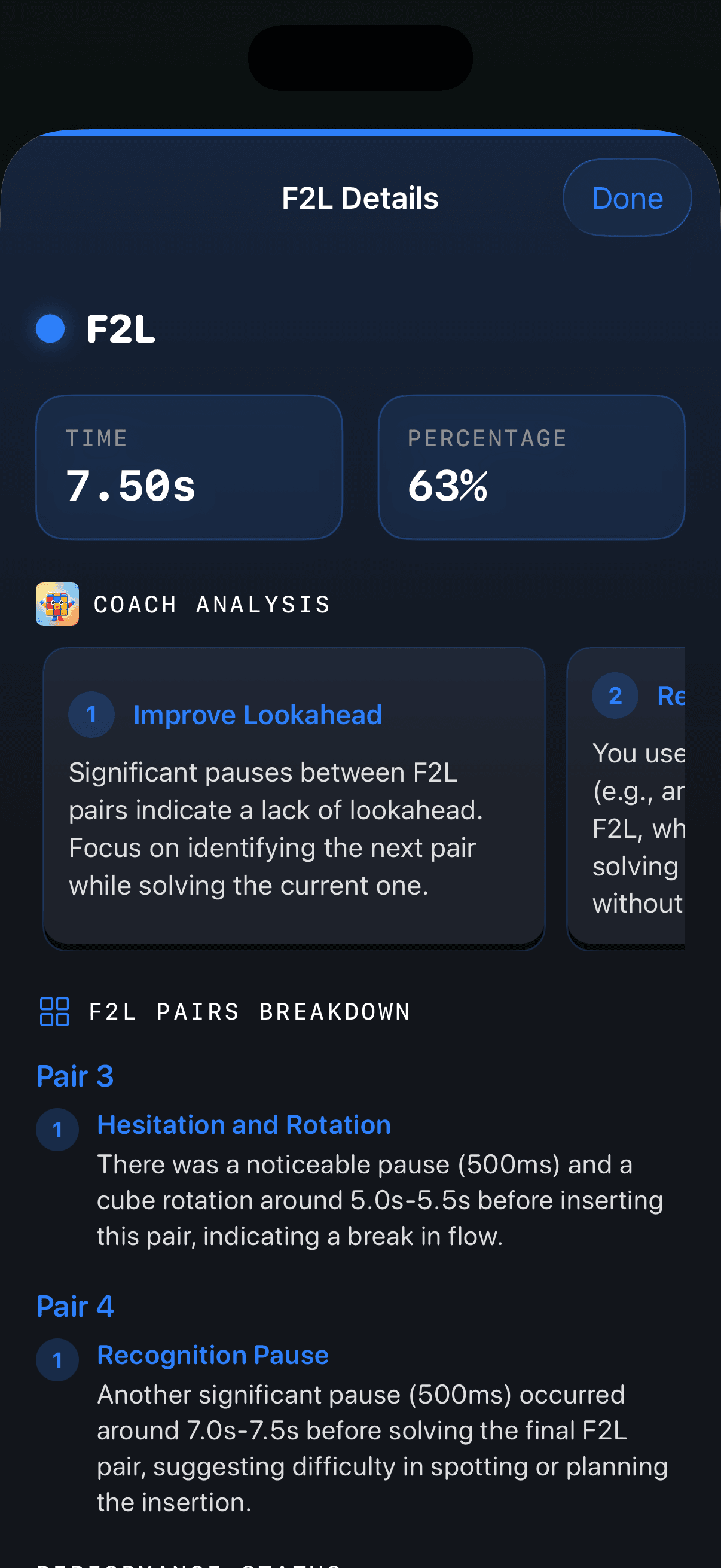
Frequently asked questions
Do I need zero rotations for good F2L?▾
No. The useful goal is fewer automatic rotations, not an artificial zero. Keep a rotation when it makes the current pair or the next pair clearly easier to recognize and execute.
Should I learn advanced F2L algorithms first?▾
No. Make intuitive F2L reliable first. Then add alternatives only for recurring cases where you can explain why the new solution improves your current one.
Why do rotations make F2L feel slower?▾
A rotation can interrupt your view of the pieces you were tracking and add a new recognition decision. Reducing reflexive rotations can leave more attention for the next pair.
Sources and fact checks
- J Perm: CFOP Method — F2L — Supports the staged F2L progression: build intuitive understanding first, then reduce extra moves and cube rotations through later optimization rather than memorizing every case.
- Speedsolving.com Wiki: First Two Layers (F2L) — Supports the definition of F2L as pairing and inserting four corner-edge pairs after the cross, and the use of intuitive F2L before selective algorithmic solutions.
- CubeSkills: F2L Algorithms — All Four Slot Angles — Supports practicing F2L solutions from all four slot angles instead of relying only on a single front-facing view.