
How to Use a Rubik's Cube Algorithm Trainer Without Forgetting Cases

Quick answer
A useful Rubik's Cube algorithm trainer teaches recognition and execution together, then schedules reviews before rare cases fade. Learn a small batch, identify each case from its visual cues, practice the fingertricks slowly, and use spaced repetition until the case is automatic in a solve.
On this pageChoose the next set with a purpose
Most algorithm problems are not about finding a sheet of moves. They happen when you recognize the case too late, hesitate halfway through the algorithm, or forget a rare case after a week away from it.
A trainer should treat an algorithm as a skill: recognize the case, understand the moves, execute it cleanly, and revisit it often enough that it survives real scrambles.
Choose the next set with a purpose
For a developing CFOP solver, full PLL is usually a compact first project because the cases appear in every solve and the set is manageable. Two-look OLL can come before full OLL, while advanced sets such as COLL and ZBLL make more sense after the foundation is stable.
Do not add cases only because they look impressive. Pick a set that matches your current bottleneck and allow enough review time for the cases already in progress.
Practice recognition before speed
Before drilling an algorithm at full speed, name the visual cue that identifies it: headlights, a block, a bar, a pair of oriented edges, or a specific corner pattern. Recognition is part of the algorithm, not a separate optional step.
Run a few slow repetitions with clean fingertricks. A fast, inconsistent execution often produces regrips that make the algorithm unreliable under pressure.
Use spaced repetition for rare cases
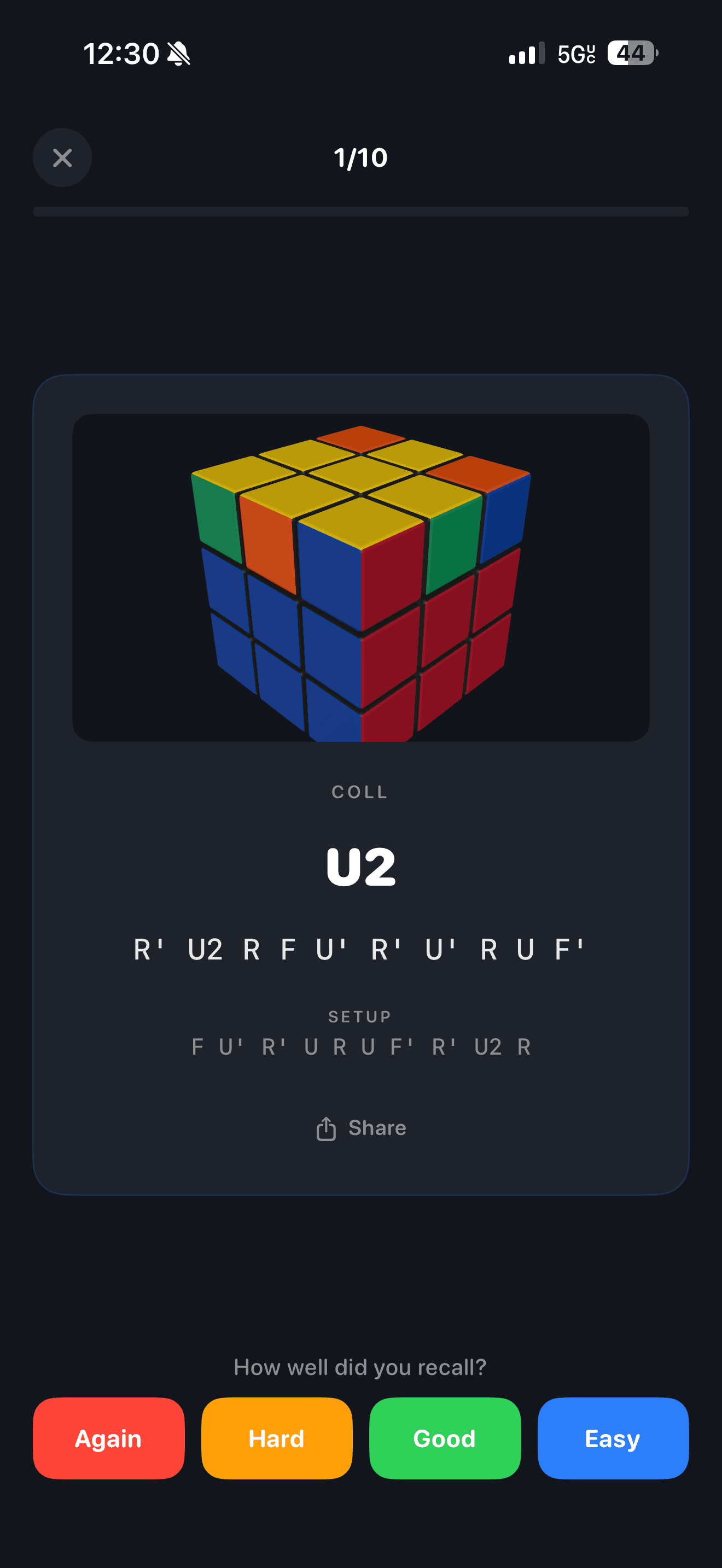
Random full solves do not guarantee that a new or rare case will return soon. A review queue can surface weak cases intentionally, which is especially important once a set is larger than a handful of algorithms.
Mark a case as learned only when you can recognize it and execute it without reading notation. Then keep it in long-term review so it stays available when it appears in a solve weeks later.
Train CFOP algorithms with CuberPal
CuberPal keeps algorithm study connected to the cases you need to recognize and retain.
- Open the catalogue for the set you are learning, from OLL and PLL through COLL and ZBLL.
- Inspect the visual case and replay the algorithm before attempting fast repetitions.
- Mark new cases as Learning so they receive more frequent practice than stable cases.
- Use spaced repetition sessions to bring back weak and rare cases deliberately.
- Check solve analysis over time to see whether last-layer recognition and execution are becoming more reliable.
Turn this into practice
Use CuberPal to connect these steps to solve analysis, focused drills, lessons, and spaced repetition.
Frequently asked questions
Should I learn full PLL or full OLL first?
For many CFOP learners, full PLL is the better first full set because it is smaller and appears once in every solve. Full OLL can follow once recognition and PLL execution are dependable.
How many algorithms should I learn each week?
A small sustainable batch is better than a large forgotten batch. Two to four new algorithms per week leaves room for recognition practice and reviews, though the right number depends on how much focused time you have.
Why can I do an algorithm in practice but miss it in solves?
You may know the moves without recognizing the case early enough, or the fingertricks may not be automatic. Include visual recognition and normal-speed execution in every review rather than only repeating notation.
Sources and fact checks
- [1]Apple App Store: Cubing Timer & Coach: CuberPal — Current product listing for CuberPal timer, analysis, coaching, algorithm practice, and cube-solver capabilities.
- [2]Cepeda et al.: Distributed practice in verbal recall tasks — Peer-reviewed quantitative review supporting spaced rather than massed review for long-term retention; cubing drill recommendations are editorial applications.
- [3]Speedsolving.com Wiki: CFOP method — Reference for the Cross, F2L, OLL, and PLL method structure and algorithm-set counts; timing targets are CuberPal editorial guidance.