
How to Fix a Stuck F2L Pair Without Guessing
Quick answer
When an F2L corner and edge are stuck in a slot or connected the wrong way, do not keep turning at random. First identify the pair’s home slot, use an empty working space to separate it without breaking the cross, bring both pieces into view, and rebuild an intuitive pair before inserting it. Slow, deliberate recoveries become fast once you recognize the same position again.
On this pageName the problem before making a move
A stuck F2L pair feels frustrating because the cube seems to offer no clean next move. Often the corner and its matching edge are already in a slot, are attached in the wrong orientation, or one piece is trapped beneath a solved pair. The usual mistake is to repeat the first trigger that comes to mind. That can preserve the problem, damage the cross, or bury another piece. A better goal is not to solve the case instantly. It is to return the two pieces to a position you can read. Once you can see both pieces and their target slot, ordinary intuitive F2L takes over again.
Name the problem before making a move
Start by finding the corner’s colors and the edge with the same two side colors. Those colors identify the slot where the finished pair belongs. Then decide which of three situations you have. The pair may be joined but sitting in the wrong slot. The corner may be in its home position while the edge is in the top layer. Or both pieces may be in a slot but connected incorrectly. This brief diagnosis prevents a recovery move from becoming a guess. Hold the cube so the target slot is visible, and look for an empty F2L slot that can act as temporary workspace. You do not need the shortest solution yet. You need a move that keeps track of what changed.
Separate the pair with a clear purpose
If the pieces are incorrectly joined, separate them in a way that sends at least one piece to the top layer and leaves the cross intact. Think of this as opening the case, not as failing it. Use the working slot to move the pair out, then pause for one beat and locate both pieces again. If a move puts one piece out of sight, undo it and choose a simpler route. A recovery is useful only when it produces a readable position. Avoid forcing the pair into its target slot while it is still wrong: the more deeply a bad pair is buried, the harder it is to recognize the next setup. At this stage, visible pieces beat clever-looking moves.
Rebuild an intuitive pair in the top layer
With the corner and edge available, use ordinary F2L logic: place them where you can see their relationship, move one piece out of the other’s path, connect them, and line the pair up with its home slot. Do not rush to a memorized advanced algorithm just because the original case looked unusual. J Perm’s F2L progression recommends understanding intuitive F2L before relying on a large set of case solutions, and the CubeSkills reference organizes difficult cases around setup moves that return to basic inserts. That is the useful pattern here. Restore a familiar shape first, then use the insert you already trust. If a pair is readable from one angle but not another, rotate before the drill begins rather than during the recovery.
Choose the insert that protects the rest of your solve
A correct recovery can still create a new problem if it breaks a solved pair or hides the next pieces. Before inserting, check whether another slot is already solved and whether your chosen moves will disturb it. An empty slot gives freedom; a filled slot asks for more care. Prefer the insert that leaves the cross unchanged, preserves solved F2L pairs, and ends with the cube in an orientation you can understand. It is fine to use a purposeful rotation while learning, especially if it makes the target slot visible. Later, compare the same recovery from more than one slot angle. The CubeSkills material presents F2L cases across all four slot angles, which is a useful reminder that the relationship between pieces matters more than one favorite front-right view.
Turn one bad case into a short practice loop
Do not wait for a troublesome case to appear randomly in a timed average. After a solve, recreate one stuck pair with the same corner, edge, and slot. First solve it slowly while saying what you are doing: identify the home slot, separate, locate, rebuild, insert. Repeat until you can describe the recovery without panic. Next, start from a different cube angle and find a second readable route. Finally, put the case back into a normal solve and check whether your recovery still protects the surrounding pairs. Five controlled repetitions are more useful than fifty frantic ones. Record one note after the session, such as “edge hidden after separation” or “back-left insert caused a rotation,” so the next drill has a concrete purpose.
Know when to stop optimizing
The reliable recovery is the right first answer even if another solver has a shorter sequence. Keep an intuitive solution until you can spot the case quickly, execute it without disturbing the rest of F2L, and transition calmly to the next pair. Only then compare an alternative for move count, grip, or visibility. This keeps advanced F2L in the right place: as refinement of a solution you understand, not as a replacement for recognition. If stuck pairs appear often, review the moment before they became stuck. You may be inserting into a full slot too early, ignoring an available empty slot, or losing track of the edge while solving the previous pair. Fixing that earlier decision can remove the recovery entirely. A simple benchmark is whether you can explain the first recovery move before your hands make it. If you cannot, slow down and rebuild the picture instead of adding speed. That habit also makes it easier to notice when a full slot is creating the trap, so the next solve can begin with a better pair order.
Continue the learning path
Learn CFOP
Build intuitive F2L before adding a large number of algorithms.
Open this topic clusterTurn this into practice
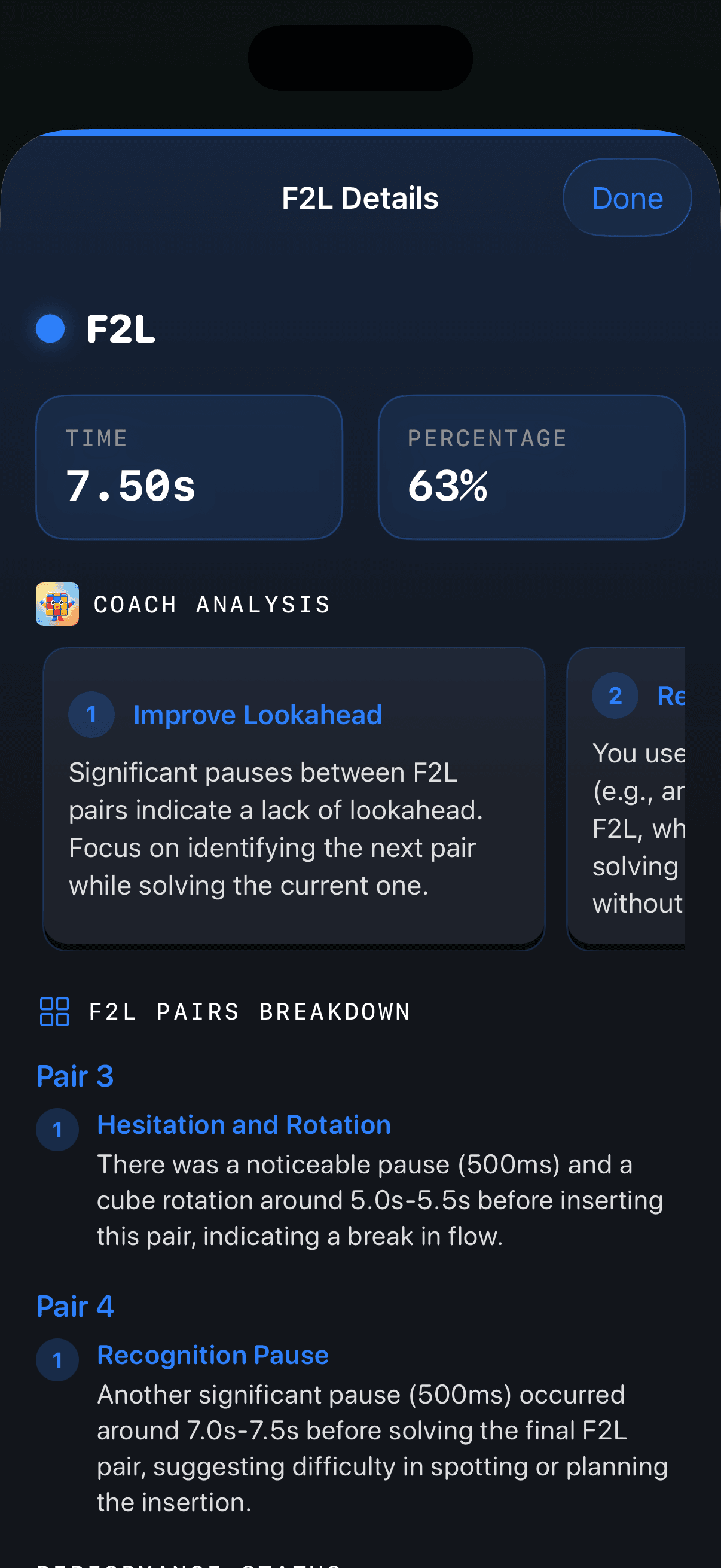
CuberPal combines a WCA-style timer, AI solve analysis, CFOP lessons, algorithm catalogues, spaced repetition, and a camera cube solver so speedcubing advice becomes a daily training loop.
Frequently asked questions
Should I learn an algorithm for every stuck F2L case?
No. Build reliable intuitive recovery first. Add a specific algorithm only after you can identify the case, explain what the alternative improves, and use it without harming the next pair.
What if both F2L pieces are already in the wrong slot?
Use a clear extraction to bring one or both pieces into view, then rebuild the pair in the top layer. Trying to force a wrongly connected pair deeper into its slot usually makes recognition harder.
Do I need to avoid all cube rotations while fixing a pair?
No. A purposeful rotation can make a recovery readable while you learn it. Reduce automatic rotations later by practicing the same case from different slot angles and keeping the version you can recognize reliably.
Sources and fact checks
- [1]J Perm: CFOP Method — F2L — Supports the recommendation to build intuitive F2L understanding before advanced case optimization and to treat F2L recognition as a core skill.
- [2]CubeSkills: F2L Algorithms — All Four Slot Angles — Supports the categories of incorrectly connected pieces and pieces in slots, setup-to-basic-insert structure, and practice across all four F2L slot angles.