
How to Learn Speedcubing Online, Step by Step
Quick answer
You don't need a paid course to learn speedcubing. Follow a clear order: learn a beginner method, learn notation, time your solves, then move to CFOP (cross, intuitive F2L, 2-look OLL and PLL), then full PLL and lookahead. Move on when a stage feels automatic, not when you've watched every video.
On this pageDo you need a speedcubing course?
- Do you need a speedcubing course?
- Module 1: Solve the cube with a beginner method
- Module 2: Learn notation and start timing
- Module 3: Move to CFOP
- Module 4: Cross and intuitive F2L
- Module 5: 2-look OLL and PLL, then full PLL
- Module 6: Lookahead, fingertricks and practice
- How long does it take?
- How to judge any online speedcubing course
- Using CuberPal as your practice companion
You don't need a paid course to learn speedcubing. What you need is a clear order: learn a beginner method, learn notation, start timing your solves, move to CFOP, then add full PLL and lookahead. Each stage builds on the one before, and you move on when a stage feels automatic, not when you've watched every video about it.
This page is laid out like a course syllabus. Each module tells you what to learn, which CuberPal guide covers it in depth and what "done" looks like before you move on. If you are brand new and want the bigger picture first, start with what speedcubing is.
Do you need a speedcubing course?
Plenty of cubers learn entirely from free resources. Tutorials, algorithm sheets and practice guides are easy to find online. The hard part isn't finding information. It's knowing what to learn next, when you're ready to move on and how to practice so the skill sticks.
That is what a good course gives you, paid or free:
- Order: a sequence that doesn't throw full OLL at you before you can solve the cross.
- Practice plans: drills for each stage, not just explanations.
- Feedback: some way to see what is actually slowing you down.
- Checkpoints: a clear sign that you're ready for the next stage.
You can get all four without paying for a course if you follow a structured path and track your own solves. The modules below are that path.
Module 1: Solve the cube with a beginner method
Everything starts with a full solve. A beginner method breaks the cube into small, learnable steps and only needs a handful of algorithms. Our guide on how to solve a Rubik's Cube walks you through it.
- What to learn: the beginner layer-by-layer method, step by step.
- How to practice: solve slowly, then solve again without looking anything up.
- Done when: you can solve the cube from any scramble without help.
Module 2: Learn notation and start timing
Notation is the language of every tutorial and algorithm sheet. Once you can read it, you can learn from anywhere. Start with Rubik's Cube notation, then learn wide and slice moves, which show up in many CFOP algorithms.
This is also the moment to start timing. Use a cube timer and get familiar with averages, because your average is the number that shows real progress. Our guide to ao5, ao12 and ao100 explains how they work.
- What to learn: face turns, primes, double turns, wide moves, slice moves and rotations.
- How to practice: read an algorithm and perform it without stopping to decode each move.
- Done when: you can follow written algorithms comfortably and you have a baseline ao5 and ao12.
Module 3: Move to CFOP
CFOP is a widely used speedsolving method. The name stands for Cross, F2L (First Two Layers), OLL (Orientation of the Last Layer) and PLL (Permutation of the Last Layer). Read what CFOP is for the overview, then follow our step-by-step learn the CFOP method guide. If you're wondering what changes from the beginner method, beginner method vs CFOP compares them side by side.
CFOP isn't the only option. Roux is a popular alternative built around blocks and slice moves. You can read about the Roux method and compare the two in CFOP vs Roux. This roadmap follows CFOP, because it's the path CuberPal's guides and trainers are built around.
- What to learn: the four stages of CFOP and how they replace the beginner steps.
- How to practice: solve with a CFOP cross and F2L, even if it feels slower at first.
- Done when: you understand what each stage does and can finish a solve using CFOP stages, with beginner steps filling any gaps.
Module 4: Cross and intuitive F2L
The cross and F2L are where most of your solve time goes, and they are mostly about planning and recognition, not memorized algorithms.
Start by planning the cross during inspection. In official WCA competitions, competitors get strictly less than 15 seconds to inspect the puzzle and start the solve, so practicing with that limit helps. Our cross planning and inspection guide shows how. Then learn F2L intuitively, pairing each corner with its edge and inserting them together, with how to learn F2L.
- What to learn: planning the full cross in inspection, then pairing and inserting F2L pairs.
- How to practice: slow solves where you track the next pair, and cross-only drills.
- Done when: you plan most crosses before the first move and solve F2L without memorized lists.
Module 5: 2-look OLL and PLL, then full PLL
The last layer is where algorithms come in. Start with the 2-look approach, which splits each step into two smaller ones with fewer algorithms to learn. Our guide to the 4-look last layer explains the structure, and 2-look OLL and 2-look PLL give you the cases.
Once 2-look feels comfortable, move on to full PLL, so the final step takes a single algorithm. To keep everything in memory, use the techniques in how to memorize cube algorithms.
- What to learn: 2-look OLL, 2-look PLL, then full PLL a few cases at a time.
- How to practice: drill recognition and execution separately, then use the cases in full solves.
- Done when: you recognize each case quickly and execute it without reading the moves.
Module 6: Lookahead, fingertricks and practice
At this point you know the method. Getting faster is about flow. F2L lookahead teaches you to find the next pair while solving the current one, so the cube never stops. Fingertricks for speedcubing help your algorithms run smoothly without regrips.
This is also where practice design matters most. Our guide on how to practice speedcubing covers session structure, and how to get faster at cubing helps you find the stage costing you the most time.
- What to learn: lookahead during F2L and efficient fingertricks for your algorithms.
- How to practice: slow, pause-free solves and targeted drills for your weakest stage.
- Done when: your solves flow with fewer long pauses and your averages keep dropping.
How long does it take?
It depends on your practice time and how you practice, so treat any timeline as a rough plan, not a promise. Our guide on how long it takes to learn CFOP suggests starting ranges of about 1–2 weeks for cross fundamentals, 2–4 weeks for basic F2L and another 2–3 weeks for 2-look OLL and PLL. Becoming fluent, with strong recognition and full last-layer sets, usually takes several months.
Speed milestones are even harder to predict. As our sub-30 guide explains, there's no reliable calendar for reaching sub-30. Watch for signs of progress instead: more planned crosses, fewer F2L stops and automatic last-layer recognition.
How to judge any online speedcubing course
If you're comparing courses, free or paid, ask these questions:
- Does it teach in a clear order, from beginner method to CFOP to full last layer?
- Does it include practice drills, not just explanations?
- Does it give you a way to get feedback on your own solves?
- Does it encourage you to track your times and averages?
- Does it tell you when you're ready to move on?
A course that only explains algorithms without helping you practice and measure progress leaves out most of what makes you faster.
Using CuberPal as your practice companion
CuberPal isn't a course, but it's built to support the practice side of this path. The timer tracks averages like ao5, ao12 and ao50, so you can see each module's effect on your times. When the last layer is your focus, the OLL and PLL trainers use spaced repetition to bring back the cases you need to review. You can see how that works in our algorithm trainer guide.
For feedback, you can record a 3x3 solve with your camera or import a video to get phase-by-phase analysis of the cross, F2L, OLL and PLL. The AI speedcubing coach uses your timer history and solve analysis to suggest what to practice next. CuberPal's paid tier is called Premium.
Continue the learning path
Learn CFOP
Build intuitive F2L before adding a large number of algorithms.
Open this topic clusterTurn this into practice
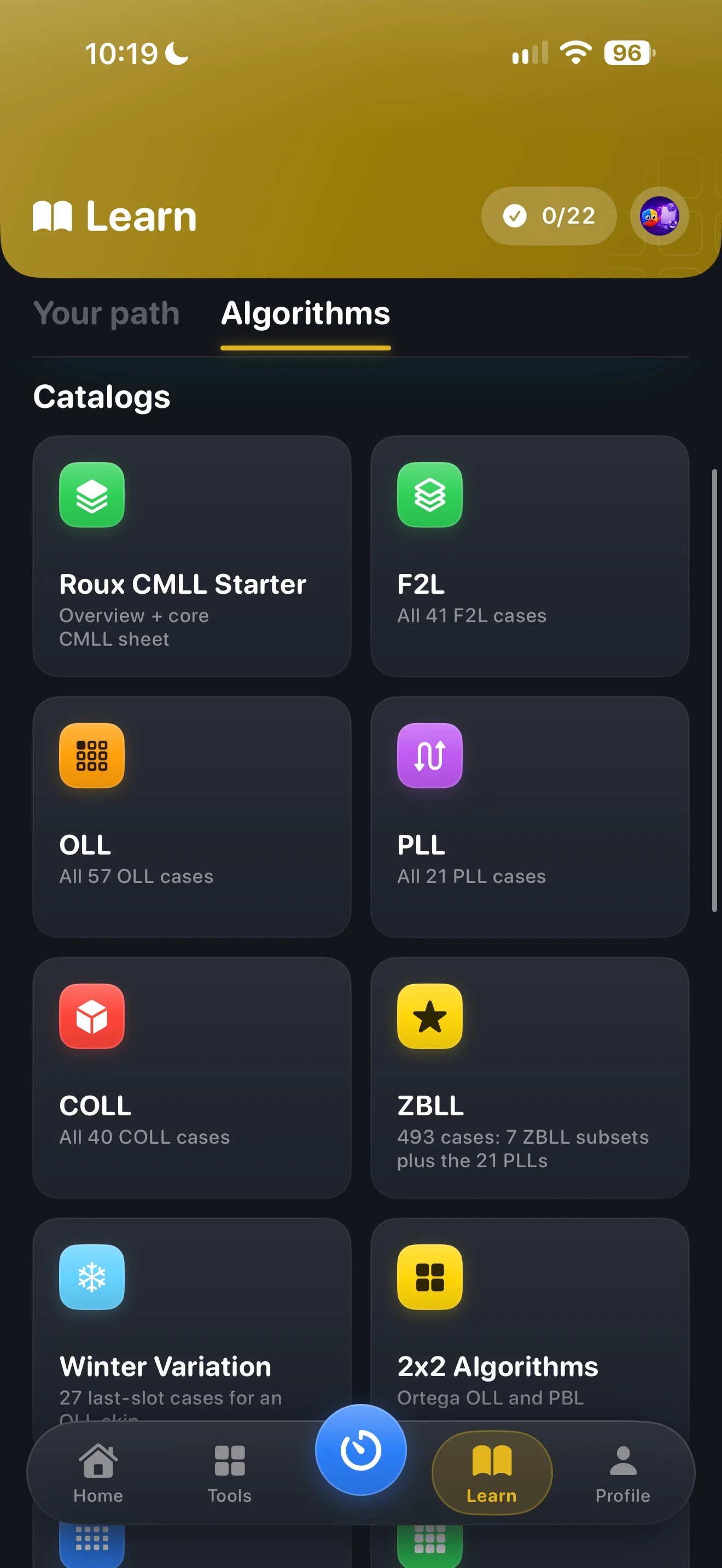
CuberPal combines a WCA-style timer, AI solve analysis, CFOP lessons, algorithm catalogues, spaced repetition, and a camera cube solver so speedcubing advice becomes a daily training loop.
Frequently asked questions
Can you learn speedcubing online for free?
Yes. Free guides cover every stage, from a beginner method to CFOP and full PLL. What matters most is following a clear order, practicing each stage until it feels automatic and tracking your times so you can see progress.
What should I learn first in speedcubing?
Learn to solve the cube with a beginner method first. Then learn notation and start timing your solves, so you have a baseline before moving to CFOP.
Is CFOP the best method to learn?
CFOP is a widely used method with plenty of learning material, which makes it a strong default, and it's the method CuberPal's guides follow. Roux is a popular alternative. Read a comparison of the two and choose the one that fits how you like to solve.
How long does it take to get sub-30?
There's no reliable calendar. It depends on your practice time, how long you've been cubing and how comfortable you are with CFOP. Track your averages and pauses instead of counting weeks.
Sources and fact checks
- [1]World Cube Association Regulations — Version April 1, 2026, rechecked 2026-11-23. Regulation A3a1: inspection is strictly less than 15 seconds.