
What Is Speedcubing?
Quick answer
Speedcubing is the practice of solving twisty puzzles as quickly and accurately as possible, usually by repeating timed solves, reviewing results, and gradually improving a method. The World Cube Association (WCA) governs official competitions for puzzles such as 2x2, 3x3, 4x4, one-handed, blindfolded, and several other events. You do not need a world-class time to be a speedcuber: learn a reliable method, use fresh scrambles, record averages, and choose the event or practice goal that keeps you engaged.
On this pageSpeedcubing is timed problem-solving, not just turning fast
Speedcubing is timed problem-solving, not just turning fast
Speedcubing means solving a twisty puzzle quickly and accurately, then using repeated attempts to make the result more consistent. The puzzle may be a 3x3 Rubik's Cube, a smaller or larger cube, or another event such as Pyraminx, Skewb, Clock, or Square-1. The goal is not simply to make one lucky solve fast. A speedcuber usually cares about a single, an average, the method used, the scramble, and what the solve reveals about the next practice target.
That makes speedcubing a blend of physical skill and decision-making. You learn to recognize pieces, plan a useful first step, execute algorithms or intuitive sequences, and keep looking ahead while the puzzle is moving. A fast solver is not necessarily turning at maximum speed every moment; fewer pauses, reliable recognition, accurate finger tricks, and a repeatable routine often matter more than frantic movement.
There is also no required speed threshold. Someone learning a beginner method and timing two-minute solves is practicing speedcubing just as surely as someone training for a sub-10-second 3x3 average. The useful definition is the activity: timed or deliberately measured solving, learning from the results, and trying to improve. Competition is one part of the community, not a requirement for joining it.
What events are part of speedcubing?
The WCA governs official competitions for mechanical puzzles operated by twisting groups of pieces. Its event list includes the familiar 3x3x3, 2x2x2, 4x4x4, 5x5x5, 6x6x6, and 7x7x7 cubes, along with 3x3 One-Handed, Clock, Megaminx, Pyraminx, Skewb, Square-1, blindfolded events, Fewest Moves, and Multi-Blind. The current rules and formats belong to the WCA, so check the official regulations when a competition detail matters: https://www.worldcubeassociation.org/regulations/.
Different events reward different skills. A 3x3 solve emphasizes planning, piece recognition, efficient pair work, and last-layer execution. A 2x2 has no centers or edges, so inspection and corner recognition become especially important. Big cubes add center building and edge pairing. One-handed solving changes grip and turning choices, while blindfolded solving separates memorization from execution. You can be interested in one event without needing to learn every puzzle on the calendar.
The event format changes how results are summarized. The WCA uses an Average of 5 for many events, including 3x3, while 6x6 and 7x7 use a Mean of 3. An Average of 5 removes the fastest and slowest of five attempts before averaging the remaining three; a Mean of 3 averages three attempts without trimming one. In ordinary practice, you can also use an ao12 or another session statistic, as long as you name the statistic and keep the rules consistent.
How do speedcubing timers and scrambles work?
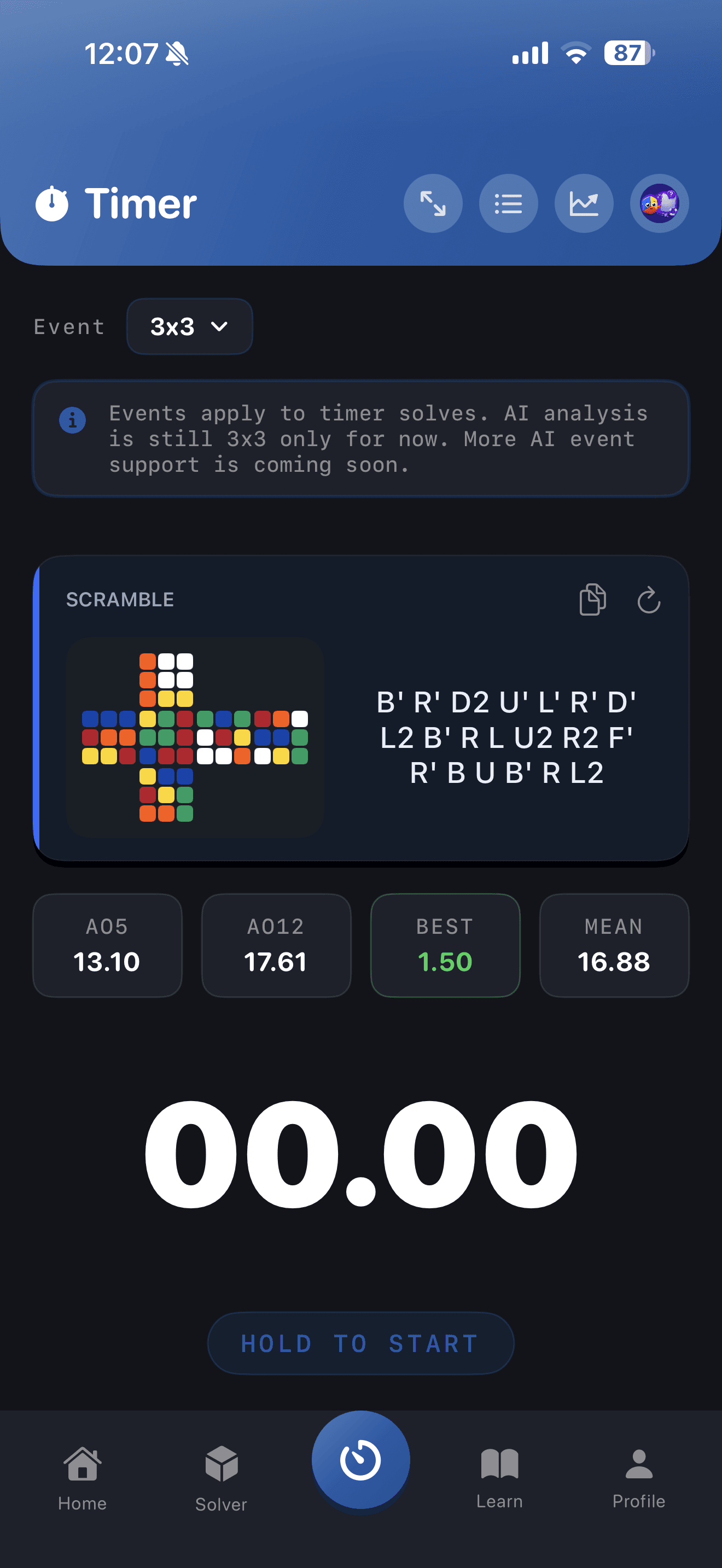
A timer gives each solve a starting point, an ending point, and a way to compare attempts. For home practice, use a physical timer, an app, or a browser timer. A useful timer shows a scramble before the attempt, lets you record penalties instead of hiding them, and keeps enough history to compare sessions. CuberPal's free online cube timer includes scrambles, optional WCA-style inspection, +2 and DNF controls, and live averages: https://www.cuberpal.com/tools/cube-timer.
For everyday practice, apply a fresh scramble to a solved puzzle and hold the same orientation while you solve. If you are preparing for a competition, practice the inspection routine too. Under the WCA regulations, competitors inspect before starting, and the timing rules distinguish a normal start from a +2 or DNF situation. Your home timer does not make a session official, but rehearsing a consistent start, stop, scramble, and penalty routine makes the numbers more useful.
Treat the timer as measurement, not a judge of your value. A slow solve can expose a recognition problem, a pause, an inaccurate algorithm, or an avoidable regrip. Write down the event and statistic alongside the time. Comparing an ao5 from a focused 3x3 session with one lucky single from a different day will create a story, but not useful evidence.
How to start speedcubing as a beginner
Start with one puzzle, usually a 3x3, and a method you can finish without guessing. A reliable beginner method is more valuable than a fast-looking algorithm list because it gives you a complete solve to time. Learn the notation, practice each step slowly, and scramble the cube again only after you can recognize what the step is trying to accomplish. CubeSkills' independent getting-started guidance recommends beginning with beginner tutorials before moving into intermediate and advanced speedcubing material: https://cubeskills.com/blog/getting-started.
Once you can solve, make a short repeatable session. Generate five fresh scrambles, inspect each one the same way, record every result, and note one observation after each solve. For example, write “long search during F2L” or “last layer was smooth” rather than trying to fix everything at once. Finish by looking at the average and choosing one drill for the next session. Ten thoughtful solves can teach you more than fifty rushed attempts with no review.
Use the CuberPal cube-fundamentals learning path when you want a structured next step: https://www.cuberpal.com/learn/cube-fundamentals. The cluster also connects to the beginner app guide at https://www.cuberpal.com/guides/best-rubiks-cube-app-for-beginners and the solver-app guide at https://www.cuberpal.com/guides/rubiks-cube-solver-app. Those pages serve different beginner needs from this definition: they help you choose learning or rescue tools after you understand what speedcubing is.
You do not need an expensive cube, a competition registration, or a large algorithm library on day one. Get a puzzle that turns reliably, learn enough to solve it, and build the habit of measuring. If you later decide that competing sounds fun, read the WCA competition information and the event-specific regulations before registering: https://www.worldcubeassociation.org/competitions.
What should you practice after your first solves?
First, practice consistency. Use the same puzzle, scramble type, orientation, and timing routine for a while so you can tell whether a change helped. Next, identify the phase that costs you the most time. Beginners often benefit from cleaner recognition and fewer pauses before they benefit from turning faster. On 3x3, that may lead from the beginner method into intuitive F2L, then into two-look last-layer steps and eventually more advanced recognition.
A simple weekly progression might look like this: one session for full timed solves, one session for slow solves that emphasize looking ahead, and one session for a specific algorithm or recognition drill. Keep the drill small enough to repeat accurately. If your times worsen while learning something new, that is normal; compare several sessions rather than abandoning the skill after one frustrating average.
When you want more structure, read How to Practice Speedcubing at https://www.cuberpal.com/blog/how-to-practice-speedcubing. When you are curious about the official event landscape, continue with WCA Events Explained at https://www.cuberpal.com/blog/wca-events-explained. If you want to attend a competition, First Speedcubing Competition explains the practical experience at https://www.cuberpal.com/blog/first-speedcubing-competition. These are next-step resources, not substitutes for the definition above: speedcubing is the measured activity that connects them.
Frequently asked questions
The most useful beginner question is not “How fast do I need to be?” but “What can I measure and improve next?” Start with complete solves, record averages, and let your own results choose the next practice target.
Continue the learning path
Cube fundamentals
Learn the notation, then use a visual solver only when you are genuinely stuck.
Open this topic clusterTurn this into practice
CuberPal combines a WCA-style timer, AI solve analysis, CFOP lessons, algorithm catalogues, spaced repetition, and a camera cube solver so speedcubing advice becomes a daily training loop.
Frequently asked questions
Do I need to be fast to call myself a speedcuber?
No. Speedcubing describes timed or deliberately measured twisty-puzzle solving and the effort to improve. You can be a beginner with two-minute solves, a casual timer user, or a competition solver; there is no universal minimum average.
What puzzle should I start with for speedcubing?
A 3x3 is the usual starting point because it has the largest beginner and speedcubing learning community. Learn a complete beginner method, then time fresh scrambles before deciding whether 2x2, big cubes, or another event is more appealing.
Is speedcubing the same as entering a WCA competition?
No. WCA competition is the official, regulated version of speedcubing, but most practice happens at home. You can use a timer, track averages, and improve your solving without ever registering for a competition.
What should I measure besides my fastest solve?
Track an average such as ao5 or ao12, the puzzle and event, penalties, and a short note about your biggest pause. Averages show repeatability, while notes help you choose a useful drill instead of chasing one lucky single.
Sources and fact checks
- [1]World Cube Association — Official source for the WCA's role governing twisty-puzzle competitions, competition information, and official records.
- [2]WCA Regulations — Official source for the current event list, Average of 5 and Mean of 3 formats, inspection, timing, and competition rules.
- [3]CubeSkills: Getting Started — Independent learning-path source for starting with beginner tutorials and progressing toward intermediate and advanced speedcubing material.
- [4]CubeSkills: Introduction to Speedcubing — Independent introductory source for framing speedcubing as a practice and learning discipline across events.