
First Speedcubing Competition Guide
Quick answer
You do not need an elite average for your first WCA competition. Register through the chosen competition's official page, meet its event-specific time limits and requirements, learn the inspection and timer procedure, bring compliant puzzles, arrive for your assigned groups, and ask the WCA Delegate whenever a rule or incident is unclear.
On this pageYou are fast enough if you meet the event requirements
- You are fast enough if you meet the event requirements
- Register from the official competition page
- Learn the official attempt before practicing pressure
- Prepare the puzzles you will actually submit
- What to bring and what is merely helpful
- Arrival, groups, and puzzle submission
- What happens at the solving station
- Judging, running, and scrambling
- Practice the mistakes that competition pressure exposes
- Set a first-competition goal you can control
You are fast enough if you meet the event requirements
WCA competitions are not reserved for record contenders. The Regulations allow any person to compete if they comply with the rules, meet the announced competition requirements, are not suspended, and follow safety measures. Your chosen competition may set a time limit, cutoff, qualification, capacity, fee, or registration deadline, so the event page—not a general speed claim—decides eligibility.
For a first event, the realistic goal is to complete official attempts, learn the flow, and meet people. Check the Events tab for each time limit and cutoff before registering. A cutoff can require a result within early attempts to receive the remaining solves; a time limit can stop an attempt that runs too long. These details vary by competition and event.
Register from the official competition page
Use the WCA competition finder, open the specific competition, and read General Info, Events, Schedule, Registration, and any newcomer FAQ. Many competitions register on the WCA site, while some use another approved system. Create the competitor's own WCA account, select events, follow payment instructions if applicable, and verify that the registration becomes accepted rather than assuming submission alone guarantees a place.
Note the opening time, competitor limit, waiting-list process, refund policy, guest rules, and deadline for changing events. Do not copy instructions from a different competition; organizers announce requirements for their event. First-time competitors receive a WCA ID after official results are published, so you do not need to invent or obtain an ID before your first competition.
Learn the official attempt before practicing pressure
The judge asks whether you are ready, uncovers the puzzle, and starts inspection timing when you confirm. You may pick up and inspect the puzzle but must not apply moves. The judge calls eight seconds and twelve seconds. Under the current rules, starting at 15.00 seconds earns a +2 penalty; at 17.00 seconds the attempt is DNF.
To start on a Stackmat-style timer, place fingers on the elevated sensors with palms down and no contact with the puzzle, wait for the ready light, then lift both hands. At the finish, release the puzzle before stopping the timer with both palms flat and down. Do not practice a theatrical slam. A calm, repeatable start and stop protects otherwise good solves from avoidable penalties.
Prepare the puzzles you will actually submit
Competitors provide their own operational puzzles and must have them ready when called. Check Article 3 for markings, missing parts, electronic components, and other puzzle rules. Magnetic puzzles can be permitted when compliant, but a WCA Delegate makes the official decision. If you are uncertain, ask before the round rather than at the solving station.
Bring your main puzzle and, as practical insurance, a legal backup you have tested. Remove smart-cube electronics or displays from consideration unless the current rules explicitly allow the puzzle for that event. Avoid distinctive damage or markings that could reveal pieces. Label the container or bag with your name without marking the puzzle in a way that changes piece identification.
What to bring and what is merely helpful
Bring every puzzle for your registered events and any identification requested for first-time verification or venue access. Keep your registration details and schedule available. Water, food permitted by the venue, a charger, layers for room temperature, and a backup puzzle are sensible additions, but they are not universal WCA requirements. Read local venue rules before packing.
Avoid carrying an oversized setup into the competition area. Keep puzzles easy to find and submit. If you use lubricant or tools, maintain puzzles away from active stations and clean any mess. Medication, accessibility items, or accommodations should be planned with organizers in advance when possible. The competition page's contact link is the right place for event-specific questions.
Arrival, groups, and puzzle submission
Arrive early enough to check in, find the venue, attend a newcomer tutorial if offered, and confirm groups and assignments. A schedule can move, so listen for announcements. When your group is called, the competition's procedure may ask you to place your puzzle with its score sheet at a drop-off table and wait in a designated area while scramblers prepare it.
Different competitions use seated judges, running judges, fixed seating, or other approved workflows. Follow organizer instructions rather than assuming every venue operates like a video you watched. Keep your puzzle covered from your own view once submitted and avoid watching other attempts in your group. If your name, event, or group seems wrong, ask staff before the round proceeds.
What happens at the solving station
A judge or runner brings the covered puzzle and asks READY? Confirm only when your hands, timer, and attention are set. Inspect, start, solve, stop, and wait while the judge records the result. Check the written time and any penalty, then sign only after the judge has recorded and signed the attempt. Your signature acknowledges that the result is correct, complete, formatted, and readable.
If anything unusual happens—timer malfunction, outside interference, dropped cover, disputed penalty—do not argue through the next solve. Keep the situation unchanged where practical and call the WCA Delegate. Organizers can help with logistics, but the Delegate makes official rulings. Asking promptly is part of correct competition procedure, not an inconvenience.
Judging, running, and scrambling
Competitions rely on participants and volunteers. You may receive judging, running, or scrambling assignments around your groups. A judge manages the attempt and signs the score sheet. A runner moves covered puzzles between scrambling and solving areas. A scrambler applies official sequences and verifies them. Attend any staff tutorial and decline a task you do not yet understand until someone teaches you.
When judging, protect the scramble, use exact inspection calls, watch the start and stop, record penalties legibly, and ask a Delegate about uncertainty. Do not coach, react to the scramble, or distract the competitor. Helping with simple assignments is one of the quickest ways to understand the event and meet other cubers, but local organizers decide the workflow and schedule.
Practice the mistakes that competition pressure exposes
At home, run small mock rounds with official-style inspection, covered scrambles, hands on sensors, and no restarts after a mistake. Practice continuing after a lockup or poor F2L pair. Competition nerves often magnify unfamiliar procedure more than they reduce cubing skill, so make the sequence of ready, inspect, start, solve, stop, and sign feel ordinary.
Learn the common meanings of +2, DNF, and DNS, but use the current Regulations for exact rulings. A puzzle that is one move from solved can receive a +2 in applicable circumstances; more than one move can be DNF. Inspection overruns have their own thresholds. Do not try to memorize every incident before your first event—know when to stop and ask the Delegate.
Set a first-competition goal you can control
Choose process goals: arrive on time, complete every attempt, use inspection calmly, sign each result carefully, and help with one assignment. Personal bests are welcome but depend on scramble and nerves. A successful first competition can include slow results if you understand the procedure and leave excited to practice again.
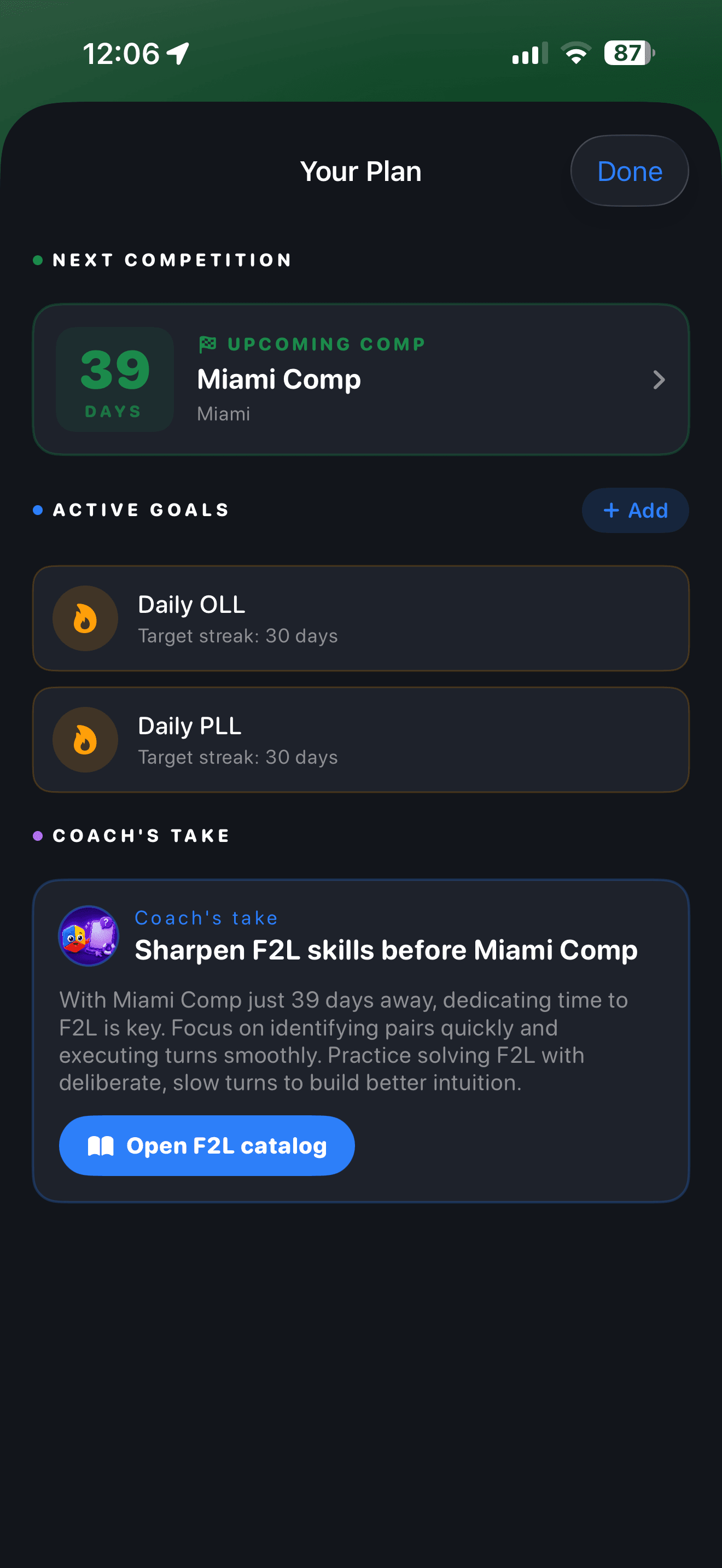
After the event, wait for official results to appear on your WCA profile and review what felt different from home. Turn one observation into a training goal, such as calmer starts or better recovery after errors. A competition countdown, timer routine, or focused practice plan is useful when it makes that next behavior concrete rather than promising a particular result on the day.
Continue the learning path
Competition ready
Practice inspection and official-style averages before the event day.
Open this topic clusterTurn this into practice
CuberPal combines a WCA-style timer, AI solve analysis, CFOP lessons, algorithm catalogues, spaced repetition, and a camera cube solver so speedcubing advice becomes a daily training loop.
Frequently asked questions
Do I need to be sub-20 to enter a WCA competition?
No. Check the specific competition's time limits, cutoffs, qualifications, and registration requirements. The WCA does not impose a general sub-20 requirement.
Do I need a WCA ID before my first competition?
No. Create a WCA account and register as a first-time competitor. A WCA ID and profile are created after your first official results are published.
Can I use my own magnetic cube?
Competitors provide their own puzzles, and magnetic puzzles can be allowed if they comply with Article 3. Ask the WCA Delegate if any marking, damage, or modification creates doubt.
What if something goes wrong during an attempt?
Call the WCA Delegate promptly and avoid changing the situation more than necessary. The Delegate makes official incident decisions; do not rely on a spectator or another competitor's guess.
Sources and fact checks
- [1]World Cube Association FAQ — Official guidance for finding competitions, registering, first WCA IDs, eligibility, and puzzle questions.
- [2]WCA Competition Tutorial — Official walkthrough of roles, groups, puzzle submission, inspection, solving, score sheets, and penalties.
- [3]WCA Regulations: Competitors — Official eligibility and registration obligations.
- [4]WCA Regulations: Puzzles — Official requirements for competitor-supplied puzzles.
- [5]WCA Regulations: Speed Solving — Official inspection, timer start, finish, and incident procedure.