
Rubik's Cube World Records: Current WCA Times
Quick answer
As of October 9, 2026, the WCA records page lists Xuanyi Geng's 2.51-second 3x3 single and Yiheng Wang's 3.51-second 3x3 average as the current headline Rubik's Cube records. The same page also lists records for 2x2 through 7x7, one-handed, blindfolded, Fewest Moves, Clock, Megaminx, Pyraminx, Skewb, Square-1, and other official events. Records can change, so treat the date and the linked WCA page as part of every claim.
On this pageThe short answer: records are a dated snapshot
The short answer: records are a dated snapshot
A Rubik's Cube world record is the best result currently recognized by the World Cube Association (WCA) for a specific event and result type. That last phrase matters: a 3x3 single is one solve, while a 3x3 average is a separate record built from a competition round. The official WCA records page is the source of truth for the current holder, result, competition, and solves behind each row. On the page observed on October 9, 2026, the 3x3 single was 2.51 seconds by Xuanyi Geng at Guangzhou Grand Open 2026, and the 3x3 average was 3.51 seconds by Yiheng Wang at Hefei Cubing League 3x3 III 2026.
Because competitions keep happening, a record list is never timeless. A useful article therefore gives an as-of date, names the official page, and avoids presenting an old number as if it were permanent. The values below are a reading of the WCA mixed records view from that date, not a prediction about which solver will hold a record next.
The current 3x3 Rubik's Cube world records
The 3x3 is the event most people mean when they search for “the Rubik's Cube world record.” The WCA page separates the two headline categories:
- Single: 2.51 seconds, Xuanyi Geng, China, at Guangzhou Grand Open 2026. The five displayed solve values include the record solve in parentheses.
- Average: 3.51 seconds, Yiheng Wang, China, at Hefei Cubing League 3x3 III 2026. The row shows the five attempts used for the average, with the fastest and slowest marked as excluded.
These are different achievements. A single rewards one extraordinary solve. An average shows that a solver produced a very high level across a short set of attempts, so it is usually the better comparison for consistency. You should not compare a single with an average as though they were the same measurement, and you should not call a personal best a world record just because it is fast for your level.
2x2 through 7x7 records
The WCA records page also lists the standard cube events by size. On the October 9, 2026 snapshot, the mixed view showed these headline rows:
- 2x2x2: Ziyu Ye held the 0.39-second single, while Sujan Feist appeared with a 0.86-second average row.
- 4x4x4: Tymon Kolasiński held the 15.18-second single, and the 18.56-second average was set at Seoul Winter 2026.
- 5x5x5: Tymon Kolasiński held the 29.49-second single, while Timofei Tarasenko held the 33.19-second average.
- 6x6x6: Max Park held the 57.69-second single, and Timofei Tarasenko held the 1:01.76 average.
- 7x7x7: Timofei Tarasenko appeared as the holder of both the 1:27.47 single and the 1:35.93 average.
Big-cube records are not simply slower versions of 3x3 records. They demand center construction, edge pairing, and reliable execution across a much longer solve. That is why the page reports the results in the event's own time scale, including minutes and seconds where needed. If you are training for a big cube, compare yourself with the same event and statistic rather than borrowing a 3x3 benchmark.
One-handed, blindfolded, and other event records
World records are not limited to two-handed 3x3 and big cubes. The same official page includes event-specific records for one-handed solving, blindfolded solving, Fewest Moves, Clock, Megaminx, Pyraminx, Skewb, Square-1, and multi-blind. The October snapshot showed, for example, Patrick Ponce's 5.62-second 3x3 One-Handed single, Zhen Chen's 6.99-second 3x3 One-Handed average, Tommy Cherry's 11.56-second 3x3 Blindfolded single, and Brian Johnson's 16-move Fewest Moves result.
It also showed current rows for non-cube twisty puzzles: Ziyu Wu's 21.04-second Megaminx single, Lingkun Jiang's 1.14-second Pyraminx average, Ignacy Samselski's 1.37-second Skewb average, and Sameer Aggarwal's 4.63-second Square-1 average. These records answer different skill questions. Blindfolded events add memorization and execution constraints, Fewest Moves rewards planning, and one-handed solving changes grip and turning choices. They belong on the same record page, but they should not be treated as interchangeable leaderboards.
For any event not listed in a short summary, open the WCA records page and use the event headings rather than relying on a search snippet or an old list. The page is also the place to check the holder's name, represented region, competition, and displayed solves together. That context helps prevent a common mistake: copying a record number while losing whether it was a single, average, mean, move count, or multi-blind result.
How to read a WCA record row
Start with the event heading, then read the Type and Result columns. “Single” means the best individual attempt shown for that record category. “Average” means the event's average format, with the attempts used for the result shown in the Solves column. Parentheses identify attempts that are excluded from the displayed average, so the visible list is not five ordinary times to average again yourself.
Next, read the name, region, and competition. A record is tied to a result that occurred at a particular competition, not just to the solver's reputation. Finally, note the page's last-updated timestamp. When you share a record, include the event, type, number, holder, competition, and as-of date in one sentence. For example: “The WCA page listed a 2.51-second 3x3 single by Xuanyi Geng at Guangzhou Grand Open 2026, observed October 9, 2026.”
The authoritative source for the figures in this article is the official WCA records page: https://www.worldcubeassociation.org/results/records. Check that page again before publishing a social post, video, or updated article because a new competition can change the table.
How to use world records in your own practice
World records are inspiring, but they are a poor day-to-day target for a beginner. A better use is to separate the record from the measurement habit behind it. Choose your event, use a fresh scramble, record every result, and compare the same statistic over several sessions. A 3x3 solver can begin with an average of five; a big-cube solver can choose a small set of consistent attempts; an event with a different format should be labeled clearly instead of forced into an ao5 comparison.
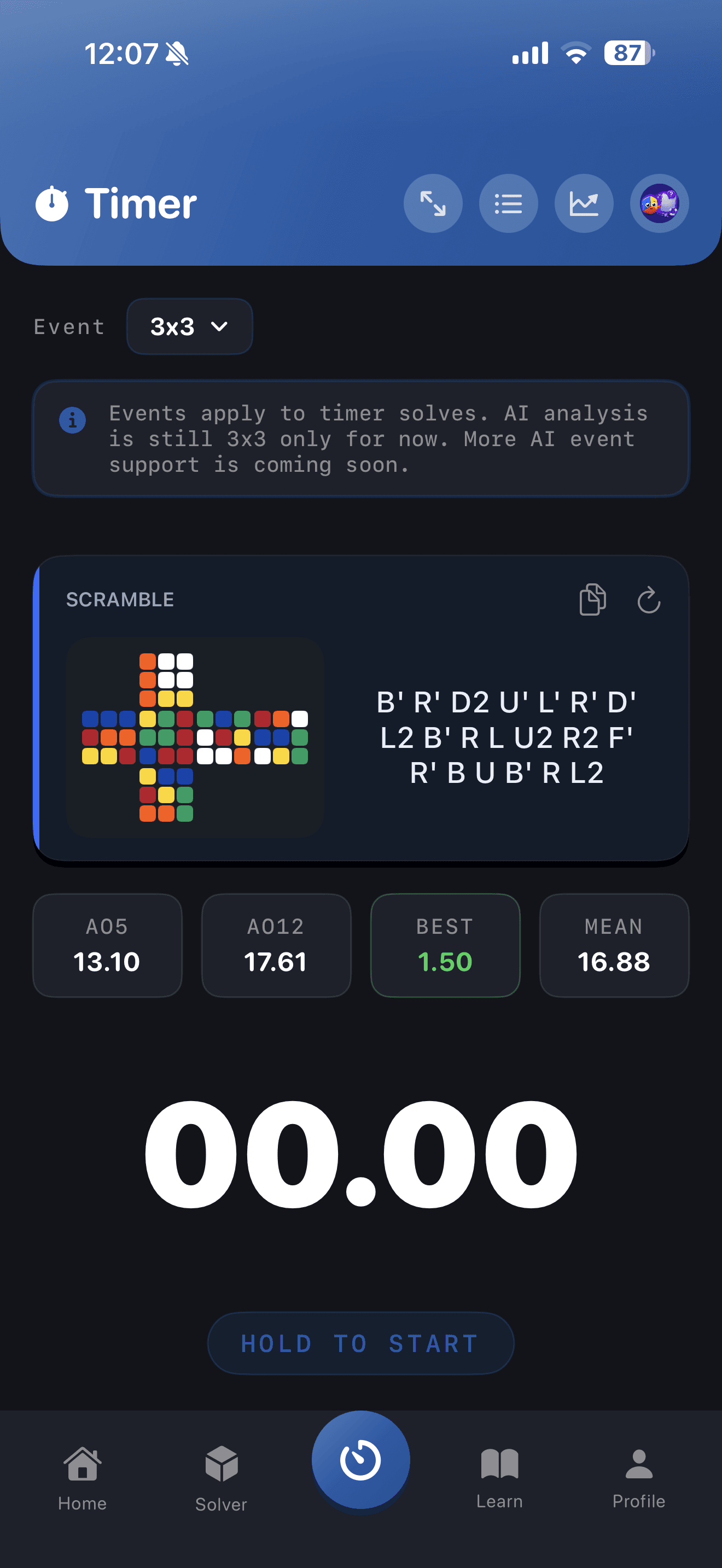
For a simple practice setup, use the free CuberPal online cube timer at https://www.cuberpal.com/tools/cube-timer. It gives you a scramble, optional inspection, penalties, and running averages so your session has a repeatable record. The timer is a practice tool, not a way to create an official WCA result, but it makes personal data easier to compare honestly.
If competition is your next step, read the WCA inspection guide at https://www.cuberpal.com/guides/wca-inspection-rules and the cube-timer guide at https://www.cuberpal.com/guides/best-cube-timer-app. For the event landscape, continue with https://www.cuberpal.com/blog/wca-events-explained; for the practical first-competition experience, see https://www.cuberpal.com/blog/first-speedcubing-competition. Those pages serve the competition-ready cluster around this records overview, while the official WCA records page remains the source for current numbers.
Frequently asked questions
The fastest single and the fastest average are separate records. A solver can hold one without holding the other, and the answer can change after the next completed competition. Always name the event and result type when you quote a record.
A personal best is your best recorded result; a world record is the best result recognized on the WCA's official records page for that event and category. Your timer can measure a personal best, but only an eligible competition result can enter the official record system.
The safest way to find the newest number is to open the official WCA records page, check its last-updated line, and read the row for the exact event and type. Search results and older articles can lag behind the live table.
Continue the learning path
Competition ready
Practice inspection and official-style averages before the event day.
Open this topic clusterTurn this into practice
CuberPal combines a WCA-style timer, AI solve analysis, CFOP lessons, algorithm catalogues, spaced repetition, and a camera cube solver so speedcubing advice becomes a daily training loop.
Frequently asked questions
What is the current 3x3 Rubik's Cube world record?
On the WCA records page observed October 9, 2026, the 3x3 single was 2.51 seconds by Xuanyi Geng and the 3x3 average was 3.51 seconds by Yiheng Wang. Recheck the official page for later changes.
What is the difference between a single and an average record?
A single is one solve. An average is the result of a competition set with the event's average format, so it measures consistency across several attempts. They are separate record categories.
Who verifies Rubik's Cube world records?
The World Cube Association maintains the official records page for its recognized events. The competition result, event category, and record row should be checked there rather than copied from an unofficial ranking.
Can my home timer result become a world record?
No. A home timer can track a personal best and practice averages, but an official world record requires an eligible result at a WCA-recognized competition under the applicable procedures.
Sources and fact checks
- [1]World Cube Association: Official Records — Primary official source for the current event record rows, holders, results, competitions, displayed solves, and the records-page update timestamp observed October 9, 2026.