
WCA Events Explained
Quick answer
As of July 2026, the WCA recognizes 17 events: 2x2 through 7x7; 3x3 One-Handed; 3x3, 4x4, and 5x5 Blindfolded; 3x3 Multi-Blind and Fewest Moves; plus Clock, Megaminx, Pyraminx, Skewb, and Square-1. The WCA has announced that FTO becomes official in January 2027 and Clock's final official competition will be the 2027 World Championship.
On this pageThe current official event list
- The current official event list
- A time-sensitive change already announced for 2027
- The core speed events and Average of 5
- 6x6 and 7x7 use Mean of 3
- Blindfolded events have specialized formats
- Fewest Moves is a solution-writing event
- How rounds, cutoffs, and time limits interact
- Choosing a second event after 3x3
- How to practice multiple events without losing focus
- Your next event decision
The current official event list
As of July 21, 2026, Regulation 9 lists 17 official WCA events. The cube events are 2x2, 3x3, 4x4, 5x5, 6x6, and 7x7. The 3x3 variants are One-Handed, Blindfolded, Fewest Moves, and Multi-Blind. There are also 4x4 Blindfolded, 5x5 Blindfolded, Clock, Megaminx, Pyraminx, Skewb, and Square-1.
A competition does not need to offer all 17. Its Events and Schedule tabs show the actual lineup, rounds, limits, and qualifications. Events outside Regulation 9 can be held unofficially but do not enter official WCA results. Because the list can change, use the live Regulations rather than an old poster or video when planning a competition.
A time-sensitive change already announced for 2027
The WCA announced in June 2026 that Face-Turning Octahedron, usually shortened to FTO, will become available as an official Average of 5 event on January 2, 2027. Clock remains an official event in the current 2026 rules and will generally remain available through July 18, 2027. The 2027 World Championship is announced as its final official competition.
That means a 2026 explanation should not silently replace Clock with FTO, and a 2027 explanation should not keep the old list forever. Check the date on any event guide. Organizers planning future competitions also need the Regulations cycle that implements FTO, because the announcement says its detailed regulations will be developed for January 2027.
The core speed events and Average of 5
For 3x3, 2x2, 4x4, 5x5, One-Handed, Clock, Megaminx, Pyraminx, Skewb, and Square-1, the current full-round format is Average of 5. A competitor receives five attempts. The best and worst results are removed, and the arithmetic mean of the remaining three determines the average. One DNF can become the discarded worst result; more than one DNF or DNS makes the average DNF.
These events feel very different despite sharing a format. 3x3 is the most common foundation. 2x2, Pyraminx, and Skewb have short solves and heavy inspection value. One-Handed changes grip and algorithm choices. Larger cubes add centers, edge pairing, and parity. Megaminx is longer and recognition-heavy, while Square-1 changes shape and uses different notation.
6x6 and 7x7 use Mean of 3
The full-round format for 6x6 and 7x7 is Mean of 3. All three attempts are averaged; there is no dropped best or worst. A DNF or DNS makes the mean DNF. The format reflects longer solve times and the practical cost of fitting attempts into a competition schedule.
For a new big-cube competitor, consistency matters because every attempt contributes. Check the competition's time limit and any cutoff phase. A cutoff may give a smaller number of early attempts and require one result under a threshold to continue. The limit and cutoff are local competition details, not permanent properties of the event.
Blindfolded events have specialized formats
Blindfolded events combine memorization and execution under rules that differ from sighted speedsolving. The current Regulations specify event-specific Best of X formats and may recognize additional averages or means outside the round ranking. 3x3 Blindfolded, 4x4 Blindfolded, and 5x5 Blindfolded should be checked directly in Regulation 9 because formats have changed over time.
Multi-Blind scores an attempt by puzzles solved minus puzzles unsolved, with time used in the ranking rules. It is not an average of ordinary single-cube times. These events require deeper procedural study, including sight blockers, memorization timing, and equipment. Learn the current event article in the Regulations before attempting to recreate competition conditions at home.
Fewest Moves is a solution-writing event
In 3x3 Fewest Moves, competitors construct and submit a written solution under the event's procedure rather than racing a Stackmat solve. Rankings use solution length. The current full-round formats can be Best of one or two, or Mean of 3, with allowed cutoff structures defined in Regulation 9.
FMC rewards blockbuilding, insertions, cancellation, and clear notation. It is a good choice for someone who enjoys analysis more than turning speed, but it is not simply an untimed 3x3 solve. Study Article E, bring permitted writing equipment, and practice producing valid move sequences exactly as required. Competition-specific schedules often handle FMC differently from stage events.
How rounds, cutoffs, and time limits interact
An event can have several rounds. The first is open to registered competitors who meet requirements; later rounds advance a stated number or percentage based on results. Groups divide a round so scrambles and stations can be managed. Your group assignment is not your ranking and can include judging, running, or scrambling duties around the competition schedule.
A cutoff determines whether you receive all attempts in a round. A time limit caps an individual attempt or combined set of attempts. A qualification requirement determines whether you may register for an event. These terms are not interchangeable. Read the Events tab and schedule for the specific competition, because an event may be beginner-friendly at one competition and have a strict cutoff at another.
Choosing a second event after 3x3
Choose by the kind of practice you enjoy. Try 2x2, Pyraminx, or Skewb if you like quick recognition and compact methods. Try 4x4 if you want cube skills that build on 3x3 while adding centers, edge pairing, and parity. Try One-Handed if you enjoy adapting familiar CFOP ideas to a new grip. Try Megaminx if longer piece-finding solves appeal to you.
Clock and Square-1 use very different mechanics, while blindfolded and FMC reward specialized study. Watch or borrow a puzzle before buying a full event collection. Check which events nearby competitions actually offer. The best next event is the one interesting enough to practice consistently and accessible enough that you can enter it.
How to practice multiple events without losing focus
Keep one main event and one or two side events for a training block. Use event-specific scrambles and statistics; do not mix 2x2 and 3x3 times in one average. For each event, know whether you are training a single, Average of 5, Mean of 3, or another format. Match the official format during occasional mock rounds.
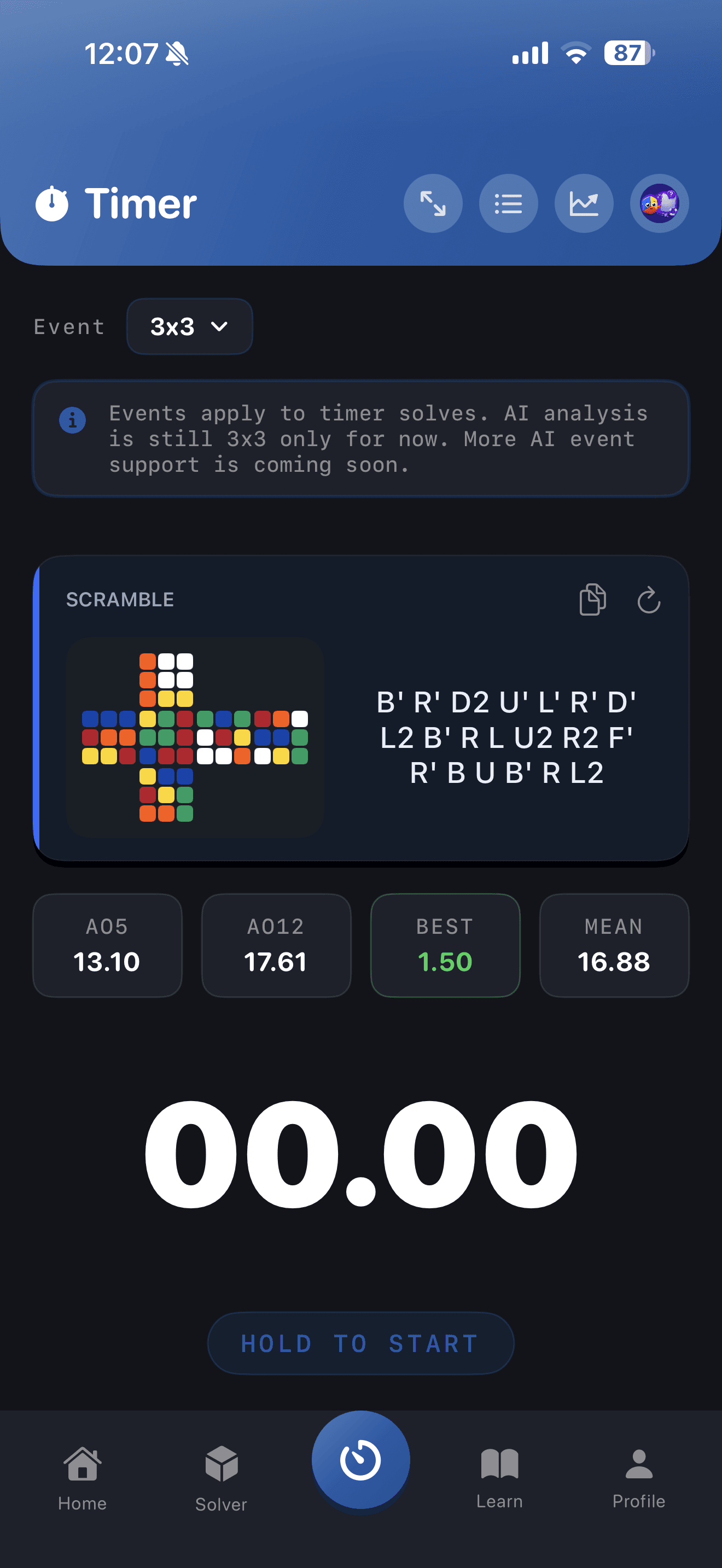
A timer's event selector is useful for keeping sessions separate, but check what the app actually supports. For example, a timer may record many events while automated solve analysis supports only 3x3. Use the right surface for the right purpose and never assume a generic scramble is competition legal. Official competitions use authorized scramble programs and procedures.
Your next event decision
Open the WCA competition finder and choose a nearby event. Read its lineup, limits, and schedule, then select one new puzzle that genuinely interests you. Learn a complete beginner method before chasing speed and record a small baseline in a separate event category. If the event is Clock or future FTO, confirm which rules apply on the competition date.
After two weeks, ask whether you enjoy its core work: algorithms, inspection, long solves, dexterity, or analysis. Continue if the answer is yes, even when times are modest. The WCA catalogue is valuable because it offers different ways to solve under shared standards, not because every competitor must collect results in all events.
Continue the learning path
Competition ready
Practice inspection and official-style averages before the event day.
Open this topic clusterTurn this into practice
CuberPal combines a WCA-style timer, AI solve analysis, CFOP lessons, algorithm catalogues, spaced repetition, and a camera cube solver so speedcubing advice becomes a daily training loop.
Frequently asked questions
How many official WCA events are there in 2026?
There are 17 as of July 2026. The WCA has announced FTO for January 2027 and Clock's removal after the 2027 World Championship, so recheck the live Regulations for later competitions.
Which events use Average of 5?
The current full-round Average of 5 events include 2x2 through 5x5, 3x3, One-Handed, Clock, Megaminx, Pyraminx, Skewb, and Square-1. Future FTO is also announced as Average of 5.
What is the difference between Average of 5 and Mean of 3?
Average of 5 removes the best and worst of five and averages the middle three. Mean of 3 averages all three attempts, so any DNF or DNS makes the mean DNF.
Does every WCA competition offer every event?
No. Organizers choose a lineup within the rules and publish it on the competition page. Always check Events, Schedule, cutoffs, time limits, and registration requirements for that competition.
Sources and fact checks
- [1]WCA Regulations: Events — Official current event list, permitted formats, Average of 5, Mean of 3, and ranking rules.
- [2]WCA Competition Tutorial — Official plain-language overview of all 17 current events, rounds, groups, cutoffs, and limits.
- [3]WCA Competition Finder — Live source for a competition's event lineup, schedule, and registration state.
- [4]WCA: Changes to the List of Official Events, June 2026 — Official announcement of FTO's January 2027 addition and Clock's removal after the 2027 World Championship.
Keep improving
First Speedcubing Competition Guide
Read next Blog2x2 Rubik's Cube Method
Read next GuideThe Best Cube Timer App for iOS and Android
Read next GuideWhat Do Ao5, Ao12, and Ao100 Mean in Cubing?
Read next BlogRubik's Cube World Records: Current WCA Times
Read next BlogWhat Does DNS Mean in Cubing?
Read next