
What Do Ao5, Ao12, and Ao100 Mean in Cubing?

Quick answer
Ao5 (average of 5) removes the best and worst result from five solves, then averages the remaining three. Ao12 and ao100 use the same idea over 12 and 100 solves for practice tracking. In current WCA competition rules, Ao5 is an official round format for many events, while 6x6 and 7x7 use Mo3; one DNF or DNS can be the worst result in an Ao5, but more than one makes the average DNF.
On this pageWhat Ao5, Ao12, and Ao100 mean
Ao5, ao12, and ao100 are rolling ways to describe consistency rather than one lucky solve. The number tells you how many recent results are included; the “average of” part tells you that the fastest and slowest result are removed before the remaining results are averaged. If you want to check a set of times while reading, use the cubing average calculator and compare its result with the examples below.
What Ao5, Ao12, and Ao100 mean
An Ao5 uses your five most recent solves. Remove the single best and single worst, then calculate the arithmetic mean of the three left in the middle. Ao12 does the same with 12 solves, leaving 10 to average. Ao100 removes the fastest five and slowest five, leaving 90. These are rolling windows: after a new solve, the oldest solve drops out and the window moves forward.
The terms are useful at different scales. Ao5 reacts quickly to the session you are currently solving, ao12 smooths out a few unusual scrambles, and ao100 is better for seeing whether a change in your method or practice is holding over time. None of them turns a single personal best into proof of a new average.
Worked Ao5 example
Suppose your five results are 8.42, 9.10, 9.48, 10.02, and 13.60 seconds. The fastest result, 8.42, and the slowest, 13.60, are trimmed away. The remaining calculation is (9.10 + 9.48 + 10.02) ÷ 3 = 9.53 seconds when rounded to hundredths. That 9.53 is your Ao5; it is not the mean of all five results.
The trim protects the number from one unusually easy or difficult solve, but it does not erase every bad session. If your middle three results are all slow, the average will show that. This is why an average is useful for deciding whether your solving is becoming repeatable.
What the current WCA rules change
The World Cube Association defines the official competition calculation. Its current regulations use Average of 5 for full rounds in 3x3, 2x2, 4x4, 5x5, one-handed, Clock, Megaminx, Pyraminx, Skewb, and Square-1. For 6x6 and 7x7, the full-round format is Mean of 3 instead: all three results are averaged and none is removed. The WCA also uses different formats for blindfolded and Fewest Moves events, so “average” does not mean the same competition format everywhere.
A DNF (Did Not Finish) or DNS (Did Not Start) is treated as the worst result in an Ao5. One DNF or DNS can therefore be trimmed as the worst result. If an Ao5 has more than one DNF or DNS, the WCA records the average as DNF. A +2 remains a numeric result after its penalty is applied; it is not the same thing as a DNF.
Which average should you use in practice?
Use Ao5 when you want a quick check during a focused session. Use Ao12 when you want enough solves to reduce the effect of one awkward scramble without waiting for a long session. Use Ao100 when you are comparing a week or month of practice and want a steadier signal. Keep the event, scramble source, inspection setting, and penalty rules consistent; otherwise the numbers are answering different questions.
An average is most useful when it changes what you do next. After a session, inspect your phase times or solve notes, choose one bottleneck, and make the next drill specific. The guide on how to practice speedcubing shows how to turn a session into a small, repeatable practice plan instead of chasing one exceptional single.
Tracking averages with CuberPal
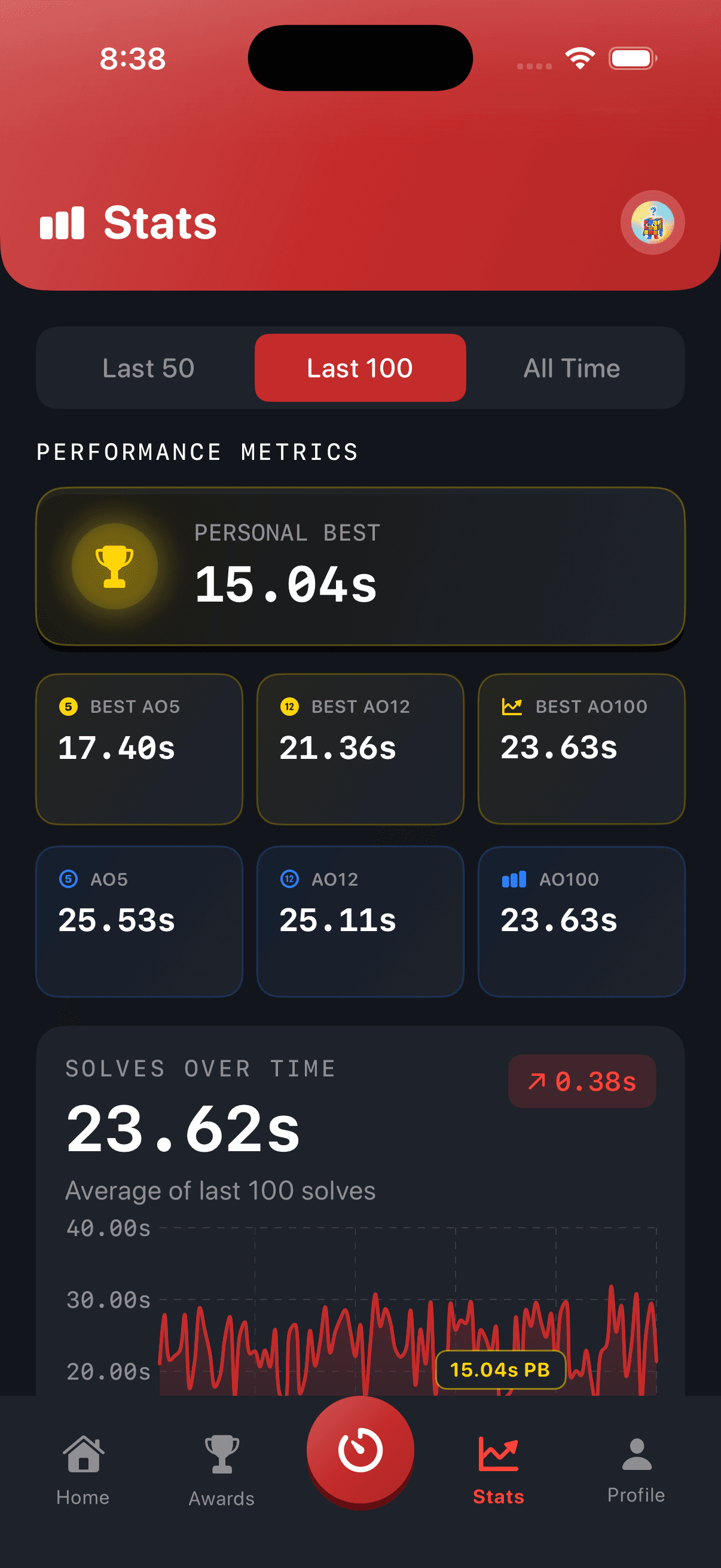
CuberPal’s current product listing describes a timer and statistics workflow for tracking solves, and the product screenshot on this page shows personal-best and rolling-average metrics. Use those numbers as a record of your own practice: keep 3x3, 2x2, 4x4, 5x5, and one-handed sessions separate, then compare like with like. The app can help you measure a trend; it cannot make an average meaningful if the solves were recorded with inconsistent rules.
For a simple routine, record one Ao5 to warm up, work through a deliberate drill, and finish with an Ao12 or Ao100 only when you have enough time to make the comparison useful. Read the result alongside what changed in your solving. A lower average with the same inspection and scramble conditions is stronger evidence than a faster single on its own.
The goal is not to make every average fall every day. The goal is to collect enough comparable solves that a change in recognition, F2L, turning, or last-layer execution can be seen in the trend.
Turn this into practice
Use CuberPal to connect these steps to solve analysis, focused drills, lessons, and spaced repetition.
Frequently asked questions
Is an Ao5 the same as a normal average of five solves?
No. An Ao5 removes the single fastest and slowest result, then averages the remaining three. A normal mean includes all five results, so the two calculations can differ substantially after one unusually good or bad solve.
What happens if I get a +2 or DNF in an Ao5?
A +2 is a numeric result after its penalty is applied. Under the current WCA Ao5 rules, one DNF or DNS can count as the worst result and be trimmed, but more than one DNF or DNS makes the average DNF.
Should I care more about Ao5, Ao12, or Ao100?
Use Ao5 for quick session feedback, Ao12 for a medium-size check, and Ao100 for a steadier long-term trend. Track the one that matches your question, and keep the event and timing conditions consistent.
Does an Ao100 prove that I am sub-X?
It is strong evidence of a sustained average under that target, but “sub-X” is a shorthand for the average or benchmark a cuber is discussing, not a universal WCA title. State the event and average type when you report it.
Sources and fact checks
- [1]World Cube Association Regulations — Current official source for WCA event formats, Ao5 trimming, Mo3 calculation, DNF/DNS handling, and +2 result treatment; checked 2026-10-12.
- [2]Apple App Store: Cubing Timer & Coach: CuberPal — Current public product evidence for CuberPal’s timer and solve-statistics workflow; checked 2026-10-12.