
How an AI Speedcubing Coach Can Improve Your 3x3 Practice

Quick answer
An AI speedcubing coach is useful when it turns your own solve data into one clear next step. CuberPal combines timer history, solve analysis, and coaching prompts so you can identify whether cross planning, F2L pauses, recognition, or algorithm execution deserves your next practice block.
On this pageStart with a solve, not a vague goal
Most cubers do not need more generic advice. They need help deciding what to practice after a real solve. That decision gets difficult when an average is slow for several reasons at once: a rushed cross, a pause-heavy F2L, an unfamiliar OLL, or a bad day on the timer.
An AI coach is most valuable when it has concrete evidence from your solves. It should help you interpret the patterns, choose a narrow drill, and check whether that drill improved the next set of solves.
Start with a solve, not a vague goal
“Get faster” is too broad to train. Record a normal 3x3 solve, look at the phase breakdown, and identify the largest repeatable issue. A long F2L phase with visible pauses calls for a different plan than a slow last layer caused by recognition.
The best coaching prompt is specific: “I average 28 seconds and paused before my third F2L pair.” That gives the coach a real constraint instead of inviting a list of techniques you may not need.
Turn feedback into one drill
A useful recommendation has a scope, a repetition count, and a way to assess it. For example, run ten slow solves where the cube never stops during F2L, then compare the number and length of pauses in a new recorded solve.
Avoid trying to learn a full algorithm set, improve TPS, and plan cross-to-first-pair transitions in one session. One visible bottleneck is enough for a focused practice block.
Use the coach between practice sessions
Coaching is not only for live feedback. After a session, ask what changed in your phase times, which algorithm cases still need review, or which drill should carry into tomorrow. This keeps a practice plan connected to evidence instead of motivation alone.
When a weak spot improves, move on deliberately. CuberPal is designed to make that loop visible: measure, choose a drill, repeat, and re-measure.
Use Cubey as your AI speedcubing coach
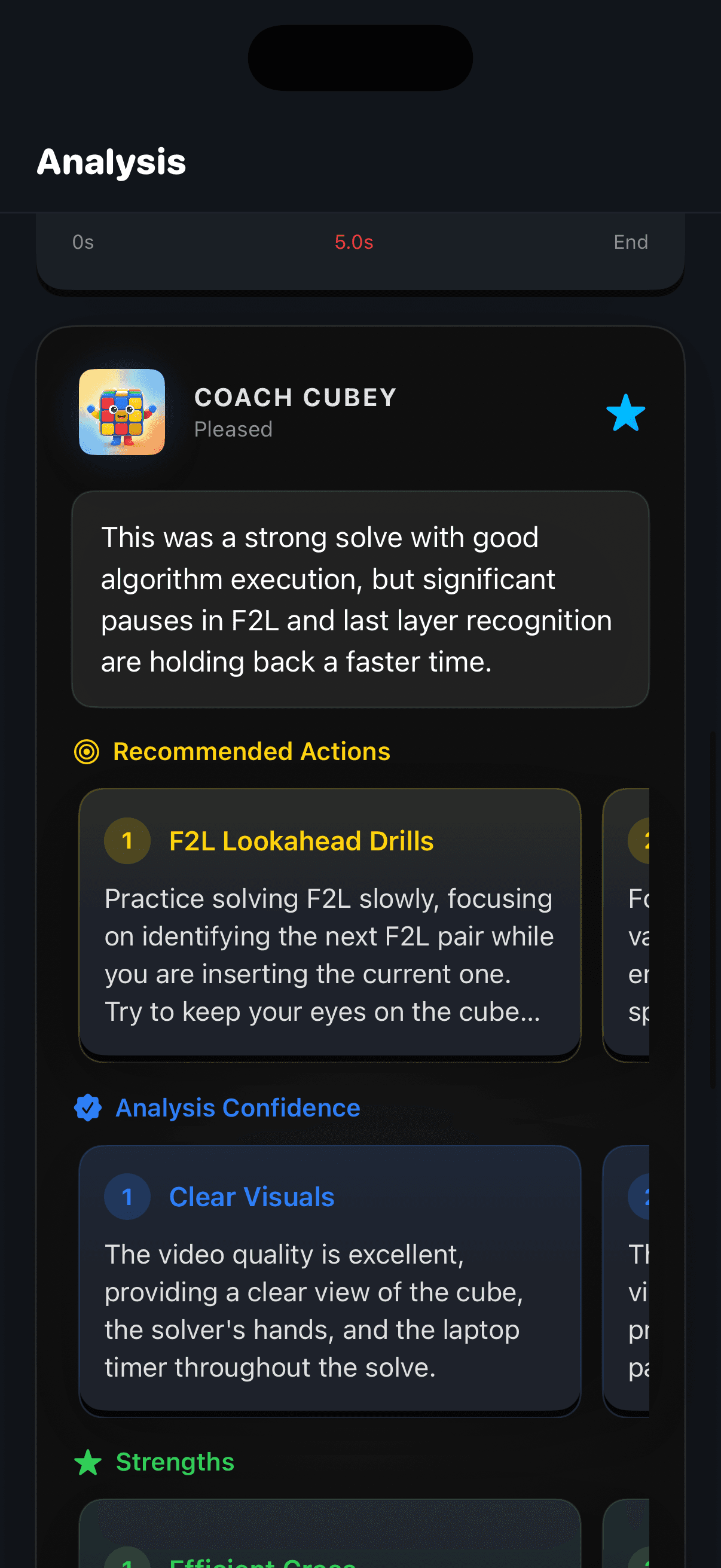
Cubey connects your question to the timer, analysis, and algorithm practice already inside CuberPal.
- Time a normal set of 3x3 solves so the coach has recent averages and solve history to work from.
- Record one representative solve or upload a video for phase and F2L feedback.
- Ask Cubey for the single highest-leverage drill for your current average and the issue you observed.
- Complete the drill, then record another solve to compare the targeted phase instead of relying on a single lucky time.
- Use the next recommendation to keep the training plan narrow and progressive.
Turn this into practice
Use CuberPal to connect these steps to solve analysis, focused drills, lessons, and spaced repetition.
Frequently asked questions
Can an AI coach replace a speedcubing coach?
It is best viewed as fast, always-available practice feedback. An experienced human coach can add perspective and demonstration, while AI can make your own timer history and solve footage easier to act on between coaching sessions.
What should I ask an AI speedcubing coach?
Ask focused questions tied to your current average or a recorded solve: which phase is slowest, how to remove a specific F2L pause, what to drill before a competition, or which algorithms deserve review.
Will an AI coach make me faster immediately?
No tool replaces repetitions. The value is choosing better repetitions: a narrow drill, clear feedback, and a way to check whether the targeted part of your solve improved.
Sources and fact checks
- [1]Apple App Store: Cubing Timer & Coach: CuberPal — Current product listing for CuberPal timer, analysis, coaching, algorithm practice, and cube-solver capabilities.
- [2]CuberPal product overview — Current product overview and repository-backed screenshots for the CuberPal workflows described in this guide.