
How Many Algorithms Are in CFOP?
Quick answer
CFOP does not require one fixed number of algorithms. You can use intuitive Cross and F2L, then solve the last layer with 16 two-look algorithms: 10 for OLL and 6 for PLL. Full OLL and PLL contain 78 cases in total, with 57 OLL and 21 PLL. Some cubers also learn case-specific F2L solutions, but those are optional additions rather than an entry requirement. Start with the smallest set that lets you finish every scramble reliably, then expand only when recognition and execution are stable.
On this pageWhy CFOP has no single algorithm count
Why CFOP has no single algorithm count
The short answer is that CFOP can mean a small beginner system or a much larger advanced toolkit. The method has four stages: Cross, First Two Layers (F2L), Orientation of the Last Layer (OLL), and Permutation of the Last Layer (PLL). Cross is planned from the scramble rather than learned as a fixed case list. F2L can also be learned intuitively: you find a corner and its matching edge, pair them, and insert them together. That means neither stage forces every learner to memorize a numbered algorithm set before they can use CFOP.
The counts become useful when you reach last layer. A full two-look last layer has 78 algorithms: 57 OLL cases and 21 PLL cases. That is a description of the complete OLL-plus-PLL collection, not a checklist a new CFOP learner must finish. Published CFOP references also describe F2L as ranging from zero memorized algorithms to 41 case-specific solutions. So a claim that CFOP always has one exact number hides the important choice: how much of your solve is intuitive, and how much is case-by-case recall?
The beginner count: 16 last-layer algorithms
A practical beginner CFOP last layer is two-look OLL plus two-look PLL. In the common breakdown, two-look OLL uses three edge-orientation algorithms and seven corner-orientation algorithms, for ten total. Two-look PLL uses two corner-permutation algorithms and four edge-permutation algorithms, for six total. Together that is 16 algorithms that can finish every last-layer state, even though orientation and permutation each take two looks instead of one.
This is usually the most honest answer for a solver asking how many algorithms they need to begin. You still need to recognize whether the top edges or corners need attention, then distinguish the two-look permutation cases, but the set is bounded and repeatable. It leaves enough mental space to learn bottom-cross planning and intuitive F2L. A new algorithm is only helpful when you can identify its case, recall the moves, and return to the next phase without a long pause.
The full last layer: 78 algorithms
Full OLL has 57 cases and completes the orientation of the last layer in one algorithm. Full PLL has 21 cases and finishes permutation in one algorithm. Those counts add to 78. Learning the full sets can reduce last-layer looks, but it also creates a recognition task: the same last layer must be recognized from the angle that appears after your final F2L pair, not only from a familiar diagram position.
Do not turn 78 into a deadline. Full PLL is often a smaller first expansion because it has 21 cases and replaces a two-step permutation. Full OLL is a larger commitment at 57 cases. The right next set depends on the evidence from your solves. If you consistently hesitate on a two-look PLL, a full PLL case may help. If the main delay is finding F2L pieces, adding more last-layer algorithms will not address that delay.
What Cross and F2L add to the total
Cross is a planning skill, not a library of standard algorithms. During inspection, you choose moves that place the four cross edges relative to their centers. There are useful techniques and common solutions, but a flexible plan matters more than recalling a flashcard sequence. Treat Cross practice as reconstruction: solve a scramble's cross, then look for a shorter route or a better ending grip.
F2L has the widest range. You can begin with no memorized F2L algorithms by learning how a corner and edge separate, pair, and enter an open slot. Later, some cubers add case-specific solutions for awkward inserts, back slots, or rotation-heavy situations. That is why references may show a total from 78 to 119: the 78 full OLL and PLL cases stay fixed, while F2L can contribute up to 41 additional cases. Those 41 are an option for efficiency, not a prerequisite for calling your method CFOP.
Choose a set from a real solving problem
Start by separating recognition, recall, and execution. Recognition asks whether you can name the case and its U adjustment before turning. Recall asks whether the moves arrive without checking notes. Execution asks whether the moves remain controlled at your usual solving speed. A slow result can come from any one of those stages, so adding an algorithm before identifying the problem often produces a larger collection with the same pause.
Use a small comparison instead of guessing. Time a normal average, note the last-layer cases that repeatedly interrupt flow, and select one family to improve. For example, keep two-look OLL and learn a few full PLL cases if corner-then-edge permutation is the recurring bottleneck. Keep your two-look fallback while the new case is unreliable. A fallback is not failure; it lets you test a new algorithm in real solves without turning every missed recognition into a stalled solve.
A manageable CFOP learning plan
First, make the 16-algorithm two-look last layer dependable while learning intuitive F2L. Next, use normal solves to find whether Cross planning, F2L pauses, OLL recognition, or PLL recognition is the largest repeated cost. If last-layer permutation is clearly the problem, add full PLL in small groups and test each case from several U-face angles. If F2L is the problem, pause the algorithm expansion and work on pair tracking, slot awareness, and slower continuous solves instead.
Keep the algorithm list visible and finite. Mark each case as unlearned, learning, or reliable, and mix recent cases with established ones rather than drilling only the new additions. A category-based practice screen can help separate a small case set from normal timed solves, but the transfer check is always a random scramble. The goal is not to collect the largest count; it is to make the next solve easier to recognize, execute, and review.
When not to add another algorithm
Hold the current set when old cases are still forgotten, when the cube regularly locks during execution, or when you cannot identify the new case before starting its moves. The solution may be spaced review, a different fingertrick, or an F2L drill rather than another memorization session. CFOP rewards coverage and consistency, but its algorithm count is a tool for choosing the next useful upgrade, not a score of how serious a cuber you are.
Continue the learning path
CFOP algorithms
Learn a small set, drill recognition, then use spaced repetition to retain it.
Open this topic clusterTurn this into practice
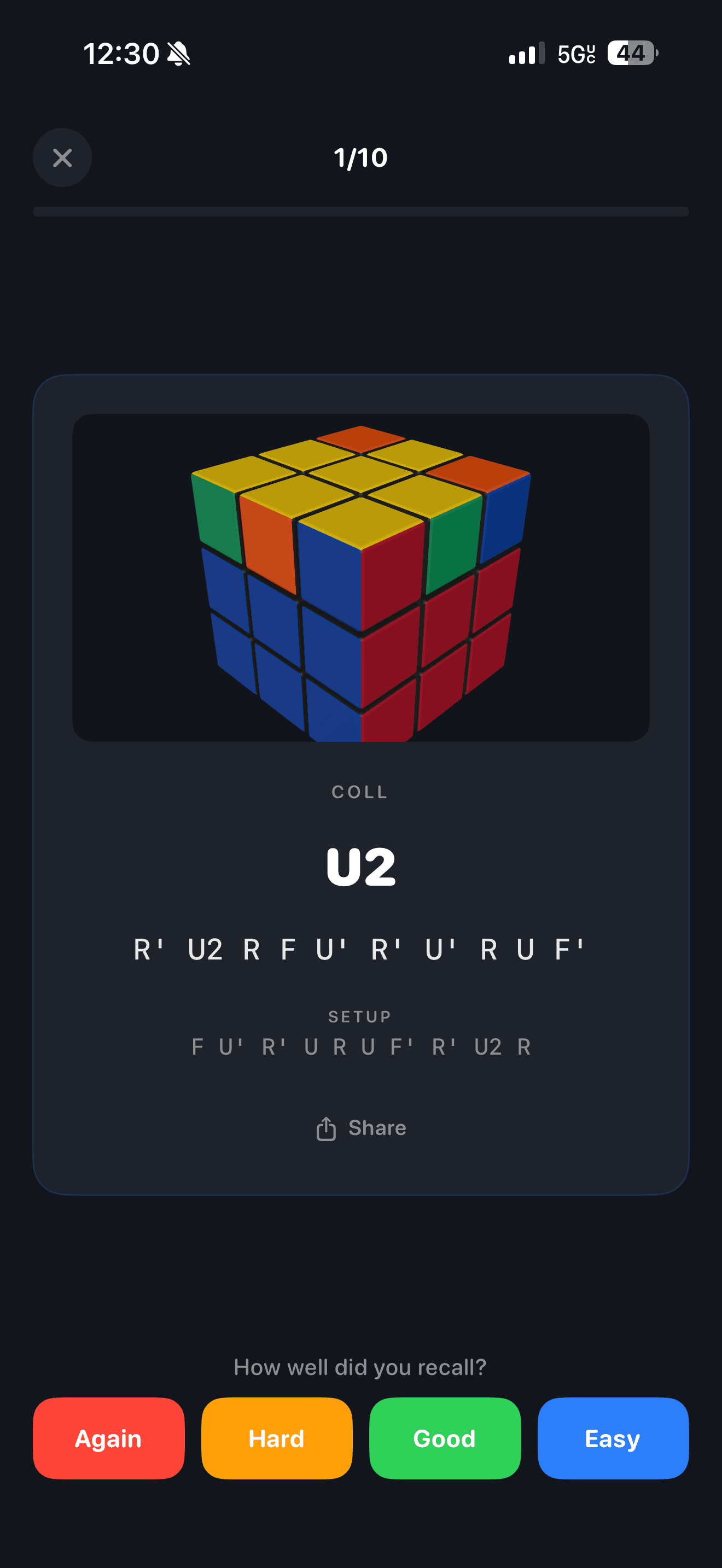
CuberPal combines a WCA-style timer, AI solve analysis, CFOP lessons, algorithm catalogues, spaced repetition, and a camera cube solver so speedcubing advice becomes a daily training loop.
Frequently asked questions
Do you need all 78 CFOP algorithms?
No. The 78-case total refers to full OLL and full PLL. You can begin CFOP with intuitive Cross and F2L plus a 16-algorithm two-look last layer, then add cases only when they solve a repeated issue.
How many algorithms are in two-look CFOP?
The standard two-look last layer uses 10 OLL algorithms and 6 PLL algorithms, for 16 total. Cross and F2L can be learned intuitively, so they do not require a fixed algorithm count at the start.
Should you learn full PLL or full OLL first?
Choose from your own solves. Full PLL has 21 cases, compared with 57 for full OLL, so it is a smaller set; however, it is useful only when last-layer permutation is a repeatable bottleneck rather than a recognition or F2L problem.
Sources and fact checks
- [1]J Perm: CFOP Speedsolving Method — Supports CFOP's four stages and the beginner two-look breakdown: 3 edge plus 7 corner OLL algorithms, and 2 corner plus 4 edge PLL algorithms.
- [2]Speedsolving.com Wiki: CFOP Method — Independently supports the 78 full-last-layer total of 57 OLL plus 21 PLL cases and the optional 0-to-41 range for case-specific F2L algorithms.