
How Many Stickers Do You Need to Identify a PLL Case?
Quick answer
For a normal 3x3 PLL, you can identify the case by reading six non-top stickers: the three stickers in the last-layer row on the front face and the three on an adjacent side such as the right face. This is called two-sided PLL recognition. It works only after OLL is complete, when the top face is already one color; practice the visible patterns and the required AUF together.
On this pageWhy the answer is six, not nine or all four sides
You need six non-top stickers to identify a 3x3 PLL case from two sides: the three last-layer stickers on the front face and the three on an adjacent face, usually the right. That is enough only at PLL, after OLL has made the U face one color. The goal is not to memorize six-color photographs. It is to recognize relationships in those six stickers, then choose the case and any AUF without rotating the cube.
Why the answer is six, not nine or all four sides
Each visible side contributes a three-sticker last-layer row: corner, edge, corner. Two adjacent rows make six stickers. In two-sided recognition, their bars, headlights, bookends, and checker relationships distinguish the 21 PLL cases from a fixed cube orientation. You do not need the middle or bottom rows because PLL moves only the already-oriented last-layer pieces. You also do not need to inspect the top face for the case itself: at PLL it is already a single color.
Set up the same view every time
Keep one color scheme and one normal solving grip. After OLL, glance at the front top row, then the right top row. Do not add a cube rotation just to reveal another face. A U adjustment is different: it changes which last-layer stickers sit at the front and right while preserving your grip. If your reference images use a different front color, translate the pattern by center colors before you decide the case.
Read a strong feature before naming the case
Start with the easiest signals. A three-sticker bar means that side is solved. Two matching corner stickers with a different edge between them are headlights. Two matching neighboring stickers make a small bar, while alternating colors make a checker pattern. One feature narrows the family; the other visible row breaks ties. For example, a U permutation has a solved bar plus a three-edge cycle, while a G permutation often needs the headlights and the adjacent row together to choose its direction.
Treat AUF as part of recognition
The six stickers should tell you both the PLL case and whether you need U, U-prime, U2, or no pre-adjustment to reach the angle you know. A correct algorithm from the wrong angle can look like a recognition miss. In practice, say the whole decision silently: case, adjustment, first move. Then include the final AUF before you consider the solve finished. This keeps recognition practice connected to a complete last layer instead of a flashcard answer.
A 10-minute drill that transfers to solves
For three minutes, present random PLL cases and cover every side except front and right. Name the case and pre-AUF without turning. For four minutes, execute only the cases you missed, slowly enough to keep layers aligned. For the final three minutes, do ordinary solves and force yourself to use the same two-side glance after every OLL. Log whether the failure was seeing the pattern, choosing the algorithm, or executing it. Repeating the algorithm does not fix a cue you cannot yet distinguish.
When two-side recognition is not the right next skill
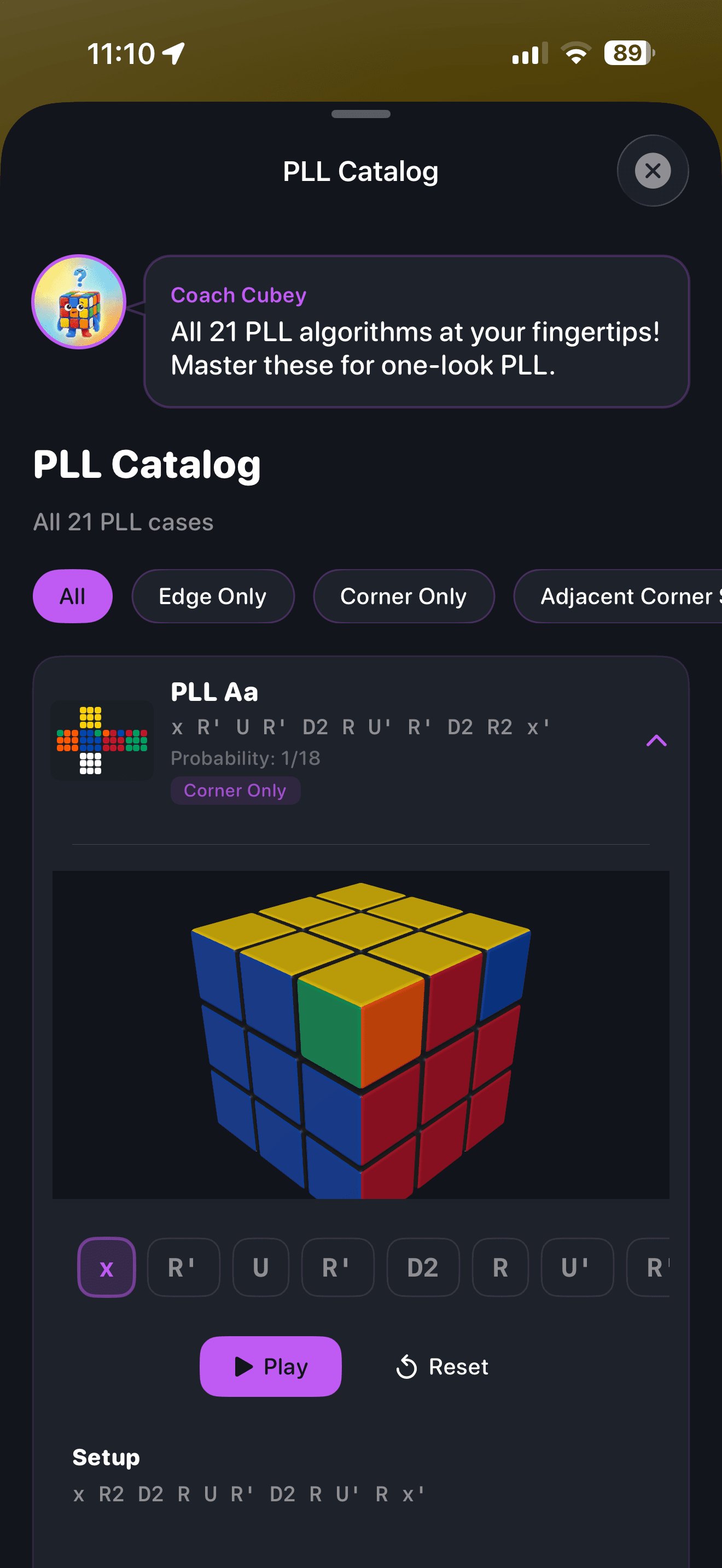
If you still hesitate on two-look PLL, first make corner and edge permutation dependable. If you can identify a full PLL but cannot recall the algorithm, work on recall rather than adding another visual system. Two-sided recognition is most useful when your basic cases already work and the remaining delay is caused by rotating or scanning. A CuberPal PLL catalog can support that drill by letting you compare the visible case diagram with the algorithm, then return to mixed recognition practice.
The useful takeaway
Six stickers are enough because two adjacent last-layer rows carry the relationships needed for two-sided PLL recognition. Build the habit gradually: first take as long as needed while seeing only those two sides, then identify families from bars and headlights, then add AUF and execution. The win is not a theoretical sticker count. It is recognizing the next last-layer decision while your hands stay in a useful grip.
Continue the learning path
CFOP algorithms
Learn a small set, drill recognition, then use spaced repetition to retain it.
Open this topic clusterTurn this into practice
CuberPal combines a WCA-style timer, AI solve analysis, CFOP lessons, algorithm catalogues, spaced repetition, and a camera cube solver so speedcubing advice becomes a daily training loop.
Frequently asked questions
Can six stickers identify every PLL case?
Yes, in standard two-sided PLL recognition. Read the three last-layer stickers on two adjacent side faces from a fixed color scheme and use their relationships to identify the case and its angle. This assumes OLL is already complete.
Do I need to look at the top face during PLL?
Not to identify the permutation. At PLL, the top face is already oriented to one color. The useful information is in the side stickers of the last layer, especially bars, headlights, and checker relationships.
Is two-sided PLL recognition necessary for full PLL?
No. You can learn full PLL with slower inspection first. Two-sided recognition is an upgrade for removing cube rotations and long scans once you can reliably recognize and execute the basic cases.
Sources and fact checks
- [1]CubeSkills PLL Recognition Trainer — Supports that the trainer practices all 21 PLL cases by looking at only two sides of the cube.
- [2]Cubing Algs: 2-Sided PLL Recognition — Supports the two-sided feature system and the use of bars, headlights, and related visible case cues.