
What Are OLL and PLL in Cubing?
Quick answer
OLL means Orientation of the Last Layer: it turns the last-layer pieces so the top face shows one color. PLL means Permutation of the Last Layer: it moves those already-oriented pieces into their correct locations. In CFOP, OLL comes first and PLL comes second; beginners usually learn them as 2-look OLL and 2-look PLL before full sets.
On this pageWhat OLL and PLL mean
What OLL and PLL mean
OLL and PLL are the two final stages in the CFOP method for solving a 3x3 Rubik’s Cube. OLL stands for Orientation of the Last Layer. It changes the direction the last-layer pieces face so the top face becomes one color. PLL stands for Permutation of the Last Layer. It moves those oriented pieces around the last layer until every side matches its center. The shortest way to remember the difference is: OLL changes which way pieces face; PLL changes where pieces sit.
The names describe jobs, not individual algorithms. A case is a particular sticker pattern that needs a particular sequence of moves. A single OLL or PLL algorithm can solve several related situations after a small U-layer adjustment, and some beginner-method sequences overlap with the 2-look sets. That is why learning OLL and PLL is more than memorizing two definitions: you learn to identify a visual case, choose the right stage, and execute a sequence without changing the orientation you are using.
Where OLL and PLL fit in CFOP
CFOP is short for Cross, First Two Layers, Orientation of the Last Layer, and Permutation of the Last Layer. Cross builds the four-edge foundation. F2L pairs each corner with its matching edge and inserts the pair into an open slot, solving the first two layers together. After F2L, the last layer may have the right pieces facing different directions and sitting in different locations. OLL handles the direction problem first, and PLL handles the location problem second.
This order gives you a useful visual checkpoint. When OLL is complete, the top face should be solved as a color face, even though the side stickers can still be scrambled. That tells you it is time to inspect PLL. If the top face is not complete, starting a PLL algorithm is usually a stage-selection mistake. If the top face is complete but the side colors are not aligned, that is exactly the kind of state PLL is meant to fix.
The distinction also explains why a PLL algorithm should not be used to repair a wrongly oriented top face. PLL preserves the orientation you have already created while changing the positions of the pieces. OLL is allowed to change the stickers facing upward because its purpose is to create that solved top face. Naming the problem before turning prevents a lot of random algorithm attempts.
OLL: orient the last layer
In OLL, the goal is to make every sticker on the last-layer face point upward. The pieces do not all need to be in their final positions yet. For example, the top can show a complete yellow face while the red-yellow edge is still above the blue center. That is an OLL success and a PLL starting point, not a failed solve.
Full OLL is commonly described as 57 cases. A learner does not need to start with all 57. The usual 2-look OLL route divides the work into two recognitions: first orient the four last-layer edges, then orient the four last-layer corners. The common beginner breakdown is three edge-orientation algorithms and seven corner-orientation algorithms, although a particular case may already be solved or covered by something learned earlier.
When reading an OLL case, look at the pattern on the top face before thinking about speed. A line, an L shape, a dot, or an already-oriented edge pattern can tell you which family of cases you are seeing. Keep the cube in the same grip while you compare the pattern with a reference. If you rotate the cube or change the top color halfway through recognition, you are changing the question you are trying to answer.
PLL: permute the last layer
PLL begins after the top face has been oriented. Its job is to move the last-layer corners and edges to their matching side centers without flipping or twisting them. A simple example is a top face that is completely yellow but has two side edges swapped. OLL cannot help because the stickers already face the right direction; PLL supplies the permutation that puts the pieces in the right places.
Full PLL has 21 cases. The common 2-look PLL route splits them into corner permutation and edge permutation. The usual beginner set contains two corner algorithms and four edge algorithms. Once you finish the corner step, pause and check that the corners form the correct side-color arrangement before starting the edge step. This checkpoint makes it easier to tell a recognition error from a sequence or setup error.
PLL recognition often uses side patterns such as headlights, bars, blocks, or solved faces. The exact visual cue depends on the case and the reference you are using, so learn each algorithm with a consistent setup. A U, U’, or U2 adjustment before the algorithm is part of the recognition process, not an afterthought. If the algorithm seems to leave the cube worse, first check whether the case was held at the intended angle and whether the final AUF is still needed.
Full OLL and PLL versus 2-look
The word full means solving the entire OLL or PLL stage in one algorithm after recognition. The phrase 2-look means splitting that same stage into two smaller decisions. Together, 2-look OLL and 2-look PLL create the four stages often called 4-look last layer: edge orientation, corner orientation, corner permutation, and edge permutation. The name refers to four recognitions, not four total algorithms.
2-look is not a lesser definition of CFOP. It is a practical learning route that reduces the number of cases you must recognize at once. The tradeoff is that the last layer normally takes more algorithm stages and often more moves. Full OLL and full PLL reduce those stages, but they add a larger recognition and retention burden. Many cubers learn full PLL before full OLL because 21 cases is a smaller expansion than 57, while keeping 2-look OLL as a dependable fallback.
Do not use case counts as a deadline. You can improve with 2-look OLL and 2-look PLL while working on F2L, cross planning, and turning control. A complete solve with reliable recognition is more valuable than a large algorithm list that disappears when the timer starts. The right upgrade is the one that removes a repeated bottleneck without making the rest of your solves less stable.
A practical learning order
Start by making the four jobs explicit in your notes: orient edges, orient corners, permute corners, and permute edges. Learn one small group at a time. For each group, first recognize the pattern without timing, then execute the sequence slowly, then put the case into a normal solve. This sequence separates memory from turning speed and makes it clear what needs work.
Use a three-question review after every repetition: Did I choose the correct stage? Did I identify the case and setup angle? Did I execute the moves without a pause or regrip that I could avoid? If the first answer is no, do recognition practice. If the second is no, review the visual pattern. If the third is no, slow the algorithm down and break it into short triggers before joining it again.
The official World Cube Association notation defines face turns such as R, U, and F, modifiers such as prime and 2, and whole-cube rotations such as x, y, and z. Keep those meanings consistent across tutorials. A notation mistake can look like a memory problem, so confirm the symbol before replacing an algorithm. When an algorithm is reliable at a slow pace, mix it with neighboring cases and then test it in an average rather than only from a prepared setup.
How to practice OLL and PLL in real solves
Use a short session with a clear handoff between isolated practice and full solves. Begin with five recognition-only attempts: show a case, name OLL or PLL and its substep, and point to the algorithm before turning. Follow with five slow executions where accuracy matters more than the time. Finish with an average of five or twelve and record which stage caused the first pause. That record is more useful than one unusually fast single.
For the free average tool, use https://www.cuberpal.com/tools/average-calculator to check the session without doing the trimming by hand. The relevant CFOP learning path is https://www.cuberpal.com/guides/learn-oll-algorithms and https://www.cuberpal.com/guides/learn-full-pll. For focused follow-up, continue with https://www.cuberpal.com/blog/two-look-oll and https://www.cuberpal.com/blog/two-look-pll. These pages answer different next questions: this article defines the two stages, while the follow-ups and guides can take you into case practice.
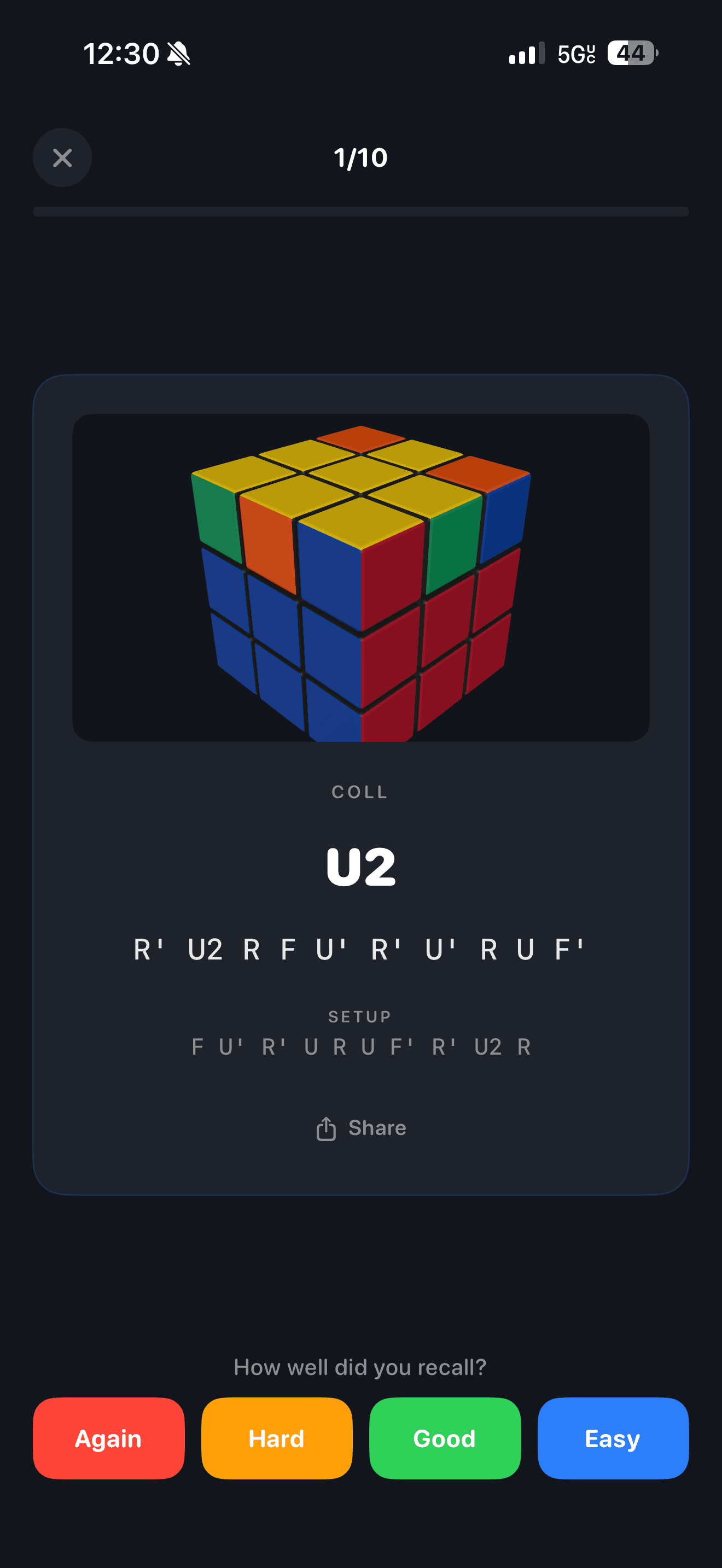
CuberPal’s current practice experience is relevant when you want to turn recognition into repeated drills: the approved algorithm-practice screenshot used with this article shows a case-quiz context, not proof that the app replaces learning the concepts. A useful loop is measure, identify the slowest OLL or PLL decision, drill that family, and measure again. Keep the target narrow until the case survives random presentation and a complete solve.
Frequently asked questions
The most common confusion is simple: OLL is about orientation, and PLL is about permutation. If the top color is not complete, stay with OLL. If the top color is complete but the pieces are in the wrong places, move to PLL. If you are still learning, use the 2-look versions first and treat full OLL or PLL as an optional progression rather than a requirement for solving or competing.
Continue the learning path
CFOP algorithms
Learn a small set, drill recognition, then use spaced repetition to retain it.
Open this topic clusterTurn this into practice
CuberPal combines a WCA-style timer, AI solve analysis, CFOP lessons, algorithm catalogues, spaced repetition, and a camera cube solver so speedcubing advice becomes a daily training loop.
Frequently asked questions
What do OLL and PLL stand for?
OLL stands for Orientation of the Last Layer, and PLL stands for Permutation of the Last Layer. OLL makes the last-layer stickers face the correct direction; PLL moves those oriented pieces into their correct positions.
Should I learn OLL or PLL first?
Learn 2-look OLL and 2-look PLL as a pair because they form the complete four-stage last layer. If you are choosing a full set afterward, many cubers learn full PLL first because it has 21 cases compared with full OLL’s commonly cited 57 cases.
How many algorithms are in OLL and PLL?
Full OLL is commonly described as 57 cases and full PLL as 21 cases. The common 2-look route uses three edge and seven corner algorithms for OLL, plus two corner and four edge algorithms for PLL, with some cases overlapping beginner-method knowledge.
Is 2-look OLL and PLL still CFOP?
Yes. 2-look OLL and 2-look PLL are beginner-friendly versions of the same CFOP last-layer stages. They take more steps than full OLL and full PLL, but they preserve the orientation-then-permutation structure and are a normal way to learn CFOP.
Sources and fact checks
- [1]J Perm: CFOP Method — Last Layer — Supports the OLL and PLL definitions, their order, 2-look substeps, and the commonly cited 57 OLL and 21 PLL case counts.
- [2]J Perm: CFOP Speedsolving Method — Cross-checks the four CFOP stages and the 2-look OLL and PLL algorithm breakdown used in the learning roadmap.
- [3]CubeSkills: 2 Look Last Layer — Provides an independent overview of the 2-look last-layer module and its OLL/PLL learning sequence.
- [4]World Cube Association Regulations — Supports the notation references for face turns, prime and double modifiers, and whole-cube rotations.
- [5]CuberPal US App Store listing — Current product evidence for CuberPal’s timer, algorithm learning, and practice-oriented app context.