
How to Get Faster at 2x2 Without Random Solves
Quick answer
To get faster at 2x2, improve the whole solve in order: plan a first face or layer during inspection, make that opening efficient, recognize the next case before turning, and execute a small method reliably. Start with a dependable beginner method, move to Ortega when the basics are automatic, and use averages plus focused drills to decide what deserves practice next.
On this pageStart with a useful baseline
- Start with a useful baseline
- Plan the first face before you turn
- Make your current method automatic
- Drill recognition separately from execution
- Choose CLL only when it fixes a real bottleneck
- Improve turning without sacrificing inspection
- Use a repeatable 2x2 practice session
- Track averages, not only personal bests
- The practical progression
A 2x2 solve is short enough that one pause can dominate the result. That makes the event exciting, but it also makes random full solves a poor diagnosis tool. If you turn faster without knowing what you are trying to see, you may simply reach the same recognition pause sooner. A better plan improves inspection, first-face construction, recognition, and execution as separate skills, then reconnects them in timed solves.
Start with a useful baseline
Begin with an average of 5 or an average of 12 using fresh scrambles and your normal start routine. Record the individual times, but do not judge the session from the best single. After each solve, write one short label: first face, recognition, algorithm recall, turning, or last adjustment. The label does not need to explain everything. It only needs to identify the moment that felt slowest.
Use the repeated label to choose one target. If several solves contain a long search before the first move, work on inspection and first-face planning. If the opening is clean but you stare at the top after making a face, work on OLL recognition. If you know the case but lock up halfway through, practice the algorithm slowly. A baseline turns an unpleasant result into a decision about the next ten or fifteen minutes.
Plan the first face before you turn
The 2x2 gives you only corners, so your opening is about finding and arranging four pieces rather than building a cross around fixed centers. During inspection, choose a color and trace all four corners that belong on that face. Notice their order, identify the first pair or short trigger, and decide where the remaining pieces will go. At first, planning a complete face is more valuable than searching for the theoretically shortest solution.
Practice this without a timer. Scramble the cube, inspect it, announce the chosen color, and describe the first two or three pieces before executing. Stop if your plan disappears. Then repeat at a slower pace until the opening feels like one idea rather than a series of searches. When one color is reliable, add the opposite color as an option. Do not force color neutrality if it makes you misread the color scheme or abandon a plan you already had.
Make your current method automatic
If you still need a reference for every solve, improve reliability before adding advanced algorithms. The official Rubik's 2x2 guide teaches a corner-by-corner beginner progression. That approach gives you a way to finish every scramble and helps you separate a piece-position problem from a sticker-orientation problem. A method you can execute calmly is a better baseline than a faster method you only recognize in prepared examples.
When the beginner solve is independent, Ortega is a practical next step. J Perm describes Ortega as three steps: make one face, orient the opposite face with OLL, then finish with PBL. The commonly presented set contains seven OLL algorithms and five PBL algorithms. Learn the case shapes and the required adjustment together; memorizing a sequence without knowing when it applies creates a new pause instead of removing one.
Drill recognition separately from execution
A fast 2x2 solver does not wait until the algorithm is finished to decide what comes next. Build recognition reps that stop before turning. Make a first face, hold the cube in a fixed orientation, and name the top-face pattern. For Ortega, then classify the bottom-layer relationship before choosing PBL: the pieces may already be aligned, swapped beside each other, or swapped diagonally. If you cannot describe the case, do not guess the algorithm. Reset and look again.
Use a second drill for execution. Choose one known case, align it carefully, and perform the algorithm at a pace that keeps every turn accurate. Repeat it from all relevant AUF positions instead of only the orientation that appeared on your first card. Then mix that case with a few older cases. The goal is not a fast isolated repetition; it is recognizing the same case when the cube arrives from a different scramble.
Choose CLL only when it fixes a real bottleneck
CLL can reduce the finish to a solved first layer followed by one algorithm, but the recognition and algorithm load is much larger. J Perm lists 42 CLL algorithms. That makes CLL a useful specialization when your first layers are efficient and your Ortega pauses are specifically caused by the two-step OLL-then-PBL finish. It is not a universal cure for slow 2x2 solves.
Before learning CLL, run a short experiment. Review ten solves and count how often you already know the first face, recognize OLL quickly, and execute PBL without a pause. If those steps are still uncertain, more algorithms will compete with skills you have not stabilized. If they are dependable and the finish is consistently the longest part, learn a small CLL family and compare it with your Ortega baseline rather than changing everything at once.
Improve turning without sacrificing inspection
2x2 rewards clean fingertricks because there are fewer pieces to track and fewer stages to hide a mistake. Start with algorithms you can execute accurately, then look for unnecessary regrips, pauses between triggers, and rotations that change your view of the case. Record a slow example of each problem and solve it again while keeping the same grip. Speed should be the final layer of the drill, not the first instruction.
Keep inspection realistic once you return to full solves. The WCA regulations list 2x2x2 as an official event, with Average of 5 as the full-round format for the event group that includes 2x2. They also require a competitor to start within 15 seconds of inspection and apply a +2 at exactly 15 seconds. You do not need to simulate every competition detail at home, but a calm inspection-to-start routine makes your practice results easier to compare.
Use a repeatable 2x2 practice session
A focused session can fit into four blocks. Warm up with three relaxed solves. Spend ten minutes on one opening or recognition drill. Complete an average of 5 or 12 with normal inspection. Finish by reviewing the most informative solve and writing the next target. If your attention drops, shorten the session; 2x2 repetitions become noisy when every attempt turns into a guess.
Keep one primary focus for several sessions. A useful two-week block might be complete first-face planning, then Ortega OLL recognition, then PBL recognition and execution. You can still do normal solves for enjoyment, but do not rewrite the plan after every bad single. Compare the same metric before and after: planning success, recognition pauses, algorithm errors, or average time. This makes improvement visible even when an average is temporarily inconsistent.
Track averages, not only personal bests
A single 2x2 skip or easy scramble can make a best time look like a breakthrough. Use averages to see whether your decisions are working across different cases. Keep 2x2 results in their own event history, review the spread of the individual solves, and note whether the slowest attempts share the same cause. The average tells you whether the session transferred; the notes tell you what to practice next.
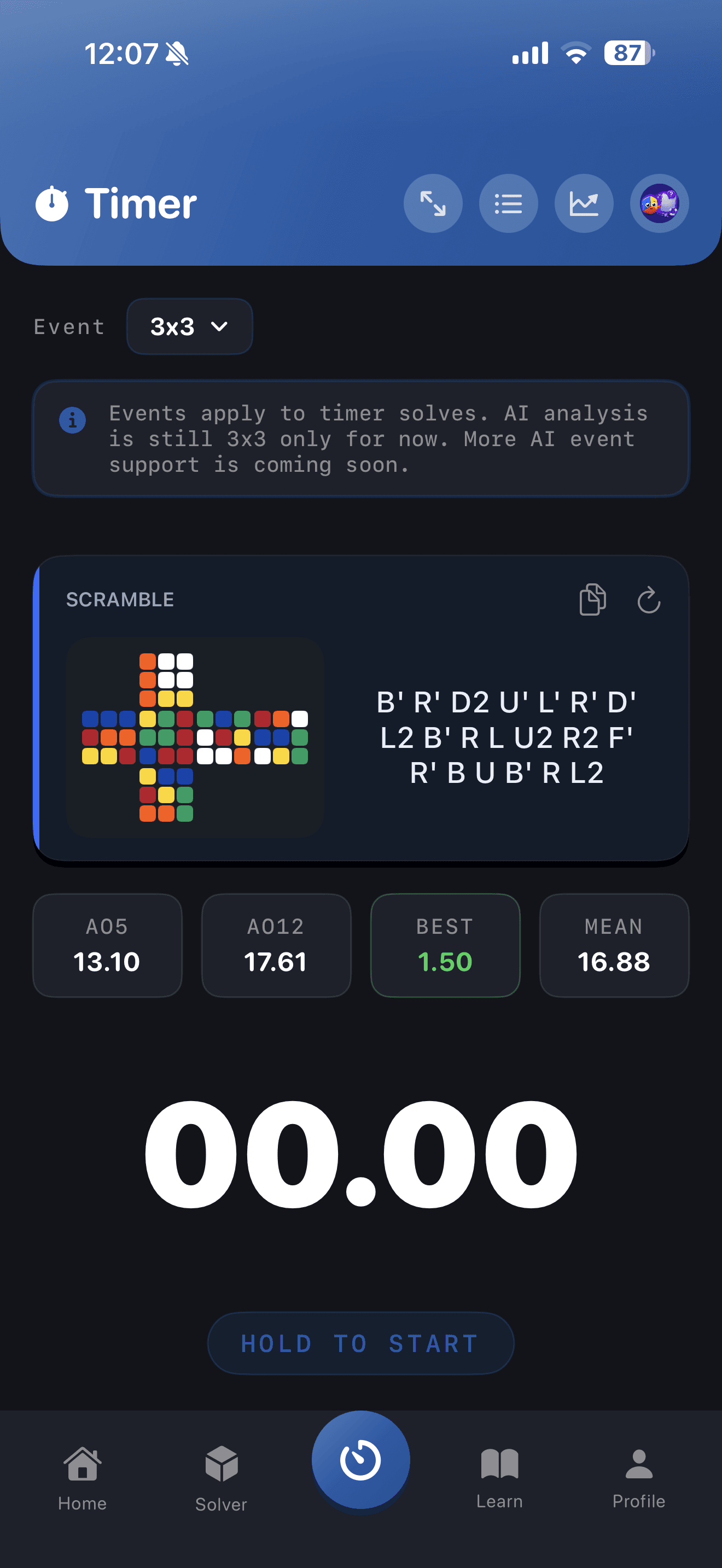
CuberPal's current App Store listing says its timer supports 2x2 with event-specific history and statistics, WCA inspection, scrambles, averages, and personal-best tracking. If you use those tools, treat them as measurement support rather than a substitute for diagnosis: time a comparable set, identify the repeated pause, drill that skill, and run another comparable set. The useful loop is inspect, execute, review, and choose one next constraint.
The practical progression
Use this order when you are unsure what to learn next: finish every scramble with a dependable beginner method, plan a cleaner first face, learn Ortega recognition and its 12-algorithm structure, improve PBL and AUF execution, then test whether CLL addresses a remaining finish-time bottleneck. Advanced EG sets and one-look solving can wait until prediction and recognition are already strengths. Faster 2x2 solving comes from seeing earlier and pausing less, not from collecting methods without a reason.
Continue the learning path
Beyond 3x3
Pick one event that feels fun enough to practice consistently.
Open this topic clusterTurn this into practice
CuberPal combines a WCA-style timer, AI solve analysis, CFOP lessons, algorithm catalogues, spaced repetition, and a camera cube solver so speedcubing advice becomes a daily training loop.
Frequently asked questions
What should I learn first to get faster at 2x2?
First make your current beginner solve reliable, then practice planning a complete first face during inspection. After that, Ortega is a practical intermediate method because it uses one face, OLL, and PBL before you consider larger algorithm sets.
Is Ortega better than the beginner 2x2 method?
Ortega is a useful next step for many solvers, but it is not automatically better for every session. Use it when you can finish the beginner method independently and are ready to recognize a first face, the top OLL case, and the final PBL relationship.
Should I learn CLL to improve my 2x2 times?
Learn CLL when your first layer is efficient and your Ortega finish is the repeated bottleneck. CLL has a much larger recognition and algorithm commitment, so stabilize inspection, first-face planning, and Ortega recognition before adding it.
How many 2x2 solves should I practice?
Use a small comparable set, such as an average of 5 or 12, after a focused drill. Repeat the same target across several sessions and review the cause of the slowest solves instead of choosing a daily total that encourages rushed, unexamined attempts.
Sources and fact checks
- [1]J Perm: 2x2 How to Get Faster — Supports the inspection emphasis and the Ortega, CLL, and EG method structures and algorithm counts used in the progression.
- [2]Rubik's Official 2x2 Solution Guide — Supports the official beginner corner-by-corner solving sequence used as the reliability baseline before speed methods.
- [3]World Cube Association Regulations — Supports 2x2 as an official event, the Average of 5 full-round format, and the inspection and timer-start rules described here.
- [4]Apple App Store: Cubing Timer & Coach: CuberPal — Supports the current product claim that CuberPal times 2x2 solves with event-specific history, statistics, scrambles, inspection, averages, and personal-best tracking.