How to Get Faster at 7x7 Without Random Solves
By CuberPal Editorial Team · Updated 2026-09-14 · Editorial standards
Quick answer
To get faster at 7x7, train the solve as three connected skills: build centers with fewer pauses, pair edges with a consistent rhythm, and protect your reduced 3x3 finish. Use short untimed drills for the stage that costs you the most, then reconnect the stages with complete solves. Track a small Mean of 3, review where the solve stalled, and change one practice variable at a time instead of chasing a faster turning speed everywhere.
A 7x7 solve can feel slow even when your hands are moving well. The puzzle contains a long center phase, a demanding edge-pairing phase, and a final stage that should look familiar because the reduced puzzle behaves like a 3x3. That length makes random full solves a poor diagnostic: a single lockup near the end can hide the fact that your centers improved, while a lucky edge-pairing run can make a weak process look fixed. A better plan separates the phases, gives each one a job, and uses complete solves only to check whether the improvements connect.
Know what is actually slowing you down
Before changing your method, record three or five normal solves and divide each result into centers, edge pairing, and the reduced 3x3 stage. You do not need perfect inspection data. A rough split is enough to answer the first useful question: are you spending time searching, turning, recovering from mistakes, or hesitating before the next action? Write one short note after each solve, such as ‘last two centers stalled’ or ‘lost the edge rhythm after four pairs.’
Use the note, not your fastest single time, to choose the next drill. If centers are consistently the longest phase, more full solves will mostly give you more chances to repeat the same search. If edge pairing is the problem, a faster center technique will only deliver you to the bottleneck sooner. If the reduced 3x3 is much slower than your normal 3x3, the big cube may be exposing recognition or turning habits that are not yet automatic on a smaller puzzle.
Build 7x7 centers with a repeatable rhythm
The 7x7 reduction process begins with six 5x5 center blocks. Faster center work is less about forcing every bar immediately and more about keeping a predictable search pattern. Start by deciding which center you are building, locate the pieces needed for the next bar, and preserve already-built bars while you place it. When you pause, identify whether the pause came from not seeing a piece or from not knowing where the partial bar should go. Those are different problems and need different drills.
- Train first-center starts separately: scramble, build one center, stop, and reset. The goal is a calm search pattern, not a benchmark time.
- Practice the last two centers as a dedicated block. They create more visible constraints because the other centers are already solved, so record where you lose track of available pieces.
- Use slow turning when learning a new center order. A steady sequence that preserves solved work transfers better than a fast attempt that requires frequent resets.
Do not add a new center system every session. Pick one approach, learn where its pauses occur, and make small changes only after you can describe the failure. The intermediate CubeSkills material separates the first four centers from the last two for exactly this reason: they are related tasks, but the information available on the cube changes as more centers are completed.
Make edge pairing a controlled process
After centers, a 7x7 requires grouping the four matching wing pieces for each edge. This phase often feels chaotic because several matching pieces can be visible at once. Use a fixed scan: choose the target edge, find its matching wings, place the useful pair in your working area, then move the completed group out without destroying the centers. A consistent scan reduces the time spent looking from one face to another and makes your mistakes easier to classify.
Separate edge-pairing accuracy from edge-pairing speed. Spend one session doing deliberate, low-turning repetitions where you say the next target before moving. Then spend a shorter session working on continuous flow with a comfortable turning speed. If you speed up before the placement pattern is stable, you will create more parity-like recoveries and false starts, which makes it difficult to tell whether your recognition or execution needs work.
- First drill: pair two or three edges from a controlled scramble, then reset and repeat the same search order.
- Second drill: complete the first eight edges while protecting your centers, then stop before the final four if that is where your rhythm breaks.
- Third drill: practise the last four edges with a deliberate pause before each setup so you learn the available-piece pattern instead of guessing.
Keep the reduced 3x3 stage from becoming free time
The final 3x3 stage is where big-cube practice connects to your regular speedsolving. Once the centers and four-piece edges are reduced, turn only the outer layers and solve the remaining puzzle as a 3x3. If this stage is noticeably slower than your normal 3x3, do not immediately blame the big cube. Check whether your grip changed, whether you are recognizing the reduced edges cleanly, or whether fatigue from the earlier phases is causing pauses.
Run a few isolated 3x3 finishes from a solved-reduction state when possible. Practise turning with the same grip you use on your 3x3, and keep the goal narrow: recognize the next case without staring at the whole cube. On long solves, a clean final stage protects consistency even when the earlier phases are not yet fast. It also prevents you from confusing big-cube handling with ordinary last-layer weaknesses.
Use full solves to reconnect the phases
Stage drills build skill, but full solves reveal whether the transitions work. After a focused drill, do a small set of complete solves at a controlled pace. Your first goal is not a personal best; it is to carry the center rhythm into edge pairing without a long reset, then enter the reduced 3x3 with a clear plan. If the same phase still dominates, return to that phase instead of extending the full-solve set indefinitely.
A useful session has a simple shape: warm up with one normal solve, complete a focused drill for the current bottleneck, do three to five full solves, and finish by writing one observation. Keep the method stable while you measure it. Changing the center order, edge technique, and turning speed at once can produce a faster result, but you will not know which change helped or which one created a new problem.
Track the right average for 7x7
Because 7x7 solves are long, a single result is especially noisy. Track a small Mean of 3 when you have enough time and energy, since the World Cube Association uses Mean of 3 for 6x6 and 7x7 full rounds. You can also use a longer personal session, but label it clearly so you do not compare a warm-up single with a competition-style mean. The number is useful only when the solves were produced under roughly the same conditions.
Record three things beside the average: the phase that felt worst, the kind of error that appeared, and the drill you will repeat next time. Review those notes after several sessions. If the same issue appears across different scrambles, it is probably a trainable pattern. If it appears once, treat it as information rather than a reason to rebuild your method. This keeps long-event practice patient and prevents a single bad solve from steering the whole plan.
A repeatable 45-minute practice session
Use this outline when you want structure without turning practice into a second job. Adjust the minutes to your schedule, but keep the order: diagnose, isolate, reconnect, review. The plan works with any timer that lets you record results and with a physical notebook if you prefer writing by hand.
- 5 minutes: one easy solve and one normal solve. Note whether centers, edges, or the reduced 3x3 felt most costly.
- 15 minutes: drill only that phase. Use slow, repeatable turns and stop to reset when the setup becomes unclear.
- 20 minutes: complete three to five full solves at a pace that protects recognition. Record a Mean of 3 when the set supports it.
- 5 minutes: review the notes, choose one next-session drill, and stop. More solves are not automatically better when attention has dropped.
The practical rule is simple: make one phase more predictable before trying to make the whole solve faster. CubeSkills' 7x7 material presents centers, edges, and the 3x3 stage as distinct parts of the solve, while its intermediate tips focus on improving those stages. J Perm's big-cube guidance likewise emphasizes broadly useful work on free-slice edge pairing, centers, edges, and the 3x3 stage rather than a single magic algorithm. Your practice should follow that same structure: identify the phase, choose a narrow drill, then check the transfer in complete solves.
Continue the learning path
Beyond 3x3
Pick one event that feels fun enough to practice consistently.
Open this topic cluster →Turn this into practice
CuberPal combines a WCA-style timer, AI solve analysis, CFOP lessons, algorithm catalogues, spaced repetition, and a camera cube solver so speedcubing advice becomes a daily training loop.
Download CuberPal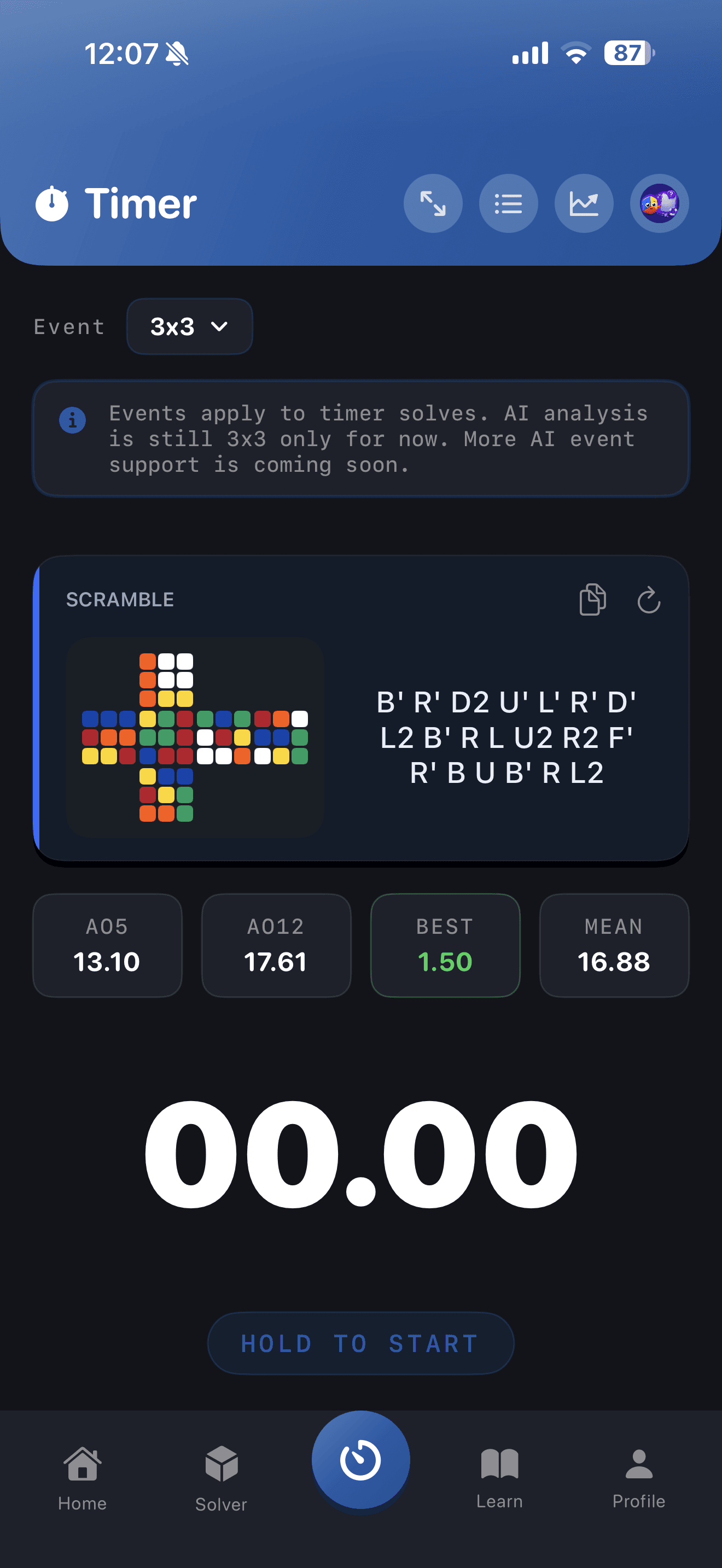
Frequently asked questions
What should I practise first to get faster at 7x7?▾
Start with the phase that consistently takes the largest share of your solve or creates the most pauses. For many solvers that is centers or edge pairing, but measure your own solves before assuming. Use short isolated drills first, then reconnect the phase with a few complete solves.
Should I learn a new 7x7 method to get faster?▾
Usually not as the first step. Keep your current reduction approach stable long enough to identify its actual bottleneck. Improve center search, edge-pairing rhythm, or the reduced 3x3 finish before changing methods; otherwise you may trade a visible weakness for an unfamiliar workflow.
How should I measure 7x7 progress?▾
Use comparable sessions rather than isolated personal bests. Record a small Mean of 3 when possible, write which phase caused the biggest pause, and compare the same kind of practice over several sessions. The WCA uses Mean of 3 for 7x7 full rounds, so it is a useful competition-oriented reference.
Do I need to practise full 7x7 solves every day?▾
No. Full solves show whether your phases connect, but stage drills are often more efficient when one phase is clearly weak. Alternate focused center or edge sessions with a smaller set of complete solves so you build the skill and still verify that it transfers.
Sources and fact checks
- CubeSkills: Intermediate Big Cube Tips — Supports the separate 7x7 speedsolving focus on first four centers, last two centers, first eight edges, last four edges, and example solves.
- CubeSkills: Big Cube Tutorials — Supports the 7x7 reduction prerequisites and the centers, edges, and reduced 3x3 stages used in the practice plan.
- J Perm: Getting Faster at 5x5 — Supports transferable big-cube practice priorities including free-slice edge pairing, centers, edges, and the 3x3 stage on larger cubes.
- World Cube Association Regulations — Supports the current official 7x7 event format: full rounds use Mean of 3 and cutoff rounds use Best of 1 before Mean of 3.