
How to Get Faster at 5x5 Without Random Solves
Quick answer
To get faster at 5x5, practice the solve as three connected skills: efficient centers, predictable edge pairing, and a clean reduced 3x3 finish. Keep your preferred reduction or Yau5 method stable, use short stage drills before full solves, and track meaningful averages so you can fix the phase that actually costs time.
On this pageKnow what actually slows a 5x5 solve
- Know what actually slows a 5x5 solve
- Build a stable reduction solve first
- Choose reduction or Yau5 deliberately
- Practice centers as a recognition skill
- Make edge pairing predictable
- Treat the final 3x3 as its own event
- Use averages and targeted sets
- Follow a four-week 5x5 practice plan
- Track the right details after every solve
Know what actually slows a 5x5 solve
A 5x5 solve is not one long algorithm. It is a sequence of centers, edge work, and a reduced 3x3 finish, so a total time alone does not tell you what to practice. Start by timing a small set of normal solves and write down where the solve felt least controlled. Did you spend too long searching for center pieces? Did an edge pair repeatedly break while you tried to store it? Did the final 3x3 feel slower than your normal 3x3? These observations are more useful than chasing a new method after every session. J Perm’s 5x5 guidance describes advanced improvement as mostly intuitive, with free-slice edge pairing, center efficiency, edge tricks, and the 3x3 stage ordered as the main areas to develop. Use that structure to turn a vague goal into one practice target at a time.
Build a stable reduction solve first
Before optimizing, make sure your basic reduction solve is repeatable. Solve the six centers without long pauses, pair all twelve edges with a consistent approach, and finish the reduced 3x3 without needing to stop and look up every step. This does not mean your beginner method must be fast. It means you should know what a completed center or paired edge looks like and be able to recover when a piece is temporarily misplaced. If you are still learning the puzzle, separate learning solves from timed solves. During learning, stop and understand why a move preserves your work. During timed practice, keep the method fixed so your results describe execution rather than changing instructions. A stable baseline makes every later technique easier to evaluate.
Choose reduction or Yau5 deliberately
Reduction and Yau5 are not two unrelated puzzles; they organize the same large-cube work in different orders. J Perm identifies reduction and Yau as the most popular 5x5 approaches. CubeSkills’ Yau5 reference describes solving two opposite centers, building three cross edges, finishing the remaining centers, pairing more edges, solving two F2L pairs, and then pairing the last four edges before the last 3x3 stage. Choose one route for a real practice block instead of switching because one solve felt awkward. Reduction is a clear foundation if you are still learning centers and edge pairing. Yau5 becomes useful when you understand those pieces and want the cross and early F2L work to guide the rest of the solve. The best method for you is the one you can recognize and execute without repeatedly re-deciding the next step.
Practice centers as a recognition skill
Fast centers come from seeing useful pieces early, not from turning every layer faster. Use untimed or lightly timed center-only drills where you build one center, inspect the next pieces, and stop before the exercise becomes a full solve. Pay attention to how often you rotate the puzzle, how often you break a nearly finished bar, and whether you can preserve a solved center while building another. Practice a simple bar-building routine first, then add efficiency only when the piece search is reliable. For a full solve, keep your attention on the next center task while finishing the current one. If you lose track, pause after the center is complete and identify the next color before turning again. The goal is fewer searches and fewer recoveries, not a dramatic increase in turning speed.
Make edge pairing predictable
Edge pairing is usually the largest 5x5-specific practice opportunity because each final edge is built from three matching pieces. First practice recognizing the matching colors and locating the free slice you will use. Then drill short sequences that pair one edge and store it without damaging completed work. Once that feels calm, practice consecutive pairs while tracking whether your next target is already visible. J Perm’s free-slice guidance focuses on solving the first eight edges while the centers remain unsolved, and the technique applies across big-cube methods. You do not need to memorize a large list of algorithms to improve this phase. Concentrate on setup, pairing, and storage. When a pair breaks, identify whether the cause was an incorrect match, an unsafe slice, or a poor storage choice. Fix that cause directly instead of repeating the entire solve.
Treat the final 3x3 as its own event
A clean big-cube solve can still finish slowly if the reduced 3x3 is treated as an afterthought. Track the final stage separately for a few sessions. Your goal is not necessarily to force your best 3x3 speed; it is to preserve the cross, recognize the first F2L pair, and keep moving after the long centers and edges phase. If your 3x3 finish is much slower than expected, run a few ordinary 3x3 solves before returning to the 5x5. That can show whether the problem is general 3x3 execution or fatigue and recognition after the earlier stages. CubeSkills’ Yau5 reference makes this separation explicit by using the cross and two F2L pairs before the last four edges, then finishing the remaining 3x3 pieces. Whatever method you use, measure the transition into the final stage instead of looking only at the complete solve.
Use averages and targeted sets
Use two kinds of practice: short targeted sets and normal averages. A targeted set might contain center-only attempts, edge-pair drills, or slow solves where you deliberately look ahead. A normal average tells you whether that skill survives when every phase is present. Keep the same method, puzzle, and timing conditions within a set. After each block, record one observation and one next action: for example, “edge pairing slowed when I stored on the wrong side; next session, drill storage after every pair.” Avoid choosing a universal time goal just because someone else uses it. J Perm explicitly notes that 5x5 goals depend heavily on your 3x3 skill and does not prescribe recommended times. Set a baseline from your own average, then make the next target behavioral and measurable.
Follow a four-week 5x5 practice plan
In week one, establish a baseline with several normal solves and review the centers, edge pairing, and 3x3 finish separately. In week two, spend most of each session on the phase that cost the most time, using slow and accurate repetitions before one or two normal solves. In week three, keep the same method and add lookahead: identify the next center piece or edge while completing the current task, and stop the drill when recognition collapses. In week four, reduce the number of isolated drills and test the full solve with a meaningful average. Compare the phase notes, not just the best single. If one phase improved while another got worse, keep the improved skill in a short maintenance block and return the main focus to the new bottleneck. This cycle keeps practice specific without locking you into a rigid schedule when your evidence points elsewhere.
Track the right details after every solve
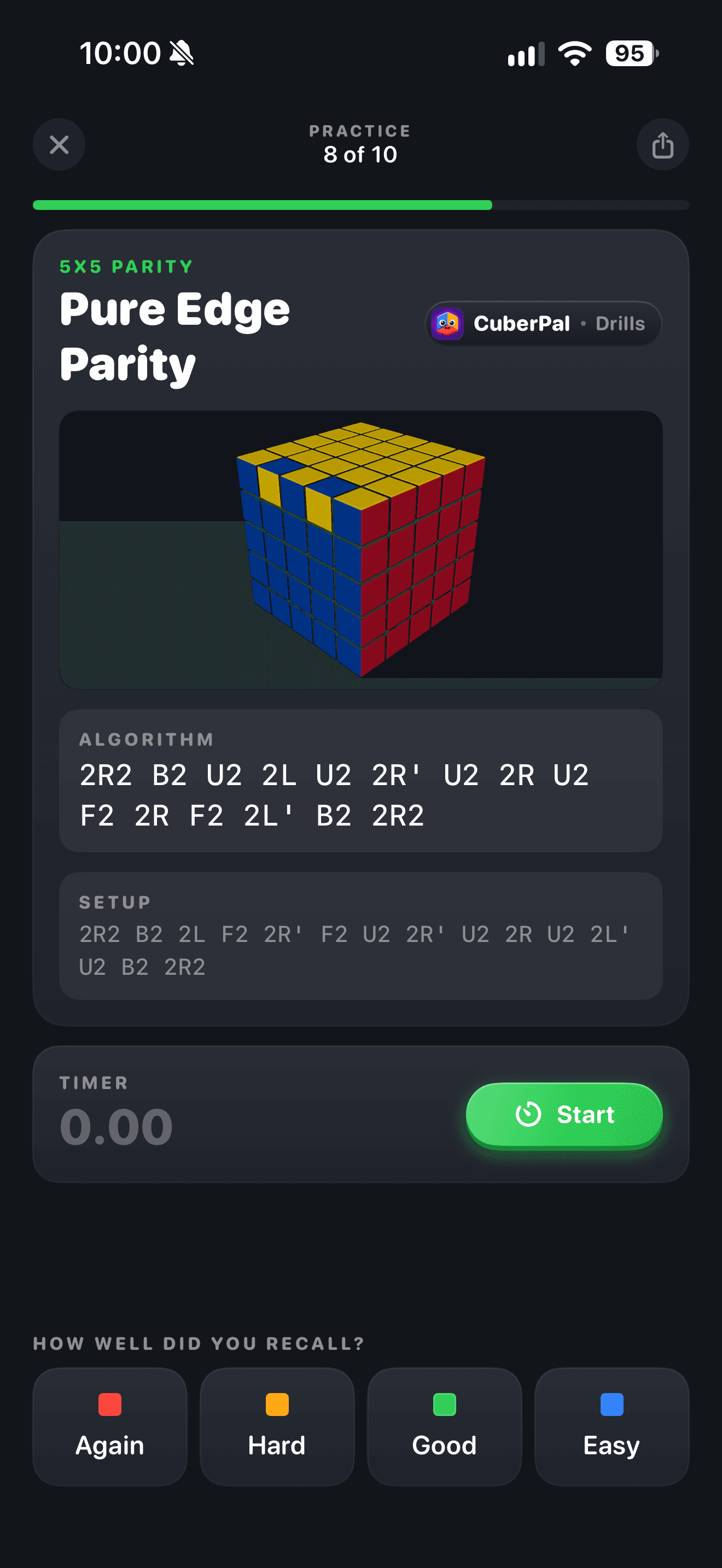
For each practice session, save the puzzle, method, total time, and the phase that felt least controlled. Add a short note about recognition, pauses, broken pairs, or a slow 3x3 finish. If you use a timer app, keep 5x5 results in their own event history so they do not blend into 3x3 or 4x4 averages. The current CuberPal App Store listing describes 5x5 timer support, event-specific history and stats, and event-aware scrambles and cube previews; those tools can help organize this record, but the improvement decision still comes from your observations. Review the notes after an average, choose one next drill, and start the next session with that decision already made.
Continue the learning path
Beyond 3x3
Pick one event that feels fun enough to practice consistently.
Open this topic clusterTurn this into practice
CuberPal combines a WCA-style timer, AI solve analysis, CFOP lessons, algorithm catalogues, spaced repetition, and a camera cube solver so speedcubing advice becomes a daily training loop.
Frequently asked questions
Do I need to learn Yau5 to get faster at 5x5?
No. A stable reduction solve is enough to build strong 5x5 fundamentals. Learn Yau5 when you understand centers and edge pairing and want to test its cross and early-F2L structure, not because changing methods automatically makes a solve faster.
Should I practice full 5x5 solves or individual stages?
Use both. Stage drills make centers and edge pairing easier to repeat and diagnose, while normal solves and averages show whether the improvement survives the full puzzle. End focused practice with at least one normal test when your technique is still accurate.
What is a good 5x5 time goal?
Choose a goal from your own baseline rather than a universal number. Your 3x3 skill strongly affects the final stage, so a measurable target such as fewer edge-pairing pauses or a more consistent average is more useful than copying someone else’s time.
Can a timer app help with 5x5 practice?
Yes, if it keeps the event separate and gives you reliable scrambles and averages. Use the app to organize attempts and trends, then pair those numbers with notes about centers, edge pairing, and the final 3x3 so the data leads to a specific drill.
Sources and fact checks
- [1]J Perm: Getting Faster at 5x5 — Supports the 5x5 improvement areas, free-slice edge pairing, reduction and Yau as popular methods, and the guidance that goals depend on 3x3 skill.
- [2]CubeSkills: Yau5 Method for Solving the 5x5 Cube — Supports the Yau5 order of centers, cross edges, remaining centers, edge pairing, two F2L pairs, and the final 3x3 stage.
- [3]World Cube Association Regulations — Supports that 5x5 is an official WCA event and that its full-round format is an Average of 5.
- [4]CuberPal on the App Store — Supports the current product claim that CuberPal includes 5x5 timer support, event-specific history and stats, and event-aware scrambles and cube previews.
Keep improving
How to Solve a 5x5 Rubik's Cube
Read next BlogHow to Get Faster at 4x4 Without Random Solves
Read next GuideThe Best Cube Timer Apps for iOS, Android and the Web
Read next BlogHow to Learn CLL Algorithms
Read next BlogHow to Solve a Square-1: Beginner Method
Read next BlogHow to Solve a Skewb
Read next