
How to Solve a Skewb
Quick answer
To solve a Skewb, first build one complete face with matching corner colors, then orient the opposite four corners, place the opposite center, and finish the remaining side centers. The method uses corner turns rather than ordinary face turns, so learn the small Sledgehammer sequence and keep the cube orientation fixed while you apply it.
On this pageUnderstand Skewb pieces and notation
A Skewb looks like a small cube, but it turns through its corners instead of turning whole faces. That difference makes the first few moves feel unfamiliar, yet the beginner solve is compact once you understand which pieces move together. This guide uses a four-stage method: solve one face, orient the opposite corners, solve the opposite center, and place the remaining side centers.
Keep the puzzle in the same orientation while reading each case. Skewb algorithms are short, but they depend on which corner is in front of you. If a sequence seems to make no progress, stop, return the puzzle to the stated grip, and check the direction of each turn before trying again.
Understand Skewb pieces and notation
A standard Skewb has eight corner pieces and six square center pieces. The centers are not fixed like the centers on a 3x3, so a face can look complete while its side colors still need to be placed. For this beginner method, choose a white center for the first face and use yellow as the opposite reference when you turn the puzzle over. If your color scheme uses different opposites, follow the same relationships rather than relying only on the color names.
The letters in Skewb notation identify corner turns. A letter without an apostrophe means a clockwise turn when you look toward that corner; an apostrophe means the opposite direction. The main sequence in this guide is the Sledgehammer: R' L R L'. In plain language, it is Right Down, Left Down, Right Up, Left Up. Practice it slowly on a solved puzzle until the four turns feel like one repeatable unit.
Step 1: Build the first face
Start with the white center facing up. Your goal is not merely four white stickers on top: the side colors of those four corners should match around the outside of the face. Find a white corner, identify the other two colors on it, and bring it beside the corresponding centers. Because the Skewb turns around a corner, use small setup turns and watch the pieces that you have already placed.
If a white corner is on the bottom, turn it into an open position before bringing it up. If a white corner is facing the wrong way, move it out of the working area and bring it back from another angle. When the last corner is awkward, it is usually faster to temporarily disturb a solved corner than to force the piece into place. Finish this stage when the white face and its four surrounding color pairs agree.
Step 2: Orient the opposite corners
Turn the Skewb upside down so the solved white face is on the bottom. Look at the four yellow corner stickers on top. At this point, do not worry about the yellow center or the side centers; only inspect whether the yellow stickers point upward. There are two useful cases. If two yellow corners point up and two point out, place one unsolved corner at the front and the other at the left, then do one Sledgehammer. If no yellow corner points up and two matching yellow stickers form headlights on one side, place that matching side on the right and do one Sledgehammer.
After the first case, the puzzle should become the second case. After the second case, all four yellow corners should point up. If the pattern does not match either description, rotate the whole puzzle to inspect the corners from another angle rather than changing the algorithm. This is a recognition step: the sequence is short, but the grip determines which corners it affects.
Step 3: Solve the opposite center
Keep white on the bottom and all four yellow corners pointing up. Hold the yellow center at the back. Perform the Sledgehammer once, rotate the entire Skewb 180 degrees horizontally, and perform the Sledgehammer again. The yellow center should now be on the solved top face. The important detail is that the 180-degree move is a whole-puzzle rotation, not another corner turn from the algorithm.
Step 4: Finish the side centers
Now place the remaining side centers. Hold white on the left and yellow on the right. You will have either three or four unsolved centers. With three unsolved centers, place the face containing the opposite center colors in front. Do one Sledgehammer, rotate the whole puzzle 180 degrees, and do the Sledgehammer again. With four unsolved centers, hold any unsolved center in front and use the same sequence; that setup reduces the puzzle to the three-center case.
When the centers are placed, check every face instead of stopping after one color looks solved. A Skewb can appear close to finished while one center is still in the wrong position. If only a small group remains, preserve the solved white and yellow faces, identify the three centers that need to cycle, and repeat the stated setup carefully. A legal Skewb move cycles pieces in groups, so an apparent two-center problem usually means the puzzle is being viewed from the wrong angle or a setup turn was not undone.
Common beginner mistakes
Most failed Skewb solves come from orientation or recognition, not from needing a longer algorithm list. Use this checklist when a solve stalls:
- You solved four stickers, but not a color-matched first face. Recheck the side colors around the face.
- You used the right sequence from the wrong grip. Put the named corner or center back in front before repeating it.
- You confused a whole-puzzle rotation with an algorithm turn. Pause after the Sledgehammer and rotate the entire puzzle 180 degrees.
- You changed methods halfway through. Finish one beginner solve slowly before trying to optimize the same cases.
How to practice after your first solve
For the first practice session, do not chase turning speed. Scramble the Skewb, solve it untimed, and say the stage out loud: first face, opposite corners, opposite center, side centers. Your first goal is reliable recognition. Once you can finish several solves without checking the guide, time a small set and write down where the pause happened.
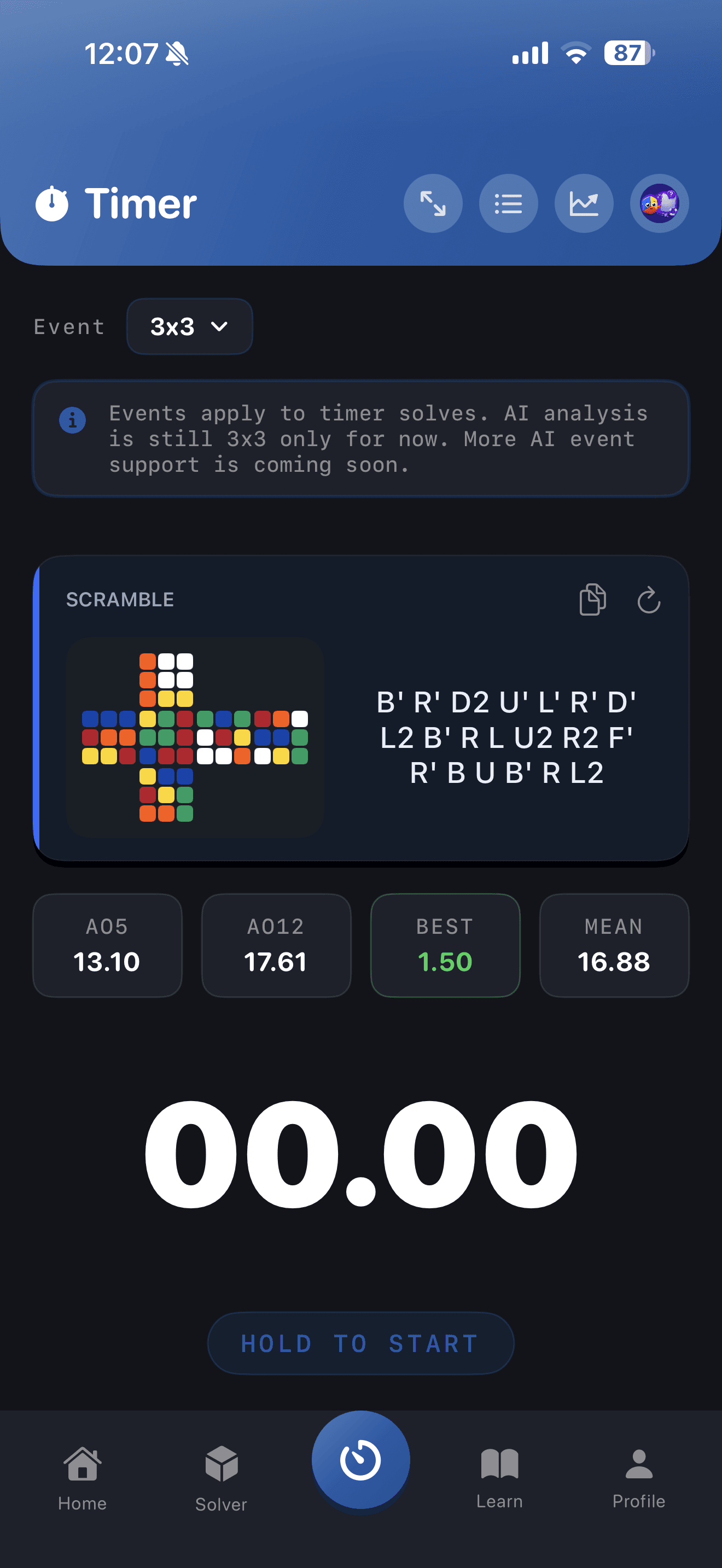
The World Cube Association lists Skewb as an official event with Average of 5 as the full-round format. That makes a five-solve practice set a useful competition-shaped checkpoint: remove the best and worst results, then average the middle three. It is not a replacement for official competition procedure, but it gives you a consistent way to compare sessions. CuberPal's current product evidence confirms a WCA-style timer, scrambles, and separate event support through 5x5 and one-handed solving; it does not list Skewb-specific timer support, so use the app only for the general timing workflow unless its live product support changes.
After each set, choose one improvement target. If the first face is slow, practice placing corners without algorithms. If the opposite corners cause hesitation, drill recognizing the two cases before turning. If the last centers fail, slow the whole-puzzle rotation and verify the front face. Small, repeatable corrections are more useful than trying to turn the Sledgehammer faster before you can recognize where it belongs.
What to learn next
Once the beginner method feels automatic, keep the same solve stages and improve one transition at a time. Learn to recognize the first-face pieces earlier, reduce unnecessary rotations, and make the Sledgehammer consistent from both directions. Only then explore faster Skewb methods or larger algorithm sets. A method you can recognize and execute accurately gives you a better foundation than memorizing advanced cases before you understand the puzzle's piece flow.
Continue the learning path
Beyond 3x3
Pick one event that feels fun enough to practice consistently.
Open this topic clusterTurn this into practice
CuberPal combines a WCA-style timer, AI solve analysis, CFOP lessons, algorithm catalogues, spaced repetition, and a camera cube solver so speedcubing advice becomes a daily training loop.
Frequently asked questions
Is Skewb easier to solve than a Rubik's Cube?
The puzzles turn differently, so Skewb can feel strange at first. Its beginner solution uses a small number of stages and a short repeatable sequence, but you still need to recognize the correct grip and distinguish movable centers from corners. Easier depends on which turning style feels natural to you.
What is the Sledgehammer on Skewb?
In the notation used here, the Sledgehammer is R' L R L'. Skewbicle describes it as Right Down, Left Down, Right Up, Left Up. Practice the sequence on a solved puzzle slowly, then use it only after matching the case and grip described in the step.
Why do my Skewb centers keep getting mixed up?
Centers are movable on a Skewb, so a correct-looking face does not guarantee that the side centers are in place. Recheck the whole-puzzle orientation, confirm the front face for the three-center case, and separate each Sledgehammer from the 180-degree whole-puzzle rotation.
Is Skewb an official WCA competition event?
Yes. The current WCA Regulations list Skewb among the official events, and its full-round format is Average of 5. Competition lineups, cutoffs, and time limits can vary, so check the specific competition page rather than assuming every event is offered.
Sources and fact checks
- [1]World Cube Association Regulations — Supports Skewb as an official event, the Average of 5 full-round format, competition scramble rules, and the current event regulations.
- [2]Ruwix Skewb Beginner's Solution Guide — Supports the Skewb piece description, corner-based notation, first-face method, center cycling, and final-corner algorithms.
- [3]Skewbicle Skewb Tutorial — Supports the four-stage beginner flow, Sledgehammer definition, case recognition, whole-puzzle rotation, and center-finishing instructions.
- [4]CuberPal App Store listing — Supports the bounded product claim about CuberPal's WCA-style timer, scrambles, and listed event-specific support through 5x5 and one-handed solving.