How to Get Faster at One-Handed Cubing
By CuberPal Editorial Team · Updated 2026-09-16 · Editorial standards
Quick answer
To get faster at one-handed cubing, keep your grip stable, remove turns that force awkward regrips, and practise the solve in small pieces before timing complete attempts. Start with controlled turning, adapt your cross and F2L solutions to your solving hand, choose reliable one-handed algorithms, and track an Average of 5 or a comparable set so each change has evidence behind it.
Set a one-handed baseline before changing technique
Begin with a small set of normal one-handed solves using the hand, cube, and timer setup you expect to keep. Five solves can show whether the session is workable, but a longer set is better for judging consistency because one lucky scramble should not decide your training plan. Record the average, the slowest attempt, and the point where the solve felt least controlled. You do not need to know every cause yet. A simple note such as grip loss during F2L, a pause before OLL, or an awkward U adjustment after PLL is enough to create a first hypothesis. Keep your regular two-handed average nearby as context, not as a second goal. One-handed solving has different mechanical limits, so compare the event with its own previous results.
Build a grip that stays quiet
Your first speed gain usually comes from making the cube predictable in your hand. Choose the hand that lets you support the cube without squeezing it, then practise holding the puzzle through the same broad stages of the solve. The thumb and fingers should guide the cube while the wrist and forearm remain relaxed. If a turn makes the cube slide, fix the grip or the solution before trying to turn harder. Use short repetitions of the moves that repeatedly break your hold: a U adjustment, a wide turn, a D move, or a last-layer trigger. Stop when your hand starts compensating with tension. A stable grip makes recognition easier because the cube returns to familiar viewing angles after each sequence.
Separate turning drills from full solves
Do not make every practice attempt a race. Spend a few minutes on isolated turning patterns at a pace where every move is deliberate, then reconnect them inside a solve. For example, repeat a comfortable R U R-prime U-prime trigger, practise U turns while keeping the cube supported, or execute a familiar PLL without looking at the timer. The objective is not a record for the isolated sequence; it is to find a motion that stays accurate without a corrective regrip. After the drill, do several slow solves and check whether the same movement remains available when you are also searching for pieces. If accuracy falls apart when attention is divided, the drill needs more gradual transfer rather than more speed.
Adapt your cross and F2L choices
A two-handed solution is not automatically the best one-handed solution. During cross practice, look for an order and orientation that keeps the cube supported and avoids a sequence of moves your hand cannot execute comfortably. You can still plan the cross during inspection, but judge the plan by control and continuity as well as move count. In F2L, choose pair solutions that keep the useful faces visible and reduce forced rotations. When two insertions solve the same pair, prefer the one with fewer awkward grip changes even if it is not the shortest sequence on paper. Practise one pair at a time with the rest of the cube ignored, then use slow solves to see whether the choice improves your ability to find the next pair. One-handed speed is often won through easier decisions, not maximum turning speed.
Make last-layer algorithms reliable in your hand
Once the cube reaches the last layer, audit the algorithms that regularly cause a stop or a dropped grip. Keep a version that you can execute cleanly with your chosen hand, and learn a replacement only when the repeated problem is clear. Practise recognition separately: show yourself a case, name it, set the cube to the starting angle, and execute without rushing. Then add an AUF or final adjustment and confirm that the cube ends in the expected orientation. One-handed algorithm practice should include the awkward cases, not just the sequences that already feel good. If you use a catalog or trainer, record the cases that fail because of recognition, recall, grip, or turning. Those are different problems and need different drills.
Use slow solves to train lookahead
Lookahead still matters in one-handed solving, but it becomes harder when your turning hand is also stabilizing the puzzle. Use slow solves where the cube keeps moving at a pace that leaves your eyes time to find the next piece. After each F2L insertion, search for the next corner and edge before you accelerate. If you lose the pair, slow down again instead of adding a rotation just to recover speed. Try a few solves with the goal of zero full stops, then a few at a moderate pace where you preserve the same visual habit. This creates a bridge between technique work and timed solves. A session that feels slow can still be productive if it reduces the number of times your eyes and hand wait for each other.
Track the event with comparable averages
Use an Average of 5 when you want a compact check on a session, and use a larger set when you want to see whether a change survives normal variation. Keep the same solving hand and avoid mixing experimental drills into the comparison set. After an average, write one sentence about the main loss: for example, three F2L pauses, two grip slips, or a recognition delay on the final layer. That note is more useful than a vague feeling that the session was bad. A timer that keeps one-handed results separate from other events can make this routine easier. CuberPal currently lists one-handed timing with WCA inspection, scrambles, ao5, ao12, and personal-best tracking; use those listed timer features to log the practice event, while treating the coaching plan here as your own training decision.
Follow a four-week practice cycle
For week one, make the grip and basic turning movements repeatable. Use short untimed blocks, then finish with a few relaxed solves. In week two, focus on cross order and one or two F2L choices that feel awkward in your current hand. Keep the rest of your method stable so you can tell whether the change helps. In week three, select a small set of last-layer algorithms or recognition cases and practise them without the clock before reconnecting them to solves. In week four, alternate controlled solves with comparable averages. Review the notes at the end of each session and keep the next target narrow. If the average improves but the hand feels tense, do not call the change finished; comfort and repeatability protect the progress you want to keep.
Diagnose a plateau without chasing TPS
When progress stops, first decide whether the limit is mechanical, visual, or procedural. A mechanical limit appears as repeated lockups, regrips, or loss of control on the same moves. A visual limit appears as searching for the next pair or failing to recognize the last layer while the cube is already positioned well. A procedural limit appears when your practice changes every session and no result can be compared. Pick one category, design a small test, and repeat it enough to learn something. It may be useful to keep practising regular two-handed 3x3 as well: the underlying skills of recognition, lookahead, and efficient solutions still transfer, even though the physical execution differs. Faster one-handed cubing comes from making more of the solve boringly repeatable, not from forcing every turn to be maximal.
Continue the learning path
Beyond 3x3
Pick one event that feels fun enough to practice consistently.
Open this topic cluster →Turn this into practice
CuberPal combines a WCA-style timer, AI solve analysis, CFOP lessons, algorithm catalogues, spaced repetition, and a camera cube solver so speedcubing advice becomes a daily training loop.
Download CuberPal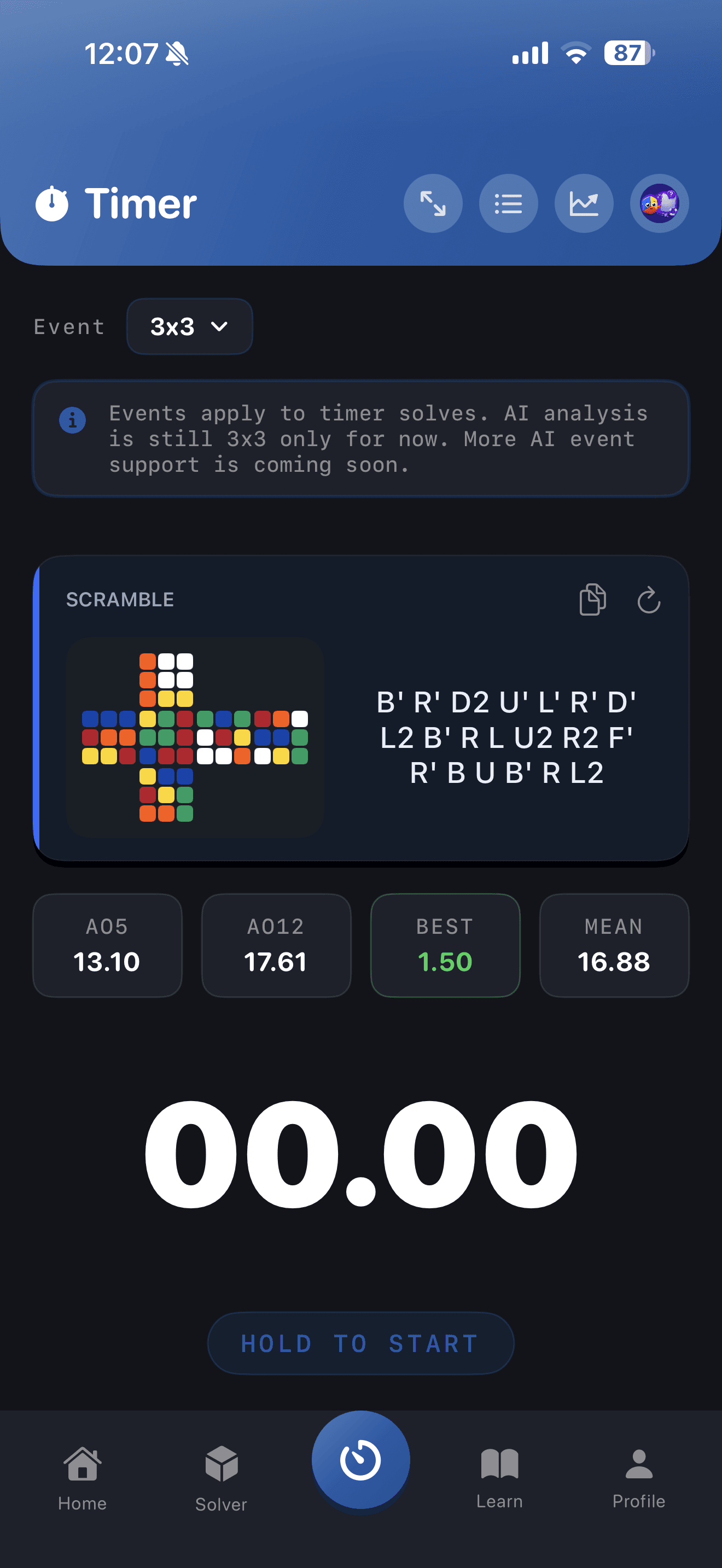
Frequently asked questions
Should I practise one-handed cubing with my left or right hand?▾
Choose the hand that gives you the most stable support and the least tension, then keep it fixed while you build a baseline. You can test the other hand later, but switching constantly makes it difficult to tell whether a technique change helped.
How much slower should one-handed solves be than two-handed solves?▾
There is no useful universal target because the gap depends on your two-handed level, experience, grip, and method. Compare one-handed averages with your own earlier one-handed averages, and use comfort and consistency as evidence alongside time.
Do I need special one-handed algorithms to get faster?▾
Not immediately. Start with algorithms you can execute accurately, then replace only the cases that repeatedly force a pause, awkward regrip, or loss of control. Specialised one-handed versions are useful when they solve a demonstrated problem.
Should I time every one-handed practice solve?▾
No. Mix untimed technique and slow-lookahead work with comparable timed sets. The timed set tells you whether the skill transfers to a full solve, while untimed work lets you correct the movement without racing through the same mistake.
Sources and fact checks
- J Perm: Getting Faster at One Handed Solving — Supports the one-handed focus on adapting F2L solutions, lookahead, cross moves, one-handed finger tricks, and the transfer of core 3x3 skills.
- CubeSkills: Introduction to One Handed Speedcubing — Supports the beginner progression through hand choice, grip, turning, improving turning, and executing solutions differently.
- CubeSkills: Intermediate One Handed Tips — Supports the intermediate practice areas of cross execution, F2L tips, last-layer tips, and one-handed turning advice.
- World Cube Association Regulations — Supports the current official status of 3x3x3 One-Handed, its Average of 5 full-round format, inspection context, and the one-hand-only solving rule.
- Apple App Store: Cubing Timer & Coach: CuberPal — Supports the bounded product claim that CuberPal times one-handed solves with WCA inspection, scrambles, ao5, ao12, and personal-best tracking.