
One-Handed Cubing: How to Start on 3x3
Quick answer
Start one-handed cubing with the 3x3 method you already know, at a deliberately easy pace. First build a repeatable grip and a few comfortable turns, then time short controlled sessions and change only the moves or algorithms that repeatedly break your flow. If you plan to compete, learn the WCA one-handed rules separately from your practice routine.
On this pageStart with a solvable first session
Start with a solvable first session
One-handed cubing, often called OH, is not a reason to discard everything you know about 3x3. Begin with your usual method and make finishing the solve the first goal. Pick an easy scramble, use the hand that feels steadier for the moment, and accept a much slower solve than your two-handed average. The useful question after that solve is not “Why was the time bad?” It is “Where did the cube stop feeling controllable?” That answer gives you a specific next drill instead of a vague urge to turn faster.
Keep the first session small: complete three untimed solves, then three relaxed timed solves. After each solve, name one friction point in plain language, such as losing the grip before a U turn, pausing before an F2L insert, or restarting a last-layer algorithm. Do not try to correct all three at once. A narrow target makes it easier to notice whether a change actually helped on the next attempt.
Build a grip and turning vocabulary before chasing speed
Choose a grip that lets you see the pieces you need without constantly regripping. Then practise a short set of turns from that grip: U, U-prime, R, R-prime, and the moves that your own solves ask for most often. Make each turn clean and return to the same resting position. If you must squeeze harder, reposition the entire cube, or use your free hand to recover, reduce the pace. Control is the prerequisite for reliable finger tricks, not a reward for being fast.
Treat the table as an optional training aid, not a shortcut to hide a bad grip. A few solves with the cube supported can help you isolate one awkward turn; a few solves held entirely in hand can reveal whether the grip is truly repeatable. Alternate the two only when you can explain what you are testing. For example: “I am using the table for this set so I can practise a smooth front-face turn without dropping the cube.”
Adapt solutions only after you can identify the problem
Most of your normal 3x3 knowledge still applies to OH, but some moves and algorithms can feel very different with one hand. Keep a familiar F2L solution or last-layer algorithm when it flows. Change it only when you can point to the exact interruption: an uncomfortable regrip, a turn you cannot execute cleanly, or a sequence that repeatedly makes you lose orientation. That keeps you from replacing useful muscle memory with a larger algorithm list before you need it.
Use a simple decision rule. Record one troublesome case, try your normal solution slowly twice, then test one alternative solution or execution twice. Keep the alternative only if it is more controlled in both attempts. This is not a claim that one algorithm is universally best; it is a way to choose based on your own hand position and consistency. J Perm’s OH material similarly separates general 3x3 skills from the moves and algorithms that may need a different execution.
Use slow solves to protect lookahead
OH exposes pauses that two-handed turning can conceal. Start a set slowly enough that you can look for the next F2L pair while finishing the current one. When you lose sight of the next piece, do not compensate with faster turning. Finish the pair, stop briefly, and identify whether the pause came from recognition, an awkward turn, or an uncertain solution. Those are different problems and deserve different drills.
A useful ten-solve structure is five slow solves focused on uninterrupted F2L, followed by five solves focused on one named turning problem. Write down only two observations: the recurring pause and the recurring awkward move. On the next session, warm up with that move or case before returning to full solves. This keeps the timer from turning every attempt into an unhelpful verdict on your overall ability.
Measure a focused OH session
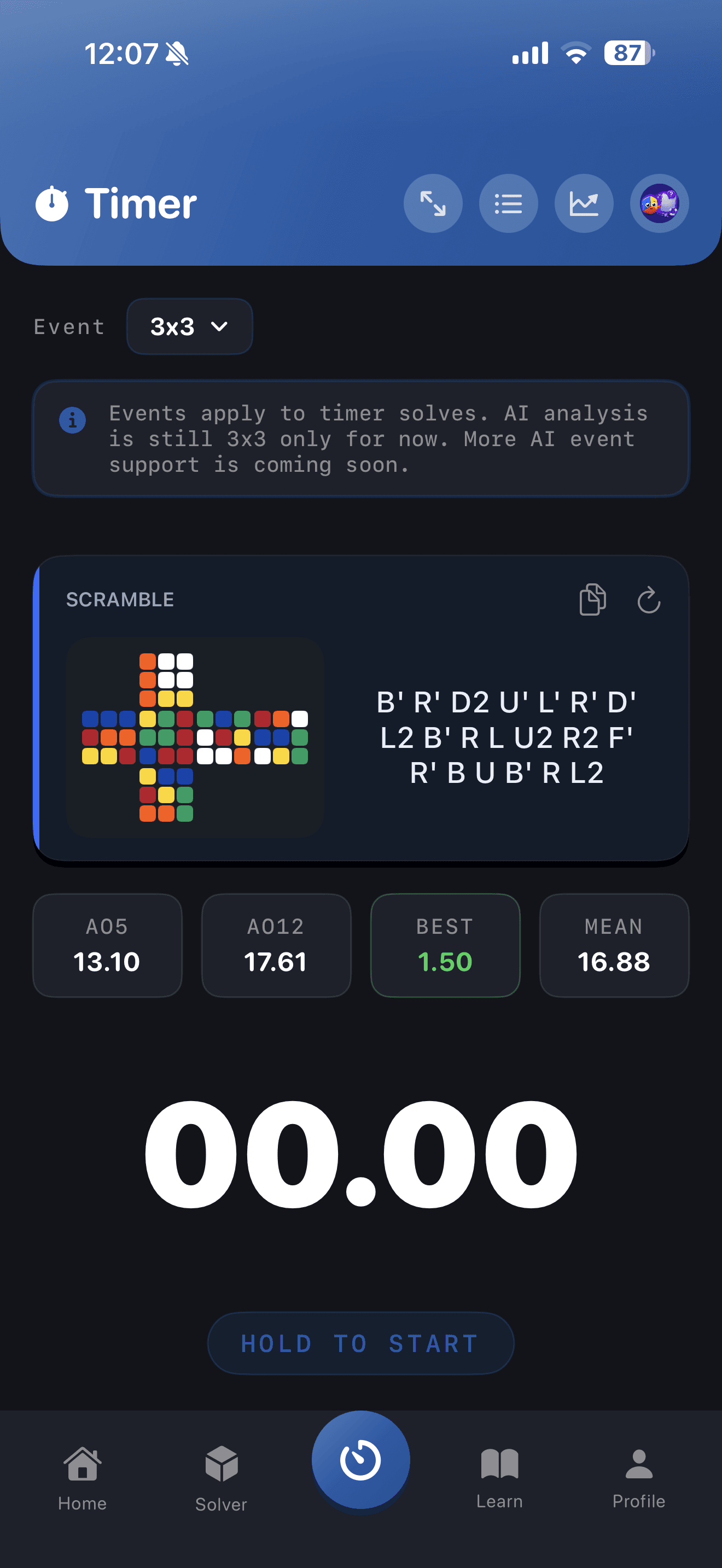
Keep one-handed results separate from ordinary 3x3 results so the comparison stays honest. Record the scramble, time, and one short note about the target for that session. The CuberPal timer screen is useful here because it pairs a scramble with a timed solve; use the same target for a small batch rather than switching from grip work to algorithms to raw speed every solve. A timer gives you a record, while the note tells you what the number was meant to measure.
Review the batch after it ends. If the same awkward turn appeared in most solves, spend the next session on that turn in isolation. If the times vary widely but your grip felt stable, keep the technique target and add more slow full solves. If the grip broke down, lower the pace again. The point is to make the next session different because of evidence from this one, not because a single fast or slow solve changed your mood.
Know the WCA boundary before a competition
For official 3x3 One-Handed, the World Cube Association lists OH as an event and applies the standard speed-solving procedure with additional one-handed rules. You may use both hands during inspection. Once the solve is underway, only one hand may operate the puzzle; operating it with the other hand is a DNF. The regulations also allow holding the puzzle against the surface to help operate it. Read the current regulations yourself before competing, because the competition setting is stricter than a casual home practice session.
Practise the competition sequence separately from technique drills. Run a few attempts with inspection, place the puzzle down, start cleanly, solve with one operating hand, release the puzzle, and stop the timer correctly. Then return to your focused grip or algorithm work. Separating these modes lets you improve OH mechanics without confusing them with rule recall, and it makes the transition to a first competition much less surprising.
Your next three one-handed sessions
Session one: finish relaxed solves and write down the one move that breaks your grip most often. Session two: practise that move and one related F2L or last-layer case slowly, then test it in five full solves. Session three: run a small timed batch with one target, review the repeated pause or awkward move, and choose just one adjustment for the next week. That sequence creates a baseline, a controlled experiment, and a practical next step without pretending that OH progress follows one universal timetable.
Continue the learning path
Beyond 3x3
Pick one event that feels fun enough to practice consistently.
Open this topic clusterTurn this into practice
CuberPal combines a WCA-style timer, AI solve analysis, CFOP lessons, algorithm catalogues, spaced repetition, and a camera cube solver so speedcubing advice becomes a daily training loop.
Frequently asked questions
Do I need a new method for one-handed cubing?
No. Start with the 3x3 method you already know. Keep solutions that feel controlled, then adapt only the specific turns or algorithms that repeatedly interrupt your grip or execution.
Can I use both hands during WCA one-handed inspection?
Yes. The current WCA regulations allow both hands during inspection. During the solve, however, only one hand may operate the puzzle, so review the current regulations before competing.
Should I time one-handed solves from the first day?
Yes, but use a few relaxed timed solves as a record rather than a judgment. Keep the batch small, give it one technique target, and write down the recurring pause or awkward move for the next session.
Sources and fact checks
- [1]World Cube Association Regulations — Supports that 3x3 One-Handed is an official event and the current competition rules on inspection, one operating hand, surface use, and timer procedure.
- [2]J Perm: One-Handed Solving — Supports the guidance that core 3x3 skills still apply in OH while F2L solutions, cross moves, finger tricks, and some algorithms may need different execution.
- [3]CubeSkills: Introduction to One Handed Speedcubing — Supports the beginner OH learning progression around hand choice, grip, turning, improving turns, changing solutions, and example solves.
- [4]CuberPal: Rubik's Cube Timer, Solver & AI Coach — Supports the current CuberPal timer and practice-path context for the product image and the article's focused timed-session suggestion.