
How to Get Faster at 4x4 Without Random Solves
Quick answer
To get faster at 4x4, first make your current reduction solve repeatable: time a small set, identify whether centers, edge pairing, parity, or the final 3x3 stage is costing the most, and train only that phase for the next session. Learn an upgrade such as Yau only after you can explain the specific delay it will remove. Record another comparable set before choosing the next priority.
On this pageStart with a small, honest baseline
A 4x4 solve can feel too complicated to diagnose. Centers, paired edges, a familiar 3x3 finish, and occasional parity all arrive in one long attempt, so doing more full solves can hide the actual problem. The useful question is not whether the whole solve felt slow. It is which stage repeatedly interrupted a clean solve. This plan keeps the method simple enough to measure before adding more algorithms.
Start with a small, honest baseline
Begin a session with five ordinary 4x4 solves using fresh scrambles. Do not reset a frustrating scramble or keep searching for a lucky one. Write down the time, then add one short note: centers, edge pairing, parity, or 3x3 stage. Five solves are enough to reveal a repeated friction point without turning the baseline into a whole workout. The WCA lists 4x4 as an official event and uses Average of 5 as a full-round format, so a five-solve set is also a familiar way to look beyond a single lucky or unlucky result.
After the fifth solve, count the notes rather than guessing from the average. If three solves stalled during edge pairing, that is the next practice target. If the times are uneven because parity caused two long solves, practice the parity recognition and execution separately, then return to full solves. A baseline is useful only when it produces one clear next action.
Make reduction reliable before chasing Yau
The reduction approach solves centers, pairs edges, and then finishes as a 3x3. J Perm presents it as the beginner method commonly used on larger cubes. That is a good training order when 4x4 is still new: clean up the phase that is already in front of you before replacing the whole workflow. During a centers-only drill, ignore the timer after each center is complete and notice whether you repeatedly scan the same pieces, undo a plan, or rotate just to find a color. Name one of those behaviors and remove it on the next scramble.
Yau is a meaningful upgrade, not a badge to collect. Its sequence starts with two opposite centers and three cross edges, finishes the remaining centers and cross, then pairs the other edges before the 3x3 stage. J Perm describes the benefit as keeping the D layer clear while pairing, which can reduce rotations and make lookahead easier. Adopt it only when your notes show that edge pairing and rotations are a real recurring loss. For the first week, use Yau on untimed or deliberately slow solves so the new order becomes understandable before you judge it by a time.
Turn edge pairing into a controlled drill
For one practice block, stop a solve after centers and work only on pairing the first four edges. The aim is not a fast partial time. It is to see a pair, choose an empty working slot, and complete the pair without changing the plan halfway through. Reset and repeat with a new scramble. If you get lost, slow down until you can say which two wing pieces you are joining and where the pair will go. That deliberate pace is more valuable than rehearsing frantic turns that you cannot reproduce.
When the first four pairs feel less chaotic, complete a few full reductions and keep the same single note after each solve. Do not add a new edge-pairing technique and a new last-layer algorithm in the same session. One changed variable makes the next baseline readable; several changes only make it impossible to know what helped.
Treat parity as a prepared interruption
Parity is not evidence that a solve has gone wrong. It is a situation that can appear after reduction, so it deserves a calm, separate routine. Keep one trusted parity resource beside your practice area and rehearse the case slowly until the grip, setup, and finish are predictable. In full solves, label the interruption, execute the routine deliberately, and return to the phase you were solving. Do not try to compensate by rushing the next 3x3 moves; that usually creates a second error and hides the real time cost.
If parity is the reason a five-solve set looks inconsistent, keep a second count: how often it appeared and how reliably you finished it. That separates a recognition or execution problem from normal variation in scramble difficulty. Once the routine is dependable, put your attention back on the phase that consumes more of every solve, usually centers or edge pairing.
Finish the 3x3 stage without abandoning the 4x4 problem
Reduction ends in a 3x3 stage, so basic 3x3 fluency still matters. Use a familiar last-layer approach and avoid changing it merely because a 4x4 average is slow. If the final stage is repeatedly the only weak note in your baseline, work on that 3x3 skill in a separate short block. Otherwise, spend the main 4x4 session on the larger-cube phase that created the delay. This prevents a comfortable 3x3 drill from becoming a way to avoid centers and edge pairing.
Use a timer to make the next session smarter
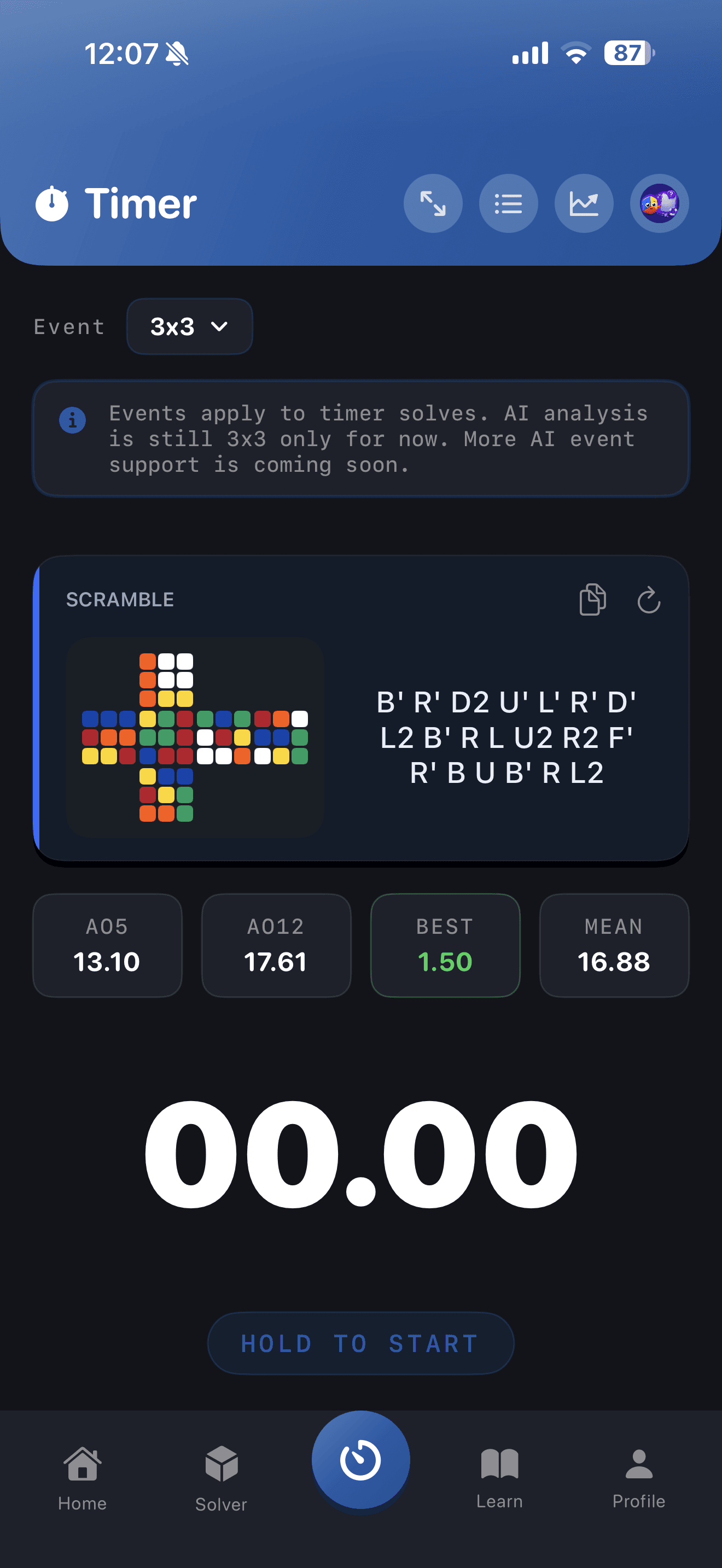
End the session with another five fresh scrambles and compare the notes with the starting set. A lower average is welcome, but the stronger result is a narrower pattern: fewer edge-pairing stalls, fewer unplanned rotations, or a parity routine that no longer derails the solve. CuberPal currently supports 4x4 timing, event-specific history and statistics, and event-aware scrambles according to its App Store listing. Use the timer history to keep 4x4 results separate from 3x3, then choose the next drill from what the new set actually shows.
Continue the learning path
Beyond 3x3
Pick one event that feels fun enough to practice consistently.
Open this topic clusterTurn this into practice
CuberPal combines a WCA-style timer, AI solve analysis, CFOP lessons, algorithm catalogues, spaced repetition, and a camera cube solver so speedcubing advice becomes a daily training loop.
Frequently asked questions
Should I learn Yau before I am fast at reduction?
Not automatically. Learn Yau when your own solve notes show repeated edge-pairing delays or unnecessary rotations that its order can address. A reliable reduction solve gives you the context to understand whether the change helped.
How many 4x4 solves should I do in one practice session?
Use a small baseline, one focused drill block, and a second comparable baseline. The point is to leave with a specific pattern to train next time, not to accumulate a large number of undiagnosed solves.
Should I practice parity separately?
Yes. Rehearse a trusted parity routine slowly until recognition, grip, and execution are predictable, then return to full solves. Track how often it appears separately from the phases that delay every solve.
Sources and fact checks
- [1]J Perm: 4x4 How To Get Faster — Supports the reduction-method sequence, the Yau sequence and its stated edge-pairing advantages, plus the framing of advanced 4x4 techniques.
- [2]World Cube Association Regulations — Supports 4x4 as an official WCA event, the Average of 5 format, and the current inspection and speed-solving procedures mentioned as competition context.
- [3]CuberPal on the App Store — Supports the current product claim that CuberPal has 4x4 timer support, event-specific history and statistics, and event-aware scrambles.