
OLL Recognition
Quick answer
Improve OLL recognition by using a fixed top orientation, classifying the edge pattern first, then reading oriented corners and side stickers. Drill case naming separately from algorithm execution, include all four U-face angles, and track whether a miss came from seeing, recalling, or turning the case.
On this pageRecognition starts before F2L ends
- Recognition starts before F2L ends
- Use a feature hierarchy instead of 57 pictures
- Read side stickers, not only the top face
- Separate the U adjustment from the case
- Train seeing, recalling, and turning independently
- Build the full set in recognition families
- Move from one-face to two-side recognition
- Connect OLL to the surrounding phases
- A 15-minute OLL recognition session
Recognition starts before F2L ends
OLL recognition is the ability to identify the last-layer orientation case and its alignment without searching around the cube. The first improvement is not faster guessing; it is moving your eyes to the top layer while the final F2L insert is still being executed. You already know where that pair will go, so use the remaining turns to collect OLL information.
Keep the last-layer color on top throughout practice. Color neutrality does not mean rotating OLL to a different face mid-solve. A fixed orientation lets visual cues become consistent. When the final pair finishes, resist turning immediately. Name the pattern, choose the adjustment, and then execute. This brief deliberate pause builds correct classification before you try to remove the pause.
Use a feature hierarchy instead of 57 pictures
Start by counting oriented top edges: zero, two, or four. With two, distinguish line from L. Then count oriented corners and note their relative positions. Finally inspect side-facing top-color stickers to separate cases that share the same top pattern. This hierarchy narrows the candidate set at each step and gives you a repeatable question under pressure.
Many algorithm libraries group OLL by shapes such as dots, lines, squares, lightning, fish, and all-edges-oriented cases. Group names vary, but grouping itself is useful because related cases share visible structure. Do not memorize the catalogue order or case number as the primary cue. In a solve, you need the shape and the action; the number is only a label for notes and lookup.
Read side stickers, not only the top face
Several OLLs have the same pattern when viewed from directly above. Their side stickers reveal which corners are twisted and which way the case must be held. Choose two adjacent viewing faces, usually front and right, and learn the decisive stickers visible there. This supports two-sided recognition without rotating the cube.
A cue should be small and specific: a pair of top-color stickers facing you, a bar on the right, or two opposite stickers pointing outward. Avoid cues such as it looks like the other lightning case. Write the actual difference. When mirror cases are confused, place their diagrams side by side and name one feature that changes. Then alternate them until the choice is automatic.
Separate the U adjustment from the case
A known OLL can appear in four rotations of the U face. The underlying orientation relationship is the same, but your algorithm expects a particular angle. During drills, identify both the case and the smallest U adjustment needed to reach your preferred setup. Randomize the angle so recognition does not become dependent on one flashcard orientation.
Decide whether you perform the adjustment before recalling the algorithm or fold it into the first trigger. Either can work, but inconsistency causes double adjustments. A useful spoken rep is case name, U-prime, execute. As speed grows, the words disappear while the decision remains. If you often begin the right algorithm from the wrong angle, the problem is alignment recognition, not algorithm memory.
Train seeing, recalling, and turning independently
Recognition-only practice shows a random case for a short interval. Name the case, adjustment, and first move, then reveal the answer without executing. Recall practice starts from the name or diagram and asks you to produce the sequence slowly. Execution practice gives a known aligned case and measures clean turns. Each block isolates a different link in the chain.
Use a simple error code: V for visual misclassification, M for memory failure, and E for execution error. After 20 mixed reps, the dominant code tells you what to do next. More algorithm repetitions will not fix a visual mirror confusion. More diagram study will not fix a regrip. This distinction prevents large practice volumes from masking the same unchanged weakness.
Build the full set in recognition families
If you use two-look OLL, master its edge and corner families first. For full OLL, add a small group that shares a feature but has clear differences. Learn two to four cases, mix them with old material, and delay the next group until random recognition is accurate. The goal is discrimination, not simply recalling each case when presented alone.
Choose early full OLL cases that are easy to identify or replace a slow two-look combination. Keep a fallback route for uncertain cases. Spaced review matters because 57 sequences and shapes decay at different rates. Review missed and slow cases more often, but continue sampling strong cases so similar patterns remain separated. A practice catalogue is most useful when it records those states instead of treating every case equally forever.
Move from one-face to two-side recognition
At first, rotating the U face to find a familiar picture is acceptable. Next, recognize from the top plus front. Then add the right side so hidden stickers can be inferred. Film solves and count cube rotations or exploratory U moves before OLL. Replace one search pattern at a time rather than demanding instant two-sided recognition for all 57 cases.
Practice with the cube below eye level as it appears during actual solves, not only with a perfect overhead diagram. Vary lighting and scramble colors while keeping the last-layer color fixed. Recognition should be based on sticker relationships, so the identity of the front center should not matter. If a case is only recognizable with green in front, the cue is tied to color rather than orientation.
Connect OLL to the surrounding phases
A strong OLL begins with the final F2L insert. Learn which insert choices preserve a useful viewing angle and leave your hands ready for the OLL's first move. During the last OLL trigger, begin reading PLL blocks and headlights. You do not need full prediction; noticing one bar can reduce the next search. Transitions turn isolated case speed into solve speed.
Time OLL from the last F2L move to the last OLL move, then occasionally split recognition from execution on video. If isolated algorithms are fast but the phase is slow, transitions or cues are responsible. If recognition is instant but execution varies, compare algorithms and fingertricks. Keep the measurement definitions stable so improvements are real rather than changes in where you start the stopwatch.
A 15-minute OLL recognition session
Spend three minutes reviewing two confusing cases side by side. Spend five minutes on 20 recognition-only prompts from random U angles. Spend four minutes executing only the misses at controlled speed. Finish with three minutes of normal last-layer solves and record whether the cue appeared without a search. Stop adding new cases when accuracy falls; repair the distinction first.
Review the log weekly. Retire cases that are fast and accurate into lower-frequency maintenance, and increase exposure for slow or confused cases. The session should end with a concrete next target, such as distinguish two lightning mirrors from the front-right view. That specific target leads naturally into the next practice block and is much more useful than trying to recognize OLL faster in general.
Continue the learning path
CFOP algorithms
Learn a small set, drill recognition, then use spaced repetition to retain it.
Open this topic clusterTurn this into practice
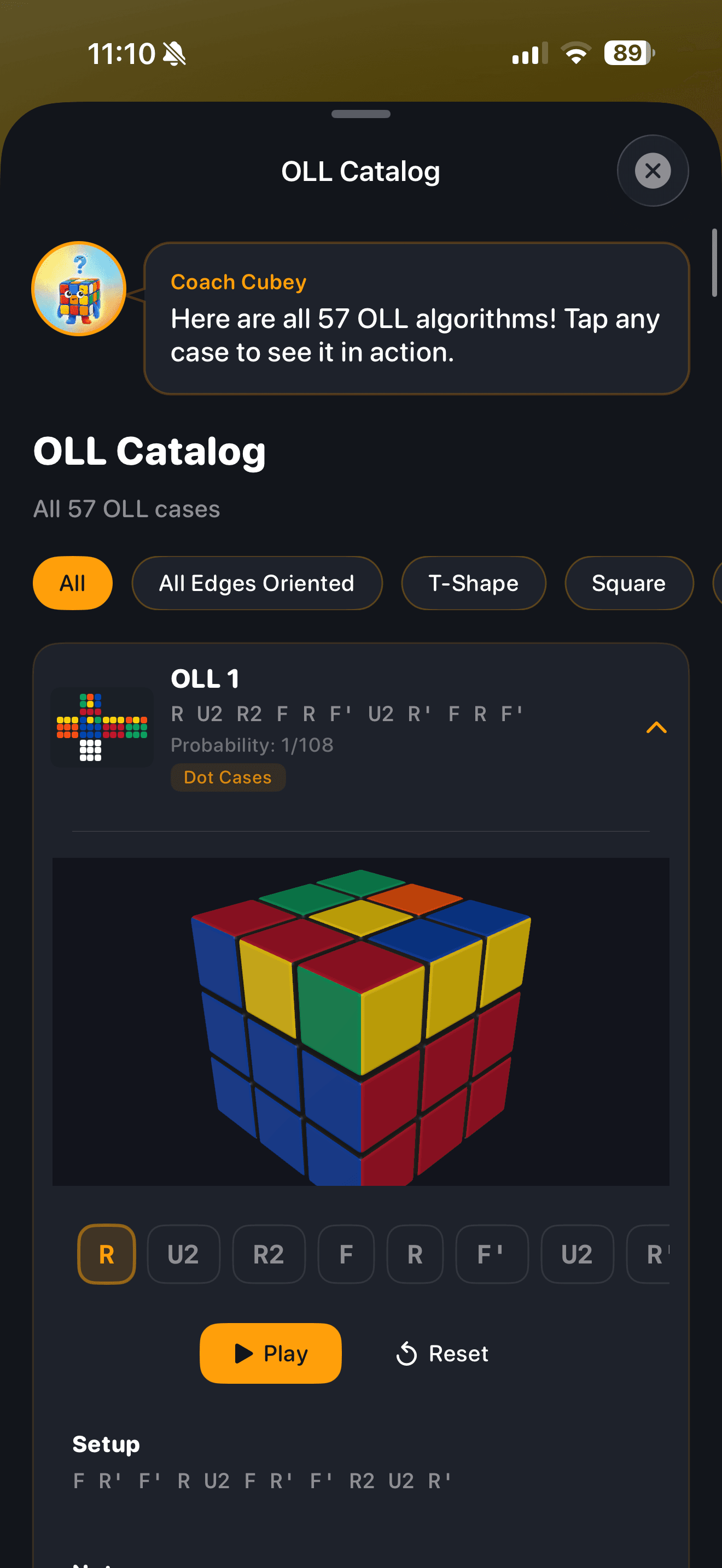
CuberPal combines a WCA-style timer, AI solve analysis, CFOP lessons, algorithm catalogues, spaced repetition, and a camera cube solver so speedcubing advice becomes a daily training loop.
Frequently asked questions
How do I recognize OLL cases faster?
Use a fixed hierarchy: oriented edges, oriented corners, then decisive side stickers. Drill the case and its U adjustment from random angles before adding execution speed.
Should I learn OLL case numbers?
Numbers are useful for lookup and notes, but visual family and cue matter more during a solve. Different resources can also emphasize different names or ordering.
Why do two OLL cases look identical from above?
The top pattern can match while side-facing stickers differ. Add front and right side cues so you can distinguish corner twists without rotating the cube.
Should recognition drills use equal or realistic case frequency?
Use balanced frequency while learning so every selected case receives enough practice. Later, use realistic random frequency to test whether recognition transfers to normal solves.
Sources and fact checks
- [1]Speedsolving.com Wiki: OLL — Reference for OLL terminology, case set, and visual groupings.
- [2]J Perm: OLL Algorithms and Trainer — Case reference and trainer behavior for balanced, realistic, and slow-case practice.
- [3]J Perm: Two-Look OLL Algorithms and Trainer — Reference for the prerequisite edge and corner recognition families.