
What Is the Hardest PLL Algorithm?
Quick answer
There is no single hardest PLL algorithm for everyone. G permutations are often difficult because four similar cases need precise recognition; N, E, V, and R permutations can also feel hard depending on the algorithm, grip, and cube. Diagnose whether the problem is recognition, recall, or execution, then train that one failure mode instead of repeatedly forcing the whole algorithm.
On this pageWhy G permutations are a common answer
The hardest PLL algorithm is the one that breaks at your current weakest step. That may be a G permutation whose four directions look similar, an N permutation that does not stay in your preferred grip, or an E permutation you recognize too late. Declaring one case objectively worst hides the useful question: do you fail to see it, remember it, begin it, or execute it cleanly?
Why G permutations are a common answer
G permutations are a family of four cases with both corner and edge movement. Their visual cues can be close when you only inspect two sides, so a cuber may know four algorithms but hesitate over direction. That makes G-perms a recognition challenge before they are an execution challenge. Learn the family together, hold the headlights or block in a consistent position, and use the adjacent row as the tiebreaker.
Hard recognition is not hard execution
A case can be easy to execute after setup but slow to recognize in a solve. Another can be instantly recognizable yet awkward because it needs an unusual grip, a slice move, or an uncomfortable regrip. Time each stage separately: show the aligned case and execute it; then show random cases and name the case plus AUF; then combine them. The slow stage tells you the right drill.
Choose an algorithm that fits your hands
PLL cases can have multiple valid algorithms. A sequence praised for low moves may feel worse on your cube or with your fingertricks than a slightly longer alternative. Compare two established choices at slow speed, then judge clean starts, layer alignment, regrips, and consistent finishes before raw time. Do not replace an algorithm every time a faster video appears; give one option enough accurate repetitions to evaluate it.
A three-part fix for one weak PLL
First, do recognition-only reps from random U angles and say the case plus pre-AUF. Second, start from the aligned case and execute slowly until every trigger is clean. Third, mix it with its mirror or closest confusing neighbor in ordinary last-layer practice. Record only the error type: wrong case, forgotten start, lockup, or final AUF. That prevents one vague frustration from becoming a hundred unhelpful repetitions.
Do not learn every difficult case at once
Keep two-look PLL as a reliable fallback while you add full PLL. Choose one visual family, learn a case and its mirror when comparison helps, and revisit them on later days. If the new case damages normal solves, return to recognition-only practice rather than burying it under more speed attempts. Full PLL becomes useful when cases survive random presentation, not when every algorithm has been watched once.
The useful answer
There is no universal hardest PLL. G-perms are a sensible first suspect if recognition is slow, while N, E, V, or R may be harder when your grip or algorithm choice is the constraint. Use a PLL catalog to compare the visual pattern and sequence, then drill the exact failure stage. The goal is not to win a tier list; it is to make your next weak case predictable and reliable in a full solve.
Continue the learning path
CFOP algorithms
Learn a small set, drill recognition, then use spaced repetition to retain it.
Open this topic clusterTurn this into practice
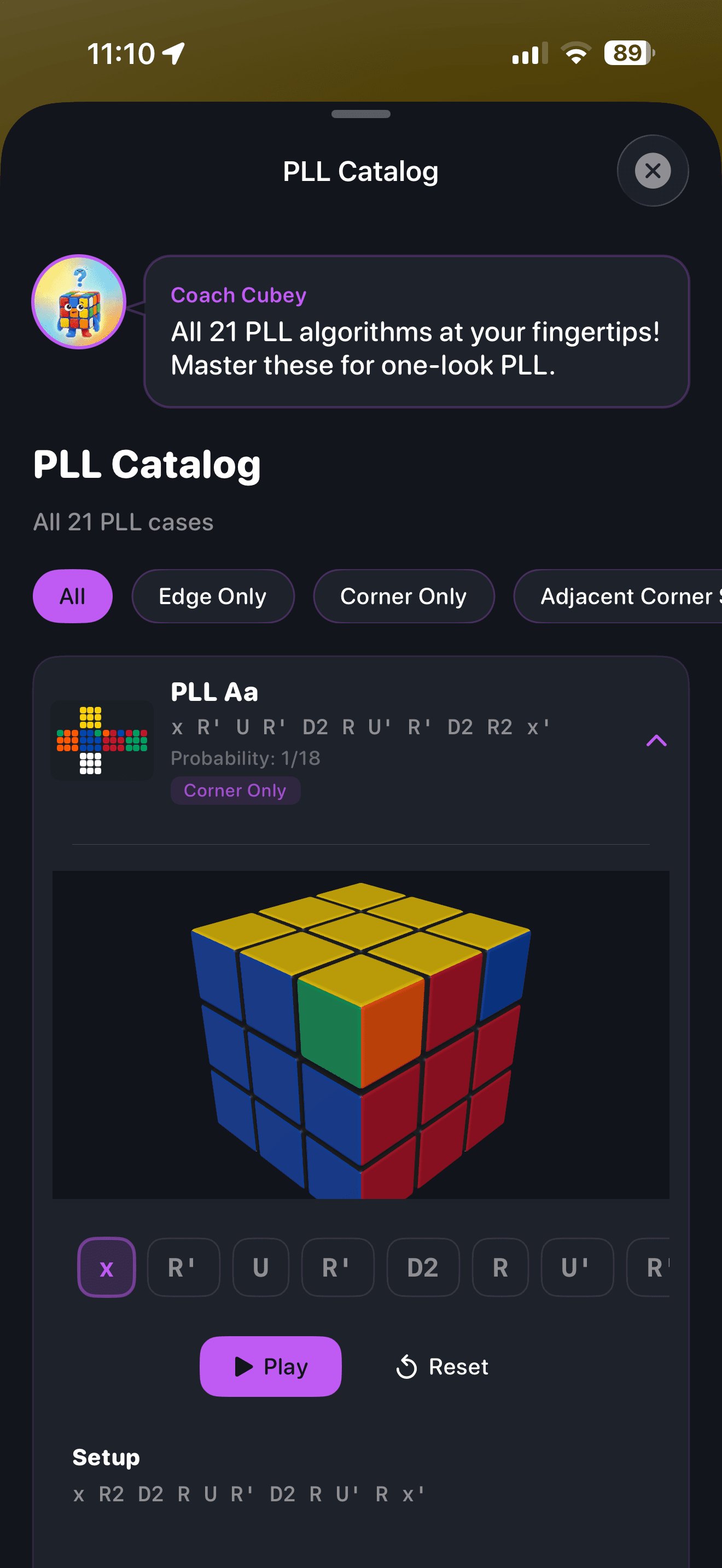
CuberPal combines a WCA-style timer, AI solve analysis, CFOP lessons, algorithm catalogues, spaced repetition, and a camera cube solver so speedcubing advice becomes a daily training loop.
Frequently asked questions
Are G permutations the hardest PLL cases?
They are commonly difficult because four similar cases must be recognized and distinguished, especially with two-sided recognition. They are not automatically the hardest execution for every cuber or algorithm choice.
Should I learn G perms last?
You can, especially if two-look PLL and more visually distinct cases are not yet stable. Learn them when you can support regular recognition practice, rather than waiting for a particular average.
Sources and fact checks
- [1]Cubefreak PLL recognition reference — Supports the role of blocks, AUF, and two-sided recognition in differentiating PLL cases, including G permutations.
- [2]PLL algorithm reference — Supports that PLL has named case families and multiple algorithm references for practical execution choices.