
4x4 PLL Parity: Recognize and Fix an Impossible Last-Layer Swap
Quick answer
4x4 PLL parity is the impossible-looking last-layer state where two edge pairs or two corners appear swapped after reduction. It is not a normal 3x3 PLL case. Confirm that the top face is already oriented, perform one verified inner-slice parity sequence, then finish the now-solvable last layer with your usual 3x3 PLL.
On this pageWhat 4x4 PLL parity looks like
A 4x4 can look solved everywhere except for a final swap that no ordinary 3x3 PLL can fix. That is unsettling only until you name the case correctly. After centers are solved and matching edge pieces are paired, a 4x4 is reduced to a 3x3-like state. But the reduction can leave a last-layer permutation that is impossible on a standard 3x3. The right response is not to repeat random PLL algorithms. Identify PLL parity, apply one verified parity sequence, and then return to the familiar 3x3 finish.
What 4x4 PLL parity looks like
PLL parity appears during the 3x3 stage of a reduced 4x4 when the last layer contains an odd swap that a 3x3 cannot have. J Perm describes the visible result as two pieces swapped, which may be two corners or two edge pairs. CubeSkills describes the same issue as an odd number of edge-pair or corner swaps during PLL. In practical terms, the top face can already be oriented, yet one pair of pieces still refuses to match any legal 3x3 PLL case. That is the diagnostic clue: do not search for a rare PLL; stop and treat it as 4x4 parity.
This is distinct from 4x4 OLL parity. OLL parity is the case with an apparently flipped edge, so the top face is not fully oriented. PLL parity is a permutation problem: orientation is complete, but the final pieces are swapped in an impossible way. Making that one distinction before turning saves a great deal of confusion. If you see a flipped edge, use the OLL-parity resource. If the top is oriented and the remaining swap cannot be a normal PLL, use the PLL-parity sequence below.
Use the verified parity sequence once
One widely used 4x4 PLL-parity sequence is 2R2 U2 2R2 Uw2 2R2 Uw2. In this big-cube notation, 2R means the second layer in from the right; 2R2 turns that inner layer twice. Uw is a wide U turn, meaning the upper two layers move together. Keep the notation and your grip deliberate. This is an inner-slice algorithm, not a normal outer-layer PLL, so treating every move as a familiar 3x3 turn is the most common way to lose the case.
Run the parity sequence once, then pause to read the new last layer. The sequence is not intended to finish every final state by itself. Its job is to remove the impossible parity condition so the cube becomes solvable like a 3x3 again. Afterward, you may have a recognizable ordinary PLL, an adjustment of the U face, or a solved layer. Read what is actually in front of you and use the normal 3x3 solution that fits, rather than automatically repeating the parity sequence.
A reliable last-layer recovery routine
Use the same short routine whenever a 4x4 last layer looks impossible. First, stop turning and check whether all top stickers are oriented. Second, decide whether the defect is a flipped edge or an impossible swap. Third, if it is an impossible swap, execute the PLL-parity sequence one time with the exact notation you learned. Fourth, inspect again as if the cube were a 3x3 and finish the resulting ordinary PLL. This sequence matters because it separates diagnosis from execution. You are not trying moves until something changes; you are removing a specific condition and then returning to normal solving.
If the result after the algorithm still seems impossible, do not label it new parity immediately. Re-check whether you made the inner-slice and wide turns as intended, then re-read the last layer. A reduced 4x4 normally returns to a 3x3-style solve once the parity sequence has been applied. It can be helpful to practise the sequence slowly from a known parity case before relying on it during a timed solve. The aim is accurate recognition and controlled execution first; speed comes after the distinction between OLL parity, PLL parity, and an ordinary PLL feels automatic.
Turn parity mistakes into useful 4x4 practice
Parity is a narrow skill, so give it a narrow practice goal. In one short session, solve a few 4x4 scrambles and record only three observations: whether you recognized the case before trying a 3x3 PLL, whether the parity sequence was accurate, and whether you calmly finished the resulting normal last layer. Do not turn one parity mistake into a full-session verdict on your centers or edge pairing. The existing 4x4 practice guide can help you decide whether parity is truly the repeated delay or simply one part of a broader reduction routine.
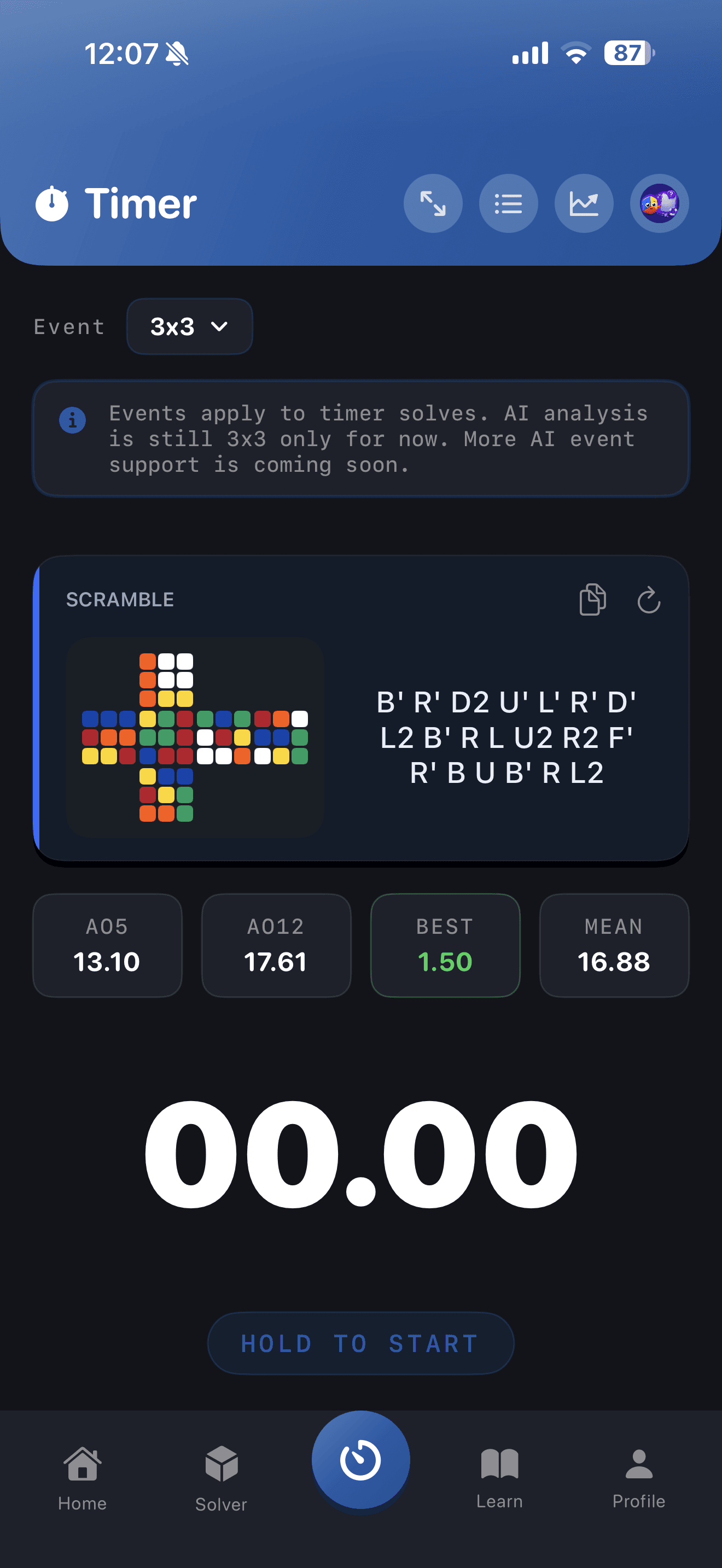
CuberPal's timer supports 4x4 with event-specific history, statistics, and event-aware scrambles. That makes it suitable for keeping these focused parity sessions separate from 3x3 results. Use the timer image at the end of this article as a reminder of the right scope: record a small comparable set, note whether the last-layer diagnosis was right, and then move on to the next 4x4 skill that repeatedly costs time. The app's current listing also makes clear that AI video analysis is limited to 3x3, so this 4x4 parity practice should rely on your own observations rather than an unsupported product claim.
Keep the two parity cases separate
A simple label prevents most last-layer panic. Flipped edge means OLL parity. Fully oriented top with an impossible swap means PLL parity. A legal-looking case with blocks, headlights, or edge cycles means use a normal 3x3 PLL. Keep those labels separate in practice and the next 4x4 parity will become a routine interruption instead of a mystery. For the exact algorithms and diagrams, return to the source tutorials rather than relying on a remembered variation from a different notation system.
Continue the learning path
Beyond 3x3
Pick one event that feels fun enough to practice consistently.
Open this topic clusterTurn this into practice
CuberPal combines a WCA-style timer, AI solve analysis, CFOP lessons, algorithm catalogues, spaced repetition, and a camera cube solver so speedcubing advice becomes a daily training loop.
Frequently asked questions
Can 4x4 PLL parity happen on a 3x3?
No. PLL parity is an odd last-layer swap that is impossible on a standard 3x3. It can appear after reducing a 4x4 because paired 4x4 edge pieces behave like 3x3 edges only after the parity condition is fixed.
Does the 4x4 PLL parity algorithm solve the entire last layer?
Usually not by itself. Its purpose is to remove the impossible parity condition so the 4x4 can be solved like a 3x3 again. Read the new case after one execution and finish with the ordinary PLL or U-face adjustment that remains.
What does 2R mean in a 4x4 parity algorithm?
In big-cube notation, 2R means the second layer from the right side. The 2R2 move turns that inner layer twice. It is different from an outer R2 move, so practise the notation slowly before using it in a timed solve.
Sources and fact checks
- [1]J Perm: How To Solve the 4x4 Rubik's Cube — Supports the reduction-to-3x3 context, PLL parity as an impossible two-piece swap, the 2R2 U2 2R2 Uw2 2R2 Uw2 sequence, 2R notation, and the fact that one execution makes the cube solvable like a 3x3 rather than necessarily solved.
- [2]CubeSkills: Beginner's Method for Solving the 4x4 Cube — Independently supports reduction, wide and inner-slice notation, PLL parity as an odd edge-pair or corner swap during PLL, and the distinction between OLL and PLL parity.
- [3]Apple App Store: Cubing Timer & Coach: CuberPal — Supports the limited product claims that CuberPal times 4x4 solves with event-specific history, statistics, event-aware scrambles, and that AI video analysis currently supports 3x3 solves.