
How to Start 3x3 Blindfolded Cubing
Quick answer
Start 3x3 blindfolded cubing only after you can solve a 3x3 reliably and read basic notation. Learn one beginner tutorial’s fixed setup and execution system, give each sticker position a letter, and practise three layers separately: tracing pieces with your eyes open, executing the moves with a visible cube, then recalling short memo sequences under a blindfold. Your first goal is one accurate solve, not a fast time.
On this pageBuild a dependable sighted base first
Blindfolded 3x3, usually called 3BLD, can look like a memory trick until you split it into skills. You first inspect a scrambled cube, convert the unsolved pieces into a short memory sequence, put on a blindfold, and use a repeatable execution method to send those pieces home. That is a different challenge from turning quickly. For a first success, treat accuracy as the goal and speed as information you can care about later.
Build a dependable sighted base first
You do not need a specific speed before learning 3BLD, but you do need a normal 3x3 solve that feels predictable. You should be comfortable reading move notation, keeping the cube in a consistent orientation, and completing familiar algorithms without stopping to decode every turn. A blindfolded method adds memo, setup moves, reversals, and cycle tracking; an unstable sighted solve makes all of those errors blend together. Spend a few sessions making your ordinary solves calm and repeatable before adding the blindfold.
Use the same cube orientation every time. Pick a color scheme, hold the cube the same way while you study it, and keep that orientation through your execution drills. Consistency gives the letters and target locations a stable meaning. If you already use a learning app, use its notation lessons or ordinary 3x3 practice to reinforce that base. CuberPal’s current learning and timer experience is relevant here as preparation for sighted practice; it is not a substitute for a blindfolded method or for competition equipment.
Understand memo and execution as separate jobs
A beginner 3BLD solve has two jobs. During memo, you trace where unsolved pieces must go and record the result mentally as letters, pairs, sounds, or images. During execution, you follow that remembered order with a fixed method. The independent beginner tutorial in the sources explains this with a lettered sticker scheme and a corner-first tracing process. Do not try to memorize an entire scramble before you can trace one small cycle correctly. First prove that you can identify a target, write its letter on paper during a study drill, and check it against the cube.
Keep your first memo deliberately short. Scramble only a few pieces, trace a single corner cycle, say or write the letters, then solve it while looking. Repeat until the tracing result and the execution result match. Do the same for edges. This is slower than jumping into full attempts, but it makes the cause of a miss visible: the trace was wrong, the memo changed, a setup move was wrong, or the execution sequence was interrupted.
Learn one beginner system and resist mixing tutorials
Choose one complete beginner tutorial that covers both corners and edges, the buffer positions it uses, setup moves, parity handling, and its letter scheme. Learn its algorithms exactly as taught before borrowing a shortcut from another method. A method is a connected system: the memo order, buffer, targets, setup moves, and reversal all assume one another. Mixing a corner idea from one video with edge execution from another is a common way to create an error that is hard to locate.
Practise each algorithm sighted until you can state what it is meant to do, not merely recite its turns. Then practise the setup-to-target, execute, and undo sequence on an otherwise solved cube. Reveal the cube after every short drill. If the target is wrong, slow down and check the setup and its reversal before running another attempt. Early blindfold progress comes from dependable checks, not from doing more full scrambles.
Add the blindfold in small, testable steps
When your short sighted drills are accurate, add the blindfold only after the memo is complete. Begin with one cycle: inspect, create a two- or three-letter memo, cover your eyes, execute, and reveal. Next, combine a few cycles. Keep a simple failure note after each attempt: memo, corners, edges, parity, or unknown. That note turns a DNF-like miss into a next drill. Do not grade yourself by the first timer number; a clean but slow solve teaches more than a fast attempt with no idea why it failed.
A useful weekly structure is two short execution sessions with the cube visible, two memo-only sessions using tiny scrambles, and one or two complete attempts. Keep the complete attempts rare enough that you still remember what you were testing. Once you can finish several accurate solves, use timed attempts to measure change. CuberPal’s timer can support ordinary sighted timing practice and consistent session records, while the blindfold-specific memo and execution drills remain the heart of this learning path.
Know the WCA flow before you compete
Home practice can be flexible, but an official 3x3 Blindfolded attempt has its own current WCA procedure. There is no separate inspection period: the attempt starts when the timer starts. The competitor removes the cover after starting, performs memo without writing physical notes or making moves, then fully dons the blindfold before the first move. A judge uses a sight blocker once execution begins. Do not rely on a summary article for a competition ruling; read the current regulations and ask the WCA Delegate when an event-specific situation is unclear.
For your first official event, rehearse the rhythm rather than trying to copy a home routine: start the timer, remove the cover, memo without notes, put on the blindfold, and release the cube before stopping the timer. That rehearsal makes the event less surprising and leaves your attention for the skill you are actually learning. If blindfolded solving feels like too many moving parts, return to a single cycle with the cube visible. A smaller accurate drill is always a valid next step.
Continue the learning path
Beyond 3x3
Pick one event that feels fun enough to practice consistently.
Open this topic clusterTurn this into practice
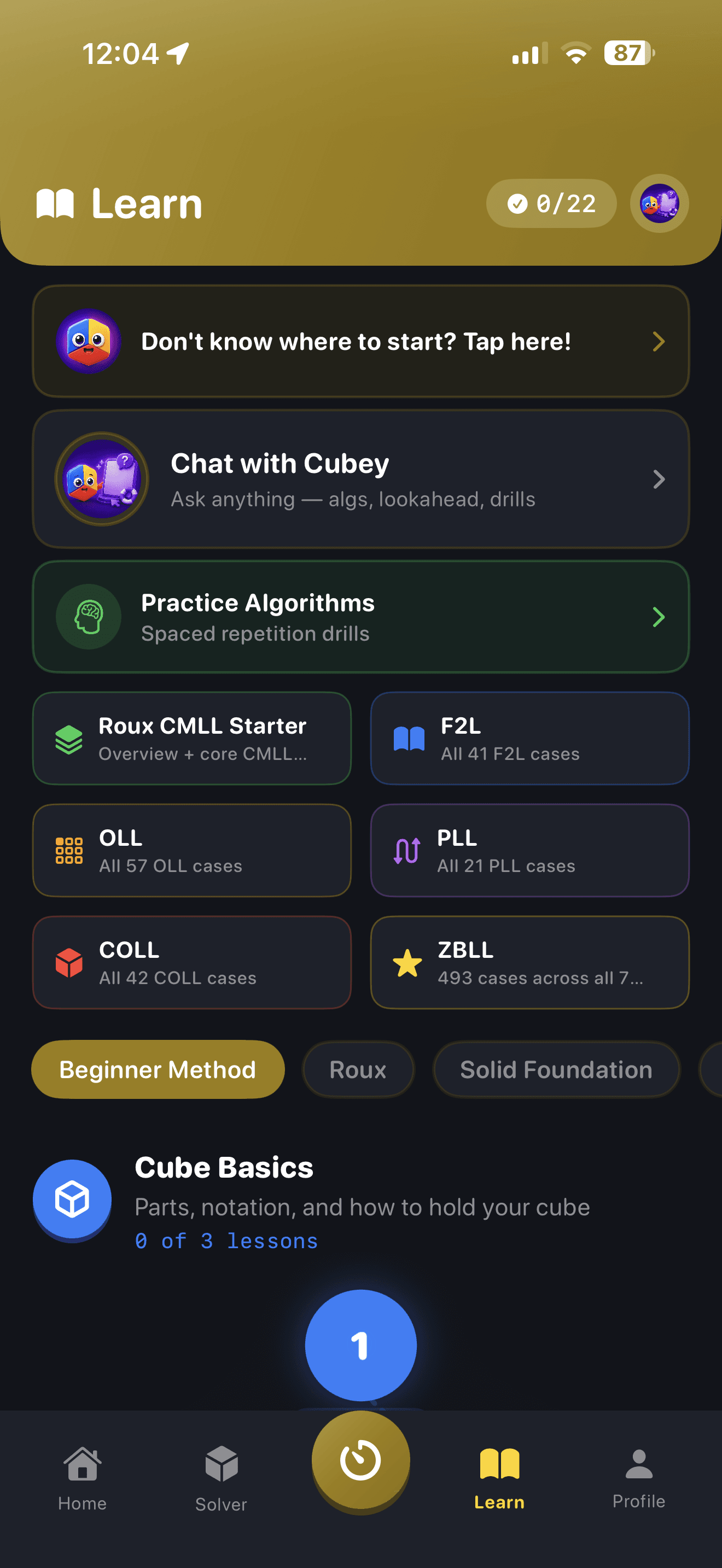
CuberPal combines a WCA-style timer, AI solve analysis, CFOP lessons, algorithm catalogues, spaced repetition, and a camera cube solver so speedcubing advice becomes a daily training loop.
Frequently asked questions
Do I need to be fast at normal 3x3 before learning blindfolded cubing?
No fixed average is required. You need a reliable sighted solve, basic notation, and enough comfort with algorithms to notice whether an execution mistake came from the moves or from the memo. Accuracy and consistency matter more than a speed milestone.
What should I practise first for 3BLD?
Start with one sighted execution drill and one tiny memo drill. Trace a short corner or edge cycle, record the letters during practice, execute with your eyes open, and reveal the result. Add the blindfold only when those checks are consistently accurate.
Is there inspection time in a WCA 3x3 Blindfolded solve?
No. Under the current WCA blindfolded regulations, the solve starts when the attempt starts. The memorization phase happens on the running timer after the cover is removed, so your official result includes both memo and blindfolded execution.
Sources and fact checks
- [1]World Cube Association Regulations — Supports the current official 3x3 Blindfolded procedure: no separate inspection period, timer start before cover removal, memorization restrictions, blindfold and sight-blocker requirements, and stop sequence.
- [2]Speedcubing.org: How to solve a 3x3 cube blindfolded — Supports the beginner model of memorizing the cube before blindfolded execution, the prerequisite of a normal 3x3 solve and notation, and the use of a lettered sticker scheme for tracing pieces.
- [3]CuberPal: Rubik's Cube Timer, Solver & AI Coach — Supports the current CuberPal product context for the contextual learning-dashboard image and the article's limited claims about WCA-style timing, 3x3 learning, and ordinary sighted practice records.