
How to Learn COLL Algorithms
Quick answer
Learn COLL after your main last-layer system is dependable, not as a replacement for full OLL and PLL. First confirm that you can recognize when the last-layer edges are oriented. Then learn the COLL families in a deliberate order, starting with a small group of familiar cases. Practice recognition without turning, execute each algorithm slowly with clean triggers, and use spaced repetition before testing the cases in normal solves. COLL solves and preserves the last-layer corners while leaving only edge permutation, so you still need the appropriate final edge step afterward.
On this pageWhat COLL actually does
What COLL actually does
COLL means Corners of Last Layer. It is a 3x3 last-layer subset that orients and permutes the four last-layer corners while preserving the orientation of the last-layer edges. When the case is set up correctly, the corners finish in one algorithm and the remaining work is edge permutation, commonly called EPLL. That is the key idea to understand before memorizing anything: COLL is a corner step, not a complete one-algorithm solve of the entire last layer.
The usual reference count is 42 cases when mirrors are included, although tutorial resources can group or count variants differently. The number is less important than the structure. COLL is organized into recognizable families, so you can learn a few related shapes together instead of treating the set as dozens of unrelated flash cards. It is also different from CLL: CLL does not preserve last-layer edge orientation in the same way, so the next step and the learning goal are different.
Check the prerequisite before adding cases
COLL is an advanced add-on to a reliable last-layer system. Before starting, make sure you can recognize and execute your normal OLL and PLL cases without repeatedly checking a reference. You should also be comfortable identifying whether the top edges are oriented after F2L. If that state is still confusing, more COLL algorithms will add recognition load without fixing the underlying problem.
Use your solves to decide whether COLL is the right next project. If your biggest pauses happen during F2L, cross planning, or basic PLL recognition, work on that first. If your last layer is already stable and you enjoy algorithm study, COLL can be a sensible next layer because it gives you a defined, finite project before the much larger ZBLL family. There is no useful universal speed cutoff; readiness is better measured by consistency and recognition than by a single average.
Learn COLL by case family
A family-based order gives your memory useful anchors. Start with Sune and Anti-Sune cases, then move through the T and U families. Continue with L, Pi, and H cases once the first groups feel familiar. This is not a rule that every cuber must follow, but it matches the way established tutorials present the set and keeps each study block visually coherent.
For each family, make a small case sheet with three pieces of information: the visual pattern, the algorithm, and the expected result after execution. Include the AUF or setup orientation you used while learning. The goal is not to memorize a diagram in one fixed view; it is to recognize the family from the angles that appear in an actual solve. Keep mirrors together when that helps, but do not hide a case behind a memorized name. Look at the stickers and explain why it belongs to that family.
Separate recognition from execution
Recognition and execution are different skills. In a recognition drill, show yourself a COLL case, name its family, identify the required AUF, and delay the algorithm. This exposes cases that look familiar but still take too long to identify. Repeat the same test from more than one viewing angle so you do not learn only the orientation used by a reference sheet.
In an execution drill, remove the time pressure. Hold the case, perform the setup deliberately, and turn at a pace where every trigger stays controlled. If you pause halfway through, restart slowly and identify the exact transition that failed. A fast algorithm that breaks your grip or leaves you unsure of the ending is not learned yet. Record recognition time and execution time separately when you can; that tells you whether the next session needs more visual work or more repetitions.
Memorize triggers, not a wall of letters
When an algorithm is long, read it in short move groups. Parentheses and trigger chunks are useful because they give your hands repeatable units instead of one unbroken string of notation. Say the purpose of each chunk out loud while learning it: setup, corner transformation, or return. Then practice the chunks separately before joining them. This is especially helpful when two cases share most of an algorithm but differ in a setup or final adjustment.
Use one or two new cases in a session, then mix them with older cases immediately. A case is not reliable because you can perform it while staring at the notation. It is reliable when you can identify it, recall the moves, and finish with the expected edge state while holding a normal solving grip. Keep your preferred algorithm, but compare alternatives when a case creates repeated regrips or an awkward recognition angle.
Use spaced review before full solves
COLL cases do not appear evenly in random solves, so normal solving alone is a poor review system. Put new cases into a queue and revisit them on a schedule. A simple version is a short review later the same day, another review the next day, then reviews after several days and a week. Move a case back to the short interval when recognition fails, not only when the algorithm itself is forgotten.
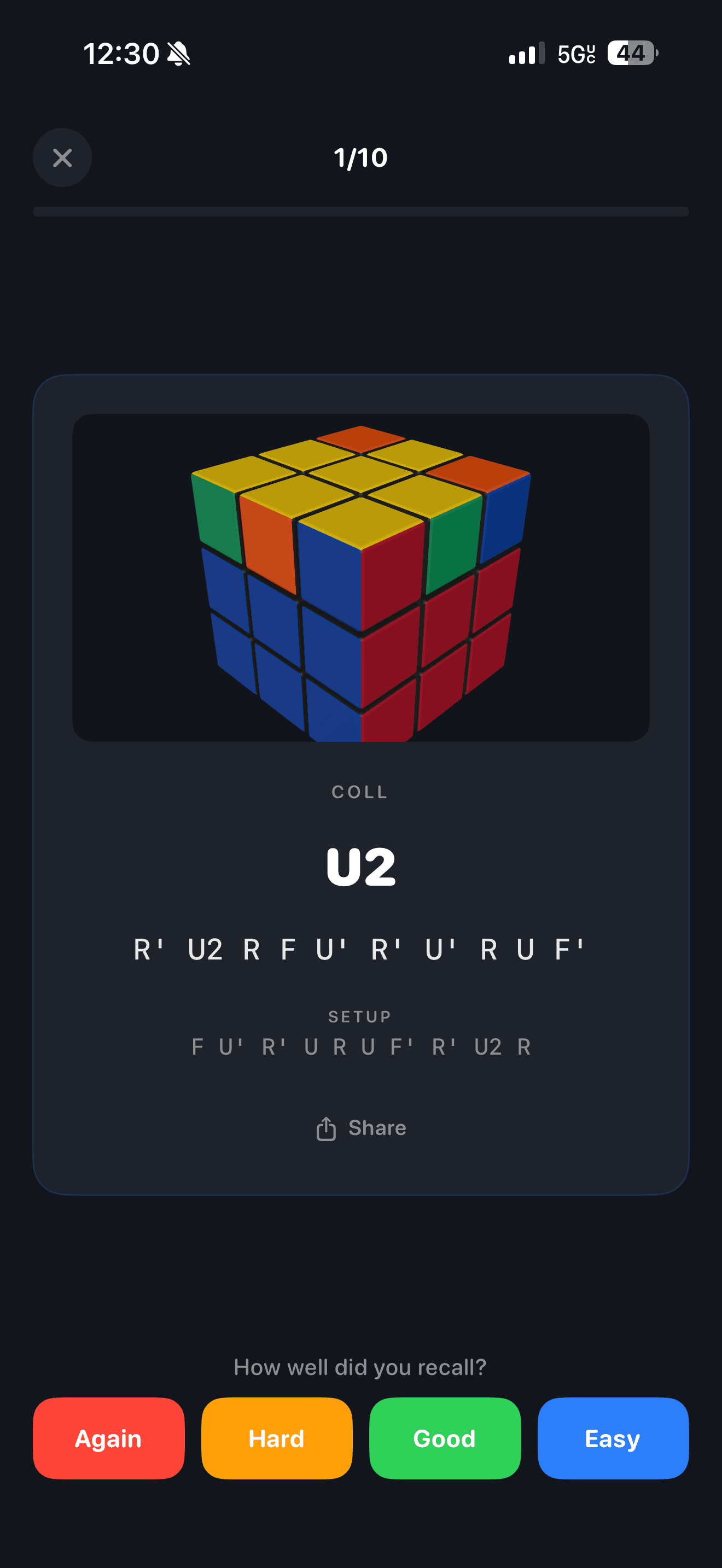
CuberPal's current App Store listing names COLL among its algorithm-practice sets and describes spaced-repetition practice. That makes the app useful for organizing a recognition-and-execution queue, while the tutorial sources remain the authority for what each case means and which algorithm you choose. After a review session, do a few normal solves so the case has to appear in the same visual and timing context as a real last layer.
Transfer COLL into real solves
Start transfer practice with a small goal: use one newly learned family in a set of normal solves, but keep your standard OLL-and-PLL route available as a fallback. After F2L, first verify the edge-orientation condition, then identify the corner case, apply the algorithm, and finish the remaining edge permutation. Do not force COLL when the recognition is uncertain. A clean fallback protects your average and gives you better evidence about whether the new case is actually helping.
Review the cases that caused pauses rather than chasing a raw best time. Note whether the problem was the edge condition, family recognition, AUF, algorithm recall, or execution. That diagnosis tells you what to drill next. Once the first families are reliable, add the next family gradually. COLL is most useful when it makes a known last-layer situation easier to recognize and execute, not when it simply increases the number of algorithms in your collection.
Continue the learning path
CFOP algorithms
Learn a small set, drill recognition, then use spaced repetition to retain it.
Open this topic clusterTurn this into practice
CuberPal combines a WCA-style timer, AI solve analysis, CFOP lessons, algorithm catalogues, spaced repetition, and a camera cube solver so speedcubing advice becomes a daily training loop.
Frequently asked questions
How many COLL algorithms are there?
The commonly cited count is 42 cases when mirrors are included, with some resources grouping variants differently. Treat the family structure and your chosen reference sheet as the practical source of truth rather than using the number as a deadline.
Should I learn COLL before full OLL and PLL?
Usually no. Learn COLL after your main OLL and PLL route is dependable and you can recognize oriented last-layer edges. Otherwise the added cases are likely to create more recognition work than useful speed.
Does COLL solve the entire last layer?
No. COLL solves and preserves the last-layer corners while leaving edge permutation for the following step, commonly EPLL. It is a corner subset, not a complete ZBLL-style one-algorithm last layer.
How should I practice COLL cases?
Practice recognition without turning, then execute slowly with clean trigger groups. Use spaced review for rare cases, mix new cases with older ones, and test each family in normal solves with your standard last-layer fallback available.
Sources and fact checks
- [1]Speedsolving.com Wiki: COLL — Supports the COLL definition, 42-case reference count, edge-orientation preservation, EPLL follow-up, and distinction from CLL.
- [2]CubeSkills: COLL Algorithms — Supports the COLL case families and the tutorial's recognition and execution learning order.
- [3]CubeSkills: COLL Algorithms PDF — Supports the use of grouped move notation and trigger segmentation as a memorization aid.
- [4]J Perm: CFOP Speedsolving Method — Supports learning core CFOP skills before advanced last-layer additions and practicing algorithms gradually.
- [5]CuberPal US App Store listing — Supports the bounded product claim that the current app listing names COLL and spaced-repetition algorithm practice.