
What Is F2L in Rubik's Cube Solving?
Quick answer
F2L stands for First Two Layers. It's the second step of the CFOP method, done right after the cross. Instead of solving the first-layer corners and then the middle edges separately, you pair each corner with its matching edge and insert the pair into its slot. Four pairs finish the first two layers. Most cubers learn it intuitively first and add algorithms later.
On this pageWhat F2L stands for and where it fits in CFOP
If you've watched a speedcubing video, you've probably heard the term F2L. It sounds technical, but the idea behind it is simple: instead of solving the bottom two layers of the cube in two separate stages, you solve them together, one corner-edge pair at a time.
F2L stands for First Two Layers. It's the second step of the CFOP method, done right after the cross. This page explains what F2L is, how pairs and slots work, how it differs from the beginner method and why it matters for your times. It doesn't teach specific moves. For that, it points you to the guides that do.
What F2L stands for and where it fits in CFOP
F2L means First Two Layers. It is the second of the four steps in CFOP:
- Cross: build a cross on the bottom, with each edge matching its side center.
- F2L: finish the first two layers by pairing corners with their matching edges and inserting each pair into its slot.
- OLL: orient the last layer so the whole top face is one color.
- PLL: permute the last layer, moving its pieces into their final positions.
CFOP stands for Cross, F2L, OLL and PLL. If you'd like the full picture of how the steps connect, read what CFOP is and follow the step-by-step learn the CFOP method guide. For the last two steps, see what OLL and PLL are.
How F2L works: pairs and slots
The first two layers of a 3x3 contain four corner pieces and four edge pieces. Each corner belongs with exactly one edge: the one that shares its two side colors. A corner and its matching edge, joined together, make a pair.
The cube has four slots where these pairs finally live, one in each vertical corner between the bottom and middle layers. Each slot needs one corner and one edge. Before you move anything, you find both pieces and ask where they are.
The basic idea of F2L is:
- Find a corner and its matching edge.
- Bring them together in the top layer so they form a pair.
- Line the pair up with its slot.
- Insert the pair, solving the corner and the edge in one step.
Do that four times and the first two layers are finished. You keep the cross solved while you work, which is why the cross comes first. If some of the words here are new, our guides to Rubik's Cube notation and cube rotations x, y and z explain the terms you'll see in F2L tutorials.
F2L vs the beginner method
Most beginner methods solve the first two layers in two separate stages. First you place the first-layer corners, then you place the middle-layer edges. Each stage has its own steps and its own short sequences.
F2L does both at once. Instead of placing four corners and then four edges, you solve four corner-edge pairs. That's why F2L is usually described as the step that replaces two beginner stages.
F2L isn't a separate method. It's the second step of CFOP. When people ask whether F2L is faster than the beginner method, they are really asking about that one step. It usually takes fewer moves and less searching, but only once you can recognize pairs smoothly. Our post on beginner method vs CFOP compares the two side by side, and how to solve a Rubik's Cube covers the beginner method if you haven't learned it yet.
Intuitive F2L vs algorithmic F2L
There are two ways to think about F2L.
- Intuitive F2L: you understand how moves separate, pair and insert the pieces, and you work out each solution as you go. No case list is required.
- Algorithmic F2L: you learn set sequences for specific situations and apply them when you recognize the case.
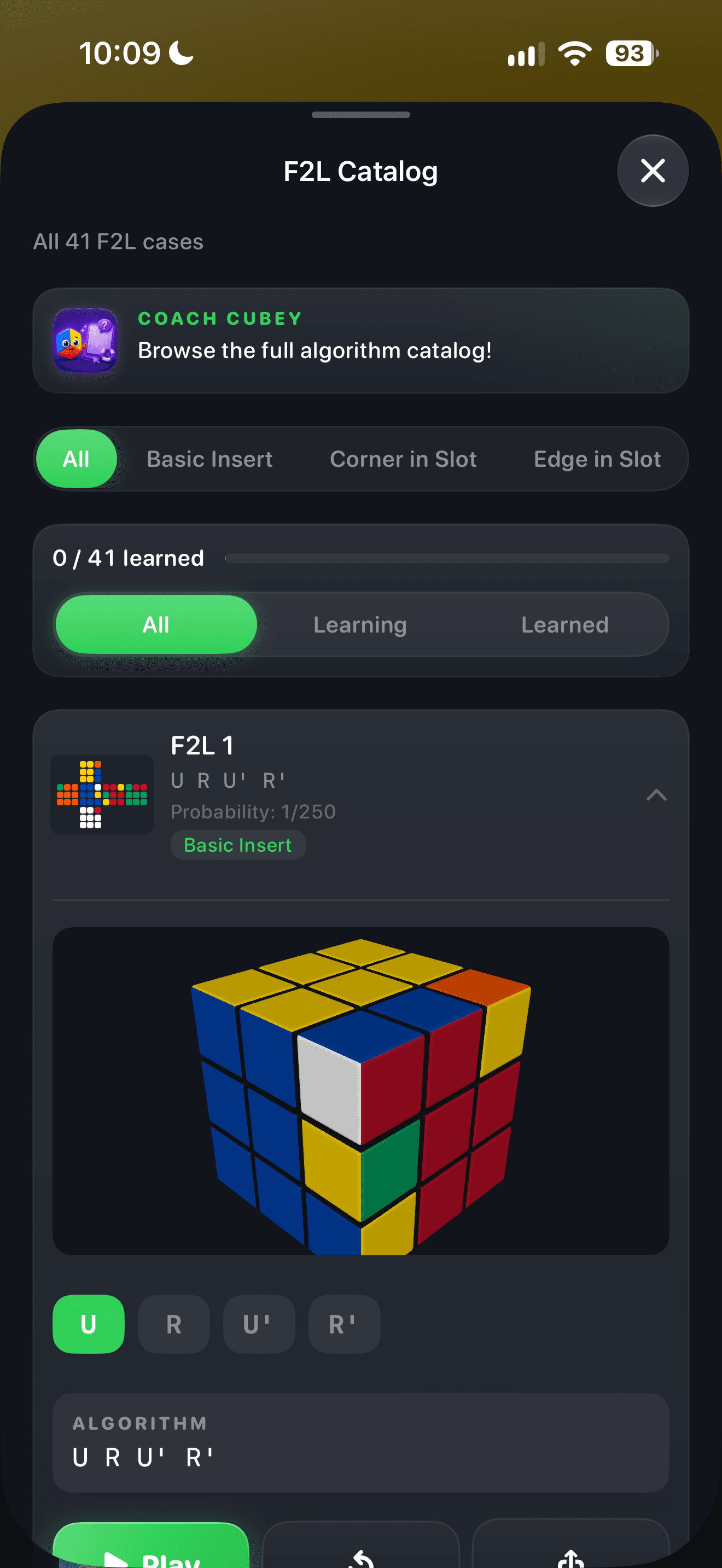
The standard last-slot F2L list has 41 cases, a figure CuberPal's F2L algorithms page uses and the SpeedSolving wiki also lists. You don't need to memorize them to get started. CuberPal's guides say you need zero F2L algorithms to start: build reliable intuitive pairs first, then add an algorithm only when a repeated case keeps causing a pause. To see how many are worth learning, read how many F2L algorithms there are.
Why F2L matters so much for your times
F2L usually takes up the largest part of a developing CFOP solve, because it involves four pairs and a lot of open-ended recognition. The cross should become a short, planned opening, and OLL and PLL are shorter algorithmic phases.
That makes F2L one of the best places to improve. A few long searches can dominate a whole solve. CuberPal's CFOP solve splits guide shows how to time each phase so you can see where your time really goes. It treats published split ranges as coaching heuristics, not rules.
Common F2L terms you'll hear
Here are terms you'll run into once you start reading about F2L:
- Slot: one of the four places where a finished corner-edge pair belongs.
- Pair: a corner joined with its matching edge.
- Insert: moving a pair down into its slot.
- Lookahead: tracking your next pair while your hands solve the current one, so you never stop turning. See F2L lookahead.
- Rotationless F2L: solving more pairs from your current grip instead of turning the whole cube by reflex. See rotationless F2L.
- Pseudoslotting: an advanced technique that temporarily moves the cross out of alignment so pieces can pair, then restores it. See what pseudoslotting is. Learn it only after normal pair recognition is reliable.
- Stuck pair: a corner and edge that are trapped in a slot or joined the wrong way. See how to fix a stuck F2L pair.
How to start learning F2L
Start with the cross. F2L assumes it's solved on the bottom, so practice planning it during inspection first. Our cross planning and inspection guide shows how.
Then follow how to learn F2L, which walks you through the basic inserts, recovering stuck pieces and a practice plan. CuberPal's guide says most cubers can solve with basic intuitive F2L after one to two weeks, and that making it faster than the beginner method usually takes another few weeks of slow solves. Treat that as a typical range, not a promise.
If you want a wider roadmap, see how to learn speedcubing online and how long it takes to learn CFOP. If you're still choosing a method, CFOP vs Roux compares two popular options.
Practicing F2L with CuberPal
CuberPal can support your F2L practice. The cube timer tracks averages like ao5 and ao12, so you can see whether your F2L work is paying off. When the last layer is also on your list, the algorithm trainer brings back cases you need to review with spaced repetition.
For feedback, you can record a 3x3 solve or import a video and get phase-by-phase analysis, and the AI speedcubing coach uses your timer history and solve analysis to suggest what to practice next. CuberPal's paid tier is called Premium.
Continue the learning path
Learn CFOP
Build intuitive F2L before adding a large number of algorithms.
Open this topic clusterTurn this into practice
CuberPal combines a WCA-style timer, AI solve analysis, CFOP lessons, algorithm catalogues, spaced repetition, and a camera cube solver so speedcubing advice becomes a daily training loop.
Frequently asked questions
What does F2L stand for?
F2L stands for First Two Layers. It's the second step of the CFOP method, done right after the cross, where you pair corners with their matching edges and insert each pair into its slot.
Is F2L hard to learn?
It takes practice because it's mostly pattern recognition, not memorization. CuberPal's guide says most cubers can solve with basic intuitive F2L after one to two weeks of practice, but timelines vary from person to person.
How many F2L cases are there?
The standard last-slot F2L list has 41 cases. They are a reference, not a requirement. Most can be worked out intuitively once you understand how a corner and edge pair up.
Do I need to learn F2L algorithms?
Not to start. Learn intuitive F2L first, and add an algorithm later only if a repeated case keeps slowing you down.
Sources and fact checks
- [1]SpeedSolving Wiki: First Two Layers (F2L) — F2L = First Two Layers; part of CFOP; 41 last-slot cases up to symmetry. Rechecked 2026-11-25.
Keep improving
What Is CFOP? The Cross, F2L, OLL and PLL Method
Read next GuideHow to Learn F2L: A Beginner's Tutorial
Read next BlogF2L Algorithms: The Complete Case List for CFOP
Read next GuideHow to Improve F2L Lookahead
Read next BlogHow to Learn Speedcubing Online, Step by Step
Read next BlogHow Long Does It Take to Learn CFOP?
Read next